



This post is the first video of a multi-part video series on “Zero Downtime Migration” which is part of our training DBA to Cloud DBA.
In this blog post, we’ve covered the Zero Downtime migration overview and capabilities to migrate the database on the cloud.
In this video, I will discuss the overview and capabilities of the ZDM.
https://www.youtube.com/watch?v=WeT5A9hK8k8
What Is ZDM?
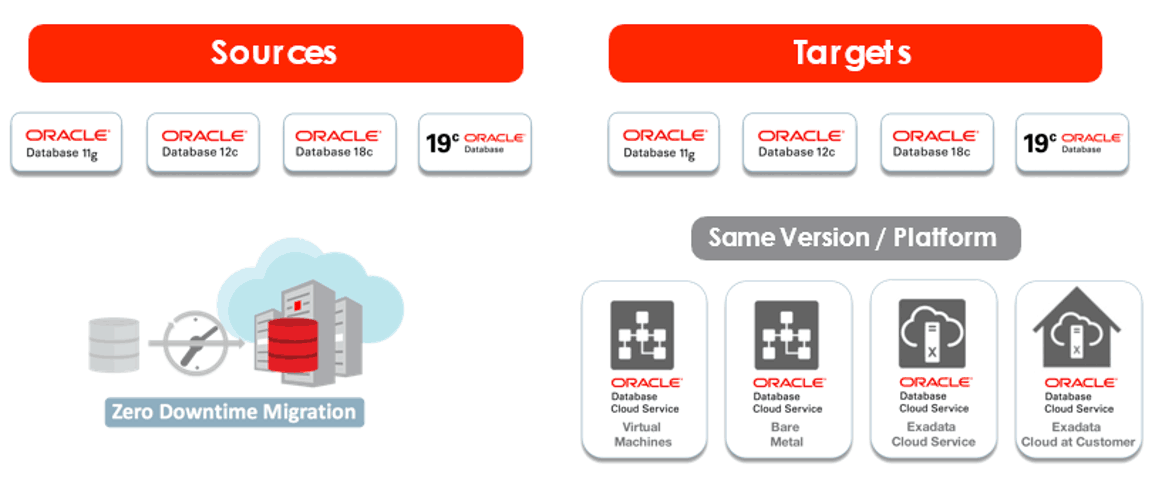
Zero Downtime Migration (ZDM) is an oracle software that is used to migrating your On-Prem or OCI-classic database to Oracle Cloud Database (VM DB, ExaCS, Bare Metal) and on to the Exadata Cloud at Customer) with the minimal downtime on production workloads.
Note: Check out our blog to know more about Database Option in OCI (VMDB, BMDB, ExaCS, ExaCC & Autonomous (ADW, ATP).
Note: Read our blog to know the difference between OCI & OCI-C.
Overview: Zero Downtime Migration Software Key Points
- Oracle Zero Downtime Migration (ZDM) is Oracle Maximum Availability Architecture (MAA) recommended software to migrate Oracle Databases to the Oracle Cloud.
- It helps to keep the migration process as simple as possible and aims to have minimal downtime on production workloads.
- The source databases can be On-Premises or on Oracle Public Cloud Gen1 (OCI-C).
- The target databases can be deployed as Database Cloud Service on Oracle Cloud Infrastructure (OCI) Bare Metal, Virtual Machine, Exadata Cloud Service, or Exadata Cloud at Customer.
- It automates the complete process of migration & reduces human errors.
Read this post for an overview of Autonomous Database, Types of Autonomous database (Autonomous data warehouse & Autonomous Transaction Processing) and Autonomous offering as Serverless & Dedicated Infrastructure.
Supported Configurations For ZDM
1) Supported Platforms for the Zero Downtime Migration Service Source Host
- Oracle Linux 7 or later releases.
2) Supported Database Versions for Migration:
- 11.2.0.4
- 12.1.0.2
- 12.2.0.1
- 18c
- 19c
Note: the source & target Database version should be the same database version.
3) Supported Database Architectures for Migration
- Oracle Database Single-Instance to a Single-instance or Oracle RAC database target
- Oracle RAC One Node, which can be migrated to an Oracle RAC database target
- Oracle RAC to an Oracle RAC database target
Read More: Oracle Enterprise Manager(OEM) 13c for beginners, what is OEM, high-level steps to deploy OEM on Oracle cloud infrastructure (OCI), OEM architecture components, OEM HA/DR overview.
Zero Downtime Migration Capabilities
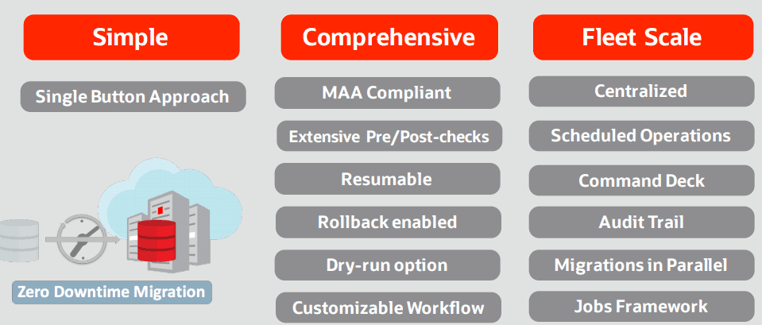
- Compliance: Zero Downtime Migration is compliant with Oracle Maximum Availability Architecture (MAA).
- Workflow customization: Workflow actions can be customized with action plug-ins.
- Dry-run Option: You can run pre-checks for tasks to stop errors during database migration.
- Job rerun ability: Your migration job can be resumed from a point of failure.
- Scheduled Operation: You can schedule your migration process to run at a future point in time.
- Resume functionality: You can pause and resume your migration job if needed.
Related Post
- [Part 1] Zero Downtime Migration In Oracle Cloud Infrastructure (OCI): Overview & Capability
- [Part 2] Zero Downtime Migration (ZDM) Database To Oracle Cloud In 8 Steps
Next Task For You
If you want to upgrade your career from an Oracle DBA to Oracle Cloud DBA, and wants to clear Oracle Cloud Database Service Specialist[1Z0-1093-21] & Oracle Cloud Autonomous Database Certification[1Z0-931-21] with 18 Hands-On labs, then register for a FREE class, and don’t miss an opportunity to gain a plethora of insights on becoming a certified Oracle Cloud DBA.


![Microsoft Agentic AI Business Solutions Architect [AB-100] | K21 Academy](https://test.k21academy.com/wp-content/uploads/2025/11/Microsoft-Agentic-AI-Business-Solutions-Architect-AB-100-Exam-Overview1.png)


