


This post is the 3rd part of our Oracle Fusion Middleware high availability series that is Part III Enterprise deployment. In this post, we are going to cover Enterprise deployment of Fusion Middleware.
For part 1 Oracle Fusion Middleware: Overview & System VS Java Components click here and for part 2 Oracle Fusion Middleware: 3 Tier Architecture Overview click here, hope this helped you in clearing the concepts about Oracle Fusion Middleware.
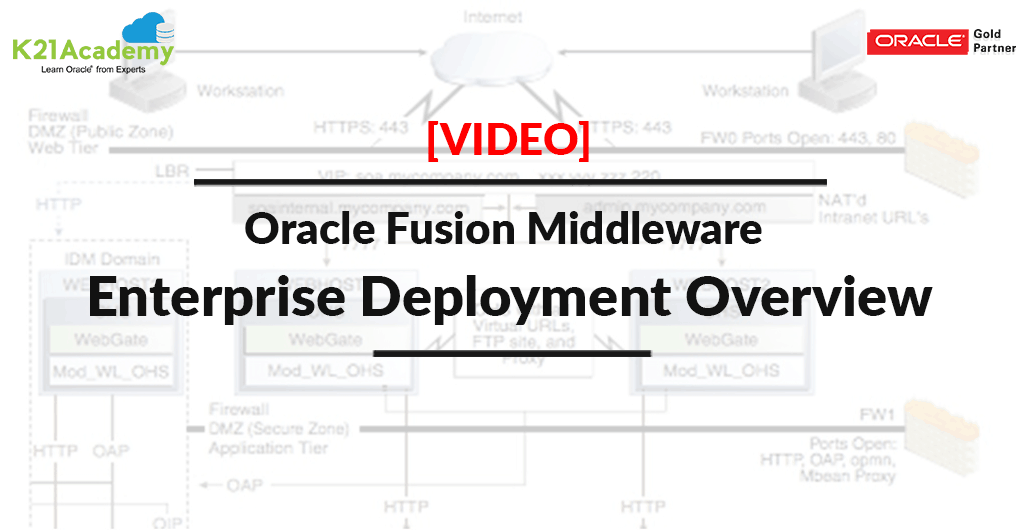
This video talk about Fusion Middleware Enterprise deployment which is an Oracle best practices blueprint based on proven Oracle high-availability and security technologies and recommendations for Oracle Fusion Middleware.
FMW: Enterprise Deployment
The Enterprise Deployment architectures are secure because every functional group of software components is isolated in its own DMZ, and all traffic is restricted by protocol and port. It considers various business service level agreements (SLA) to make high-availability best practices.
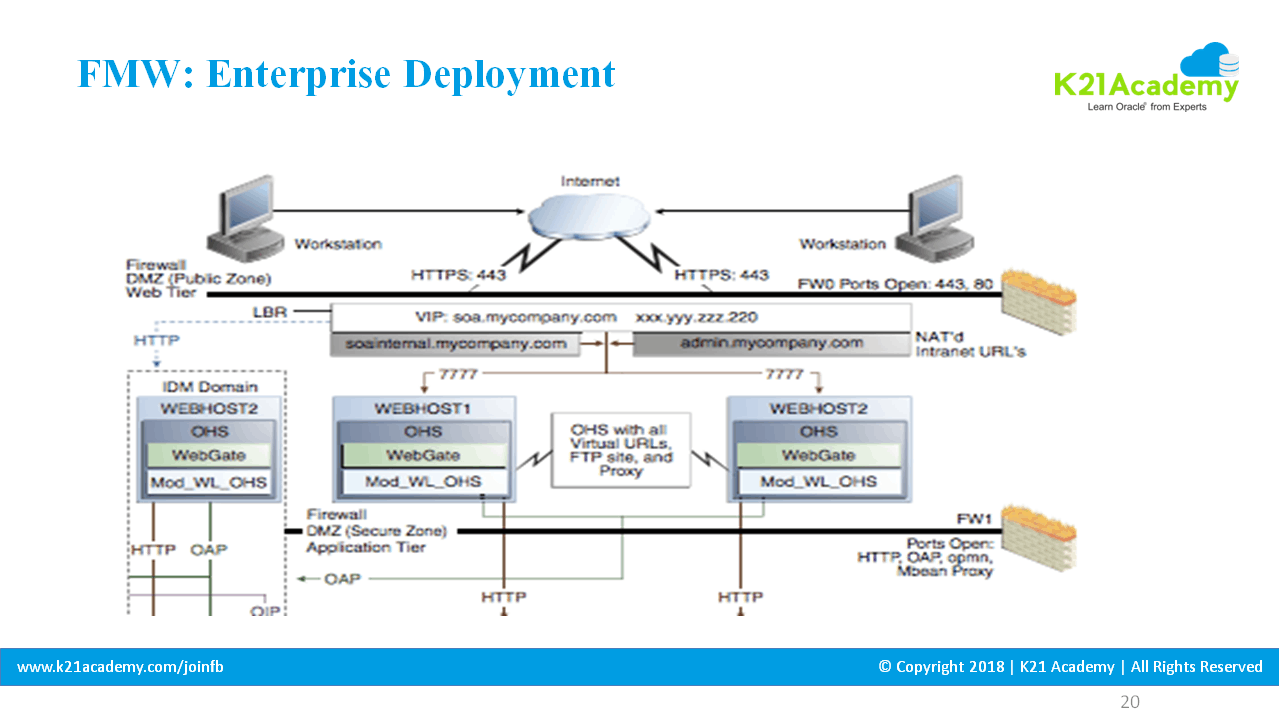
According to the above diagram, the top layer is a Client layer where the end user has a workstation or they keep a workstation. Bottom of Client layer there is a load balancer (Example you put the name of load balancer as soa.mycompany.com or admin.mycomamy.com so these are different internet URL according to what you want to do.
Then you have two Oracle HTTP server that has OHS installed and other component called WebGate which is mainly for (SSO) Single Sign-On (we have cover webgate in detail in our another Training Oracle access manager )
Then we have mod_wl_OHS, which is a module within Oracle HTTP server. The main task of HTTP server here is whatever request coming from OHS forward it to WebLogic server
Next term you have WebTier, in between we have a firewall and you only allow HTTP, OAP port, OPMN Port or MBeans and proxy port. In Middleware you have Application tier, and inside we have two hosts, SOA Host 1 and SOA Host 2.
Oracle Platform Security Service (OPSS), which is part of now Oracle fusion middleware and JRF ( Java Required File.
Quick review what we have learned in nutshell as:
Client Tier -> connected to the load balancer –> then it forward requests to OHS -> OHS to application tier or WebLogic and then it forwarding it to the database.
Click here if you want to know about my complete training program. This exact Module we cover in our Oracle Fusion Middleware Training https://k21academy.com/fmw03
Stay tuned for the further Useful things to learn in Oracle Fusion Middleware!!
Related Posts
- Part 1: Oracle Fusion Middleware: Overview & System VS Java Components click here.
- part 2 Oracle Fusion Middleware: 3 Tier Architecture Overview click here
- Oracle Fusion Middleware Training Selfpaced Click Here
- Oracle Fusion Middleware Training Click here
- [OPSS] Oracle Platform Security Service: Overview, Architecture & Features Click Here
- Oracle Fusion Middleware Training: Step by Step Activity Guides /Hands-On Lab Exercise Click Here
Have queries?
Next Task For You
Want to move ahead in your career and want to get a higher Earning Job?
Get 7+ Courses for DBAs & Apps DBA in a bundle program and learn from the Industry’s best Experts.


![Microsoft Agentic AI Business Solutions Architect [AB-100] | K21 Academy](https://test.k21academy.com/wp-content/uploads/2025/11/Microsoft-Agentic-AI-Business-Solutions-Architect-AB-100-Exam-Overview1.png)