

In this blog post, We give you an overview of OIC Message Pricing and License. It’s targeted towards individuals who are working as an Integration expert and want to minimize the expenses involved with an integration instance in the Oracle Cloud.
If you are new to Oracle Integration Cloud (OIC), then check out our blogs below as these contain all the key points that a beginner should know about Oracle Integration Cloud (OIC), creating Oracle Integration Instance and Consoles walkthrough.
- Oracle Integration Cloud (OIC) For Beginners Overview
- Create Oracle Integration Cloud Instance: Step-by-Step
- Console Walkthrough of Oracle Integration Cloud (OIC) Service
- Create Your First VBCS Instance in Oracle Cloud
When an instance is created, it allocates a number of message packs to that instance, the minimum is 1 which allows 5K messages per hour. The customer will be billed at that message pack rate for every hour that the instance is running – whether they send messages or not.
Integration Editions
There are two types of Integration instance Edition in the Oracle cloud, standard, and enterprise.
Standard includes Integration (SaaS Integration Adapters, Technology Adapters, and Scheduled File Transfer) and Visual Builder.
Enterprise instance includes all the standard features plus On-Premise Application Adapters and Process Automation.
Regardless of which edition you choose, Oracle handles cloud and database management, backup, restore, and other administrative tasks for you.
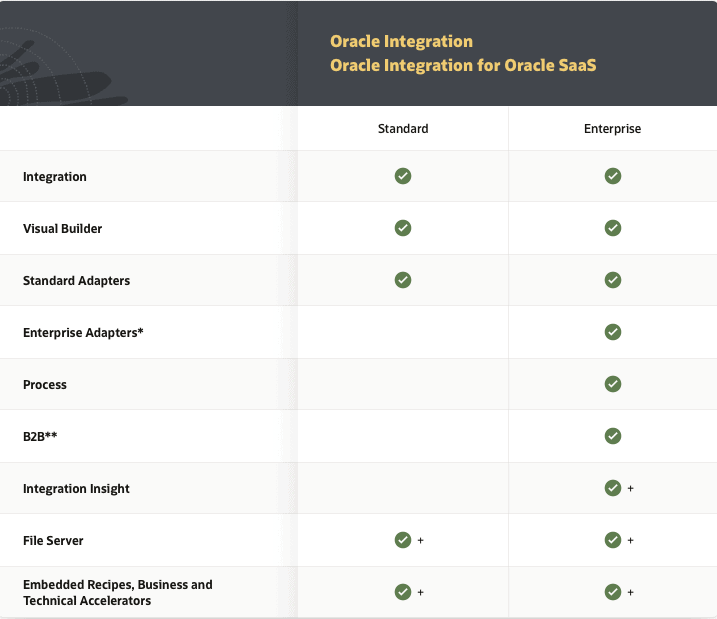
Note:
- *Enterprise adapters include Oracle E-Business Suite (EBS) Adapter, Oracle JD Edwards Enterprise one Adapter, Oracle Siebel Adapter, and SAP Adapter.
- + Available in Generation 2 only.
- **The AS2 Adapter available in the Standard edition can be used in standalone mode (for example, for tile transfer protocol use cases not using B2B features). To use the AS2 Adapter with B2B features such as the B2B action, B2B design time, and B2B runtime, you must use the Enterprise edition
Check Out : New Homepage Of Oracle Integration Cloud.
Integration License Type
There are two types of Integration Instance Licenses.
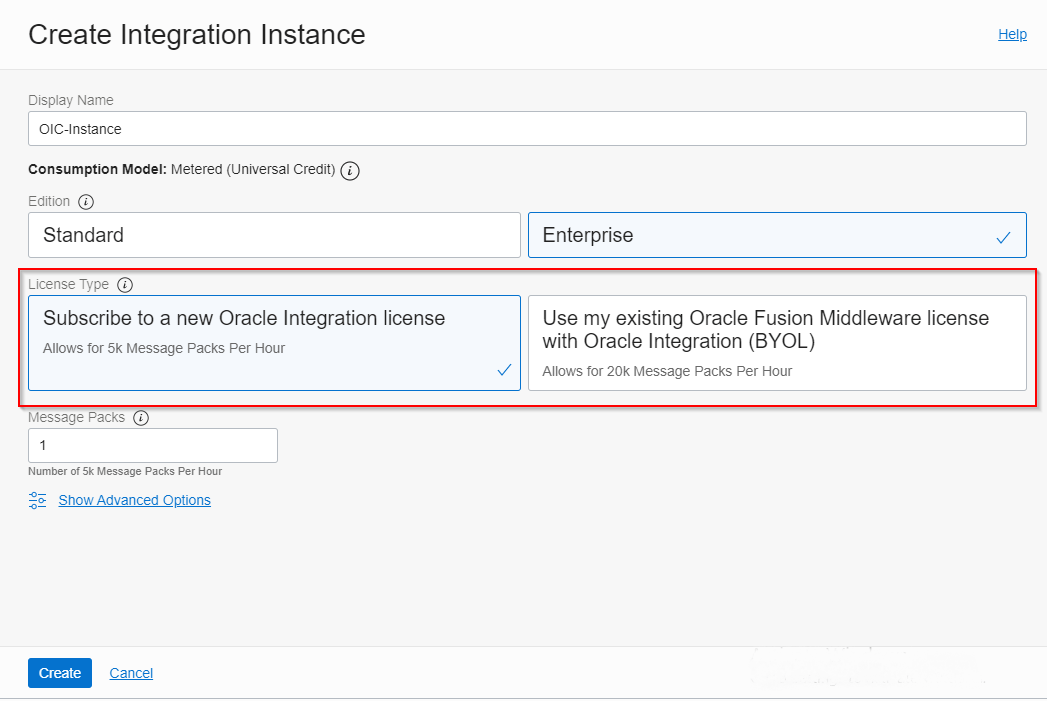
Subscribe to a new Oracle Integration License:
This provides you with message packs of size 5K per hour and you can select up to 12 sets of 5k message pack. In total, you can get a maximum of 60K messages
Use my Existing Oracle Fusion Middleware license with Oracle Integration (BYOL):
This provides you with message packs of size 20K per hour. This option is also known as bring your own license (BYOL).
In this, you can select up to 3 sets of 20k message pack giving a total of 60K messages providing the same messages as new Oracle Integration Licenses.
Go through this Oracle Integration Cloud Service Blog to get a clear understanding of what is oracle rest data services
Integration Message Packs
The message pack options available for selection are based on the version of the Oracle Integration instance you are creating.
For Oracle Integration: Select the number of message packs. The total number of messages available per pack is based on the License Type option you selected.
You can select up to 3 message packs if you bring an existing Oracle Fusion Middleware license to the cloud. You can select up to 12 message packs if you create a new Oracle Integration license in the cloud.
For Oracle Integration for SaaS: Select the number of message packs to use per month. Each message pack consists of one million messages. You can select up to 43 message packs.
Also Read : Our Previous Blog On OIC Connectivity Agent Download
How does Oracle count messages
When an instance is created, by default a message packs of 1 is selected. The customer will be charged 1 msg pack/hour for the new instance – whether messages pack is being used or not.
An integration is triggered:
For all trigger messages that are less than or equal to 50 KB is counted as 1 message.
If the message is greater than 50Kb, then 2 and more messages are counted, dependent on size.
For Example, if you are sending messages of 754KB then you will be charged (754KB divided by 50 KB) for 16 messages.
An integration invokes another integration
Oracle does not counts when an integration invokes another integration or process within OIC:
An integration calls an application, DB, File system:
- The request message is not counted
- The response message is counted in the following way:
- Message size < 50kb: 0 messages
- Message size = 50 KB: 1 message
- Message size > 50 KB: 2 and more messages
Edit Integration Editions, License Type & Message Packs
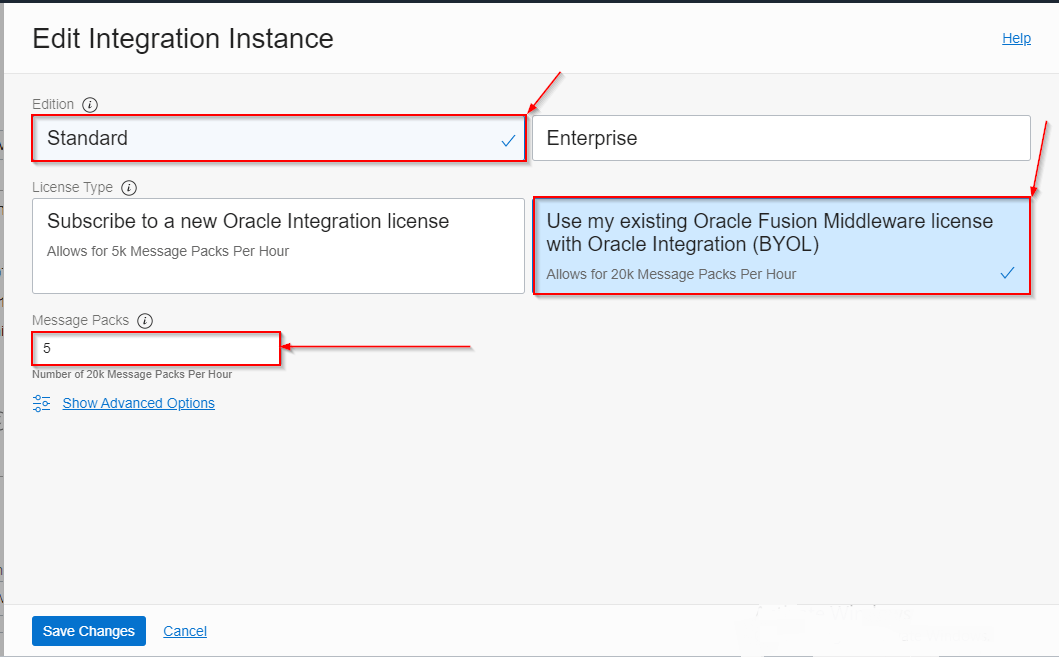
In Oracle Integration Generation 2 you can edit the Integration Editions, License types and Message packs afterward once the integration has been provisioned.
1) Click on the Instance which you want to Edit
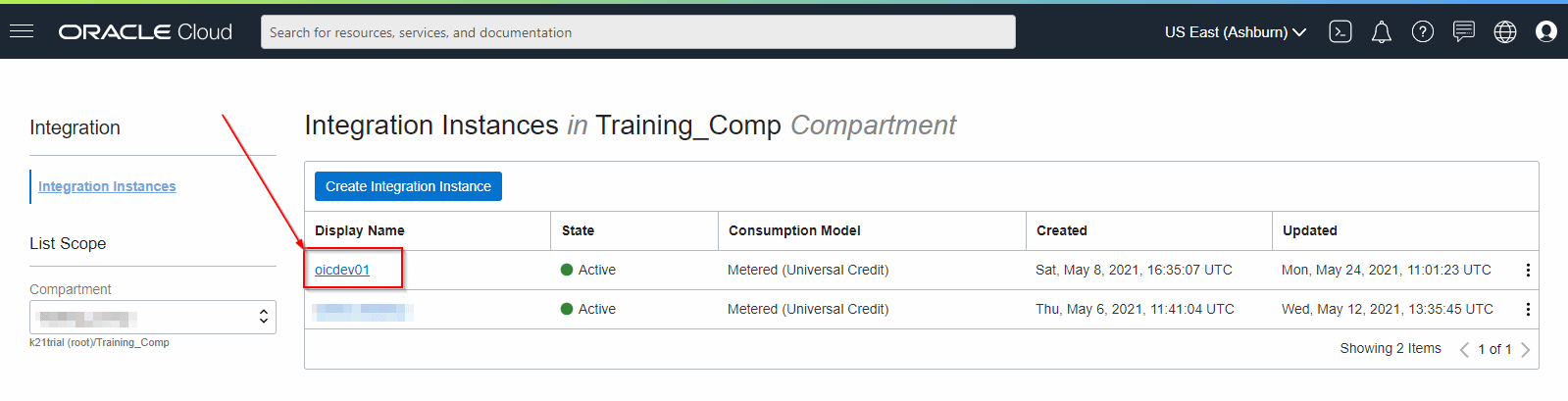
2) Now click on Edit
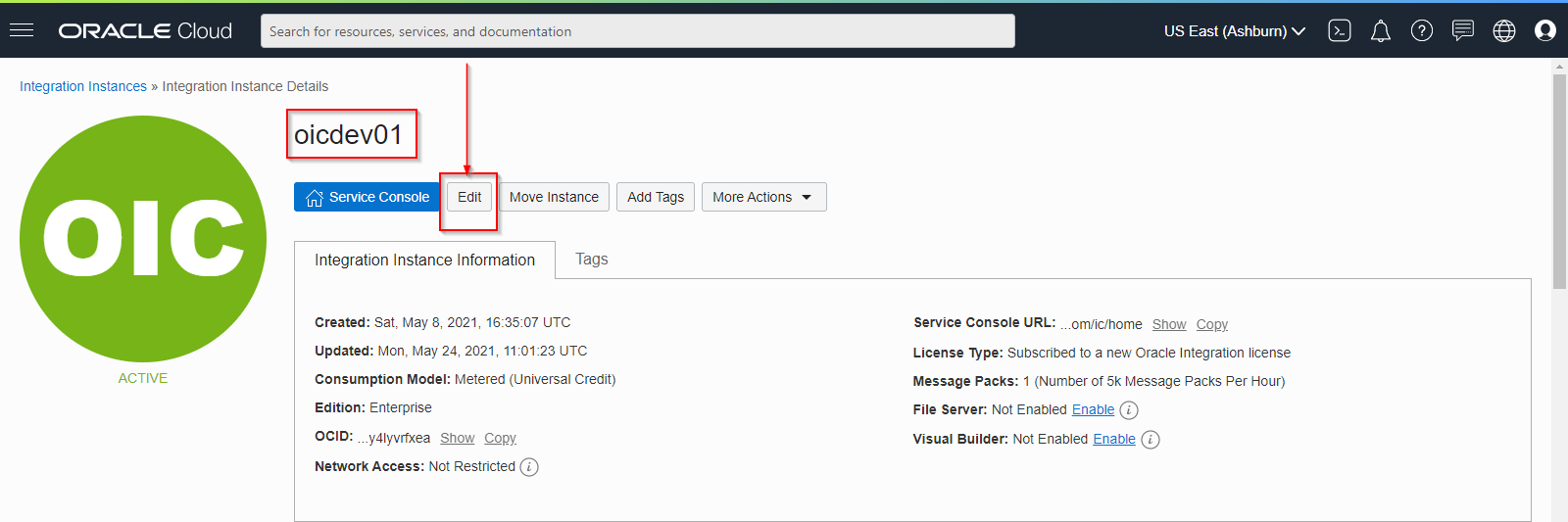
3) The Edit Integration Instance dialog will be displayed displayed. Now configure the changes according to your requirements.
4) Finally click on Save Changes
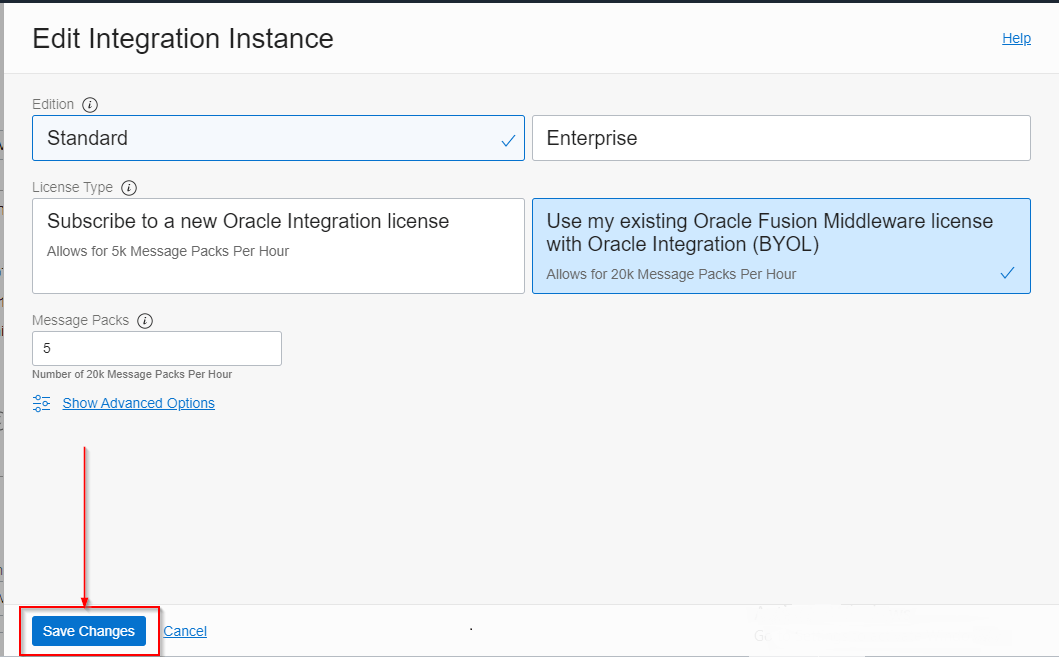
Note: Your dialog may differ, depending on options available for services purchased.
Conclusion
In this post, we gave an overview of OIC Instance Edition, Message Pricing, and License Types.
If you find this post useful and have further related questions then comment below.
Related Links/References:
- [Free Masterclass] Oracle Integration Cloud Services
- 6 Docs Every Oracle Cloud Integrator Must Read
- Oracle Cloud Documentation Links: OIC | SOA-CS | OCI
- Using Oracle Process Cloud Service
- Oracle SOA Cloud Service
Next Task For You
Do you want to learn more about Oracle and confuse where to start or which certification is right for you? Then, click on the register now button below to register for a Free Masterclass on Oracle [1Z0-1042] Certified Cloud Integration Expert, which will help you better understand and choose the right path and clear the certification exam.


![Microsoft Agentic AI Business Solutions Architect [AB-100] | K21 Academy](https://test.k21academy.com/wp-content/uploads/2025/11/Microsoft-Agentic-AI-Business-Solutions-Architect-AB-100-Exam-Overview1.png)