




This post covers key differences between Oracle Exadata & Database Appliance. This post is for beginners as well as for experience holders such as DBA’s who are just starting to learn Exadata and we have a dedicated course for Exadata where we cover everything about Exadata, which will take you from zero to hero in Oracle Exadata Database Machine.
If you want to know what is Exadata then I would highly recommend you to go through our previous posts on Exadata.
Overview of Oracle Exadata Database Machine
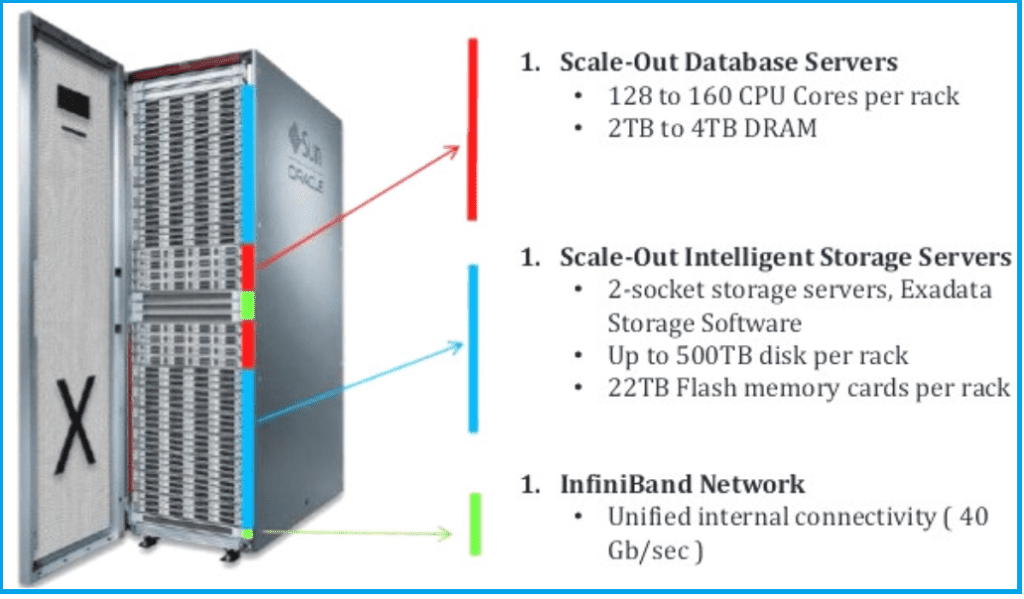
What is Oracle Exadata Database Machine? It is an easy to deploy solution for hosting the Oracle Database that delivers the highest levels of database performance available. The Exadata Database Machine is a “cloud in a box” composed of database servers, Oracle Exadata Storage Servers, an InfiniBand fabric for storage networking, and all the other components required to host an Oracle Database.
 Overview of Oracle Database Appliance
A database appliance is a pre-configured, balanced set of hardware (servers, memory, storage, and I/O channels), software (operating system, database management system [DBMS] and management software), service, and support. It is sold as a unit with built-in redundancy for high availability and positioned as a platform for DBMS used in online transaction processing (OLTP) and/or data warehousing.
Also read: Exadata Deployment Options to understand the difference between Cloud Service (ExaCS) vs Cloud at Customer (ExaCC) vs Exadata Machine.
Difference Between Exadata and Oracle Database Appliance
- Oracle Exadata is a pre-configured combination of hardware and software that provides an infrastructure for running Oracle Database. It consists of a database layer and a storage layer connected through an InfiniBand network. The database layer consists of Sun servers and runs Oracle 11gR2 software and normally Oracle RAC is deployed on database node. The database layer uses ASM to map to the storage layer. The storage layer also consists of Sun Servers and runs Oracle Storage server software. Exadata’s exclusive features are smart scan, Hybrid Columnar Compression, and Storage Indexes.
- Oracle Unbreakable Database Appliance (ODA) is a completely integrated highly available (HA) database system in a single box. ODA is an appliance and it contains storage, servers, Operating System, and a web-based monitoring tool (database control) within one box. It provides a ready-to-use, clustered database solution that includes both hardware and software optimized to work together.
- Exadata is not an appliance, ODA is. A server appliance is a computer for specific tasks, such as handling email or storing data, and a database appliance is just that; a computer to handle the database. It is meant to be bought, brought into the data center, plugged in, data loaded, and then gave access to the user, as you would do with any other appliance. But courtesy to Oracle’s inherent architecture, you can customize, tweak, and tune the appliance parameter according to your requirement.
- ODA is geared towards small and medium-sized businesses, whereas Exadata is for the big guns.
This post is from our Exadata Training, in which we cover Exadata Overview & Architecture, Exadata Storage Server Configuration, Resource Management, Optimizing Database Performance & much more.
If you have any doubts about Exadata Oracle, just post in the comments or reach out to us at contact@k21academy.com
Next Task For You
Click on the image below to download your FREE Guide, 5 Key Exadata Docs, Every Oracle DBA Must Read & Learn More.


![Microsoft Agentic AI Business Solutions Architect [AB-100] | K21 Academy](https://test.k21academy.com/wp-content/uploads/2025/11/Microsoft-Agentic-AI-Business-Solutions-Architect-AB-100-Exam-Overview1.png)