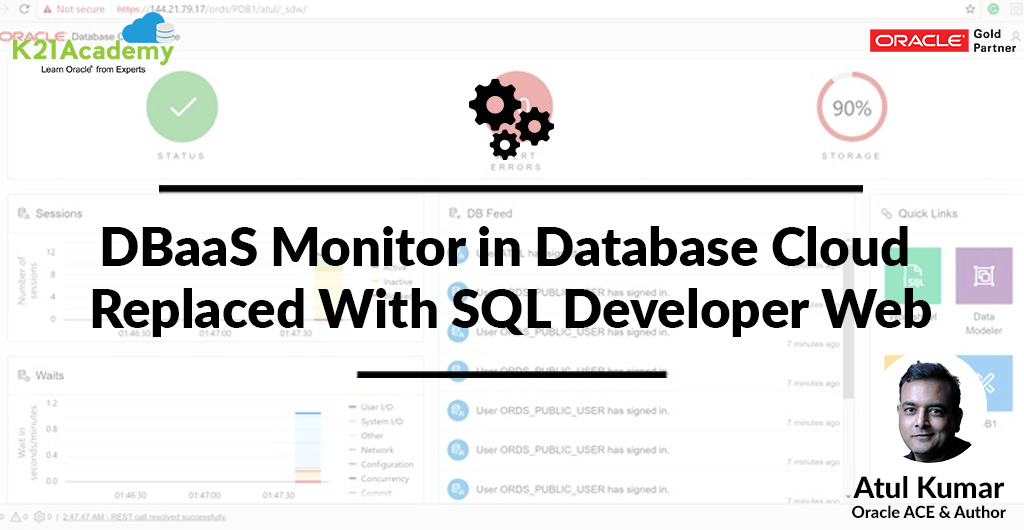





This post covers one of the latest updates (and big one) for Oracle Database Cloud Service (DBCS) users i.e. DBaaS Monitor is now decommissioned in favor of Oracle SQL Developer Web. For a list of all the DBCS updates in May 2018, go through my previous blog post here.
What is SQL Developer Web (SDW)
SQL Developer Web (SDW) is the new, browser-based application that incorporates features of both Oracle SQL Developer and Oracle DBaaS Monitor and provides a subset of the features of the desktop version.
For those who are new to Oracle database cloud, Oracle DBaaS Monitor is a GUI tool which provides monitoring and management of the Oracle database, listener, CPU, Memory, Storage etc on Oracle Database Cloud Service. It provides quick and easy access to a variety of information about the database instance running on a database Cloud deployment
SQL Developer Web enables you to run SQL statements and scripts in the worksheet, export data, and design Data Modeler diagrams using new and existing objects. It also enables database administrators to monitor and manage the database and provides a real-time SQL monitoring interface.
When you create a new database deployment in Cloud accounts created from May 2018 onwards, SQL Developer Web is automatically installed. If you have an older database deployment, you must replace DBaaS Monitor with SQL Developer Web (SDW) by updating your Oracle Cloud Tooling.
How To Login to SDW?
Access to SQL Developer Web is provided through schema-based authentication. Consequently, you can provide database developers and administrators access to databases without having to create and maintain Oracle Cloud accounts for them. However, before a developer or administrator can sign in to SQL Developer Web, you must enable their schema in the database for access but you need to make sure the database deployment is using Cloud Tooling Version 18.2.3 or later.
Accessing SQL Developer Web:
You can access Oracle SQL Developer Web in an Oracle Database Cloud Service database deployment in the following ways:
-
Using the Database Deployment’s Landing Page:
In your web browser, go to the URL: https://node-ip-address/ (Here node-ip-address is the IP address of the deployment’s compute node). In the SQL Developer box’s Schema field, enter the schema path reported by the ords assistant when the database user’s schema was enabled for SQL Developer Web access. Then click Go. When prompted for a username and password, enter the username and password of the database user whose schema path you entered in the previous step. Make sure to enter the username in uppercase. Then click Sign In.
Note: Either port 443 for Public IP must be open or use SSH Tunneling (be default port 443 is disabled on Database Cloud Service
-
Using a Direct URL:
In your web browser, go to the URL: https://node-ip-address/ords/[schema-path]/_sdw (Here node-ip-address is the IP address of the deployment’s compute node and schema-path is the schema path reported by the ords assistant when the schema was enabled for SQL Developer Web access). When prompted for a username and password, enter the username and password of the database user whose schema-path you gave in the URL. Make sure to enter the username in uppercase. Then click Sign In.

Note: Either port 443 for Public IP must be open or use SSH Tunneling (be default port 443 is disabled on Database Cloud Service
-
Using an SSH Tunnel:
Create an SSH tunnel to port 443 on the compute node hosting SQL Developer Web. After creating the SSH tunnel, Go to the URL: https://localhost/ords/schema-path/_sdw. Here schema-path is the schema path reported by the ords assistant when the schema was enabled for SQL Developer Web access. When prompted for a username and password, enter the username and password of the database user whose schema-path you gave in the URL. Make sure to enter the username in uppercase. Then click Sign In.
Features of SQL Developer Web
- Developer Features: Users of the Oracle SQL Developer desktop product will find SQL Developer Web very familiar and easy-to-use. It provides similar Worksheet and Data Modeler features, and includes a Home page that provides pertinent database statistics and access to the worksheets and diagrams you have saved.
- You can use SQL and PL/SQL statements in the worksheet to create a table, insert data, create and edit a trigger, select data from a table, and save that data to a file.
- It includes an integrated version of SQL Developer Data Modeler with basic reporting features. You can create diagrams from existing database objects, retrieve data dictionary information, generate DDL statements, and export diagrams.
- The Homepage contains widgets that provide a general overview of the activity and status in SQL Developer Web like Recently Modified Objects, Invalid Objects, My Worksheets, My Diagrams etc.
- Administrator Features: For users whose schemas have been enabled for DBA access, SQL Developer Web provides features for database and OS administration and monitoring:
- A dashboard that shows overview statistics for the database. This dashboard is displayed immediately after you sign in, and many of the statistics it displays are hot. You can click them to go directly to detail pages where you can investigate and take appropriate action. Additionally, the dashboard provides quick links to such resources as the Worksheet, Data Modeler, and SQL Monitor.
- DBA features to manage the database and see information about the listener, backups, alerts and several other items of interest to DBAs.
- OS features to monitor RAM and CPU usage, OS storage and running processes.
To know about all the DBCS updates in May 2018, go through our blog post here.
Note: Like above post, we keep our trainees updated with latest updates in our courses Cloud DBA Certification 1Z0-160 Training and Oracle DBA To Cloud DBA in 6 Weeks Training. You can get Step By Step Hands-On Activity Guides you must perform for DBA to Cloud DBA or Oracle Cloud DBA Certification here).
References
- Using Oracle SQL Developer Web in Database Cloud Service
- Oracle DBA To Cloud DBA in 6 Weeks Training
- Step By Step Activity Guides for DBA to Cloud DBA Training
- Oracle Database Cloud Service (DBCS) Changes in May 2018
Next Task For You
- Get the FREE Copy of Step-By-Step Guide to Register for Oracle Cloud Trial Account in your inbox.
- Join our FREE Masterclass on “Upgrade From DBA To Oracle Cloud DBA Including Certification & Earn More In 2020″ Click on the image below to Register for the FREE Masterclass NOW!


![Microsoft Agentic AI Business Solutions Architect [AB-100] | K21 Academy](https://test.k21academy.com/wp-content/uploads/2025/11/Microsoft-Agentic-AI-Business-Solutions-Architect-AB-100-Exam-Overview1.png)