



This post covers Oracle Cloud Certification (1Z0-160) related to Oracle Database Cloud Service (one of the hot topics in Cloud market currently) and important for
1. Database Administrators (DBAs) who are already OCA/OCP certified (and wish to upgrade their OCA/OCP in Oracle Cloud)
or
2. Anyone who is just starting or wish to become Oracle DBA
Note: If you are an Oracle DBA and wish to know task performed by Cloud DBA then check my Video Here
Oracle Certification Levels (OCA|OCP|OCM)
If you are new to Oracle Certification then its good to know that there are three certification levels in DBA ie
1. Oracle Certified Associate (OCA)
2. Oracle Certified Professional (OCP)
3. Oracle Certified Masters (OCM)
Note: These certifications are also specific to the version of Databases so like Database 12c or 11g
How To Become Oracle Database Cloud Certified?
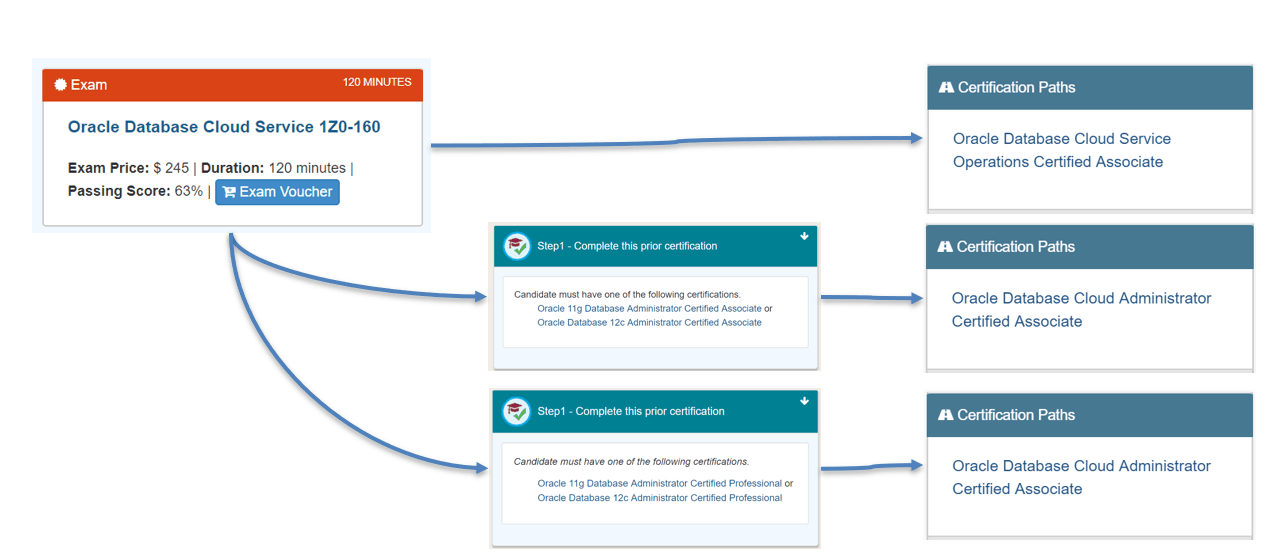
To become Oracle Database Cloud certified, you would need to pass the Oracle Database Cloud Service 1Z0-160. This tests your Oracle Database Cloud Service skills, demonstrating your ability to administer your database in the Cloud. The resulting certification depends on your background.
A. Oracle Database Cloud Service Operations Certified Associate: You get this certification if you have No prior Oracle Database certification (like OCA, OCP or OCM).
B. Oracle Database Cloud Administrator Certified Associate: You get this certification, If you have prior Oracle Database 11g or 12c Administration Certified Associate (OCA).
C. Oracle Database Cloud Administrator Certified Professional: You get this certification if you have prior Oracle Database 11g or 12c Administration Certified Professional (OCP)
Note: If you are not an Oracle DBA and wish to become Cloud DBA or become Cloud Certified then Oracle Database Cloud Service Operations Certified Associate is good to start by clearing 1Z0-160
What Exam Topics/Documentation to Study?
If you plan to take the exam, you need to be well versed with the below topics like how to sign in to an Oracle Public Cloud with a user subscription, execute a database deployment and learn how to create, delete, stop, restart, and then move to advanced topics like patching, configuring network access rules from tools and other database deployments, managing database deployment, security at the compute node and the database levels.
You also need to develop the knowledge and skills to add storage for the database deployment, create storage containers for backups stored in Oracle Storage Cloud Service containers, and perform on-demand backups & recovery.
Finally, develop a deeper understanding of the benefits of migrating an on-premises database to Oracle Database Cloud Service. Understand and validate the different migration methods, including RMAN, Data Pump, unplug/plug, remote cloning, and SQL Developer and know when to use them.
Here are Module wise exam topic that I’ll cover over next few months on this blog
- M1: Overview of Cloud Services [Last Updated 3rd Jan 2018]
Cloud Services
Oracle Database Cloud Offerings
Subscribe to an Oracle Cloud Service - M2: Creating a Database Deployment [Last Updated 9th Jan 2018]
Database Cloud Service Architecture
Features and Tooling
Automated Database Provisioning
Comparison: Database Deployment and an On-Premises Database
Using the Wizard to Create a Database Deployment
How SSH Key Pairs are Used & Creating an SSH Key Pair
Storage Used for Database Files & File System Layout - M3: Administering a Database Deployment
Using the Oracle Cloud My Services Dashboard
Viewing the Service Details & Using the Database Cloud Service Console
Configuring Connections to the Compute Node
Oracle Cloud User Roles and Privileges & Administering Users, Roles, and Privileges
Managing Compute Node Users
Managing Database Users and Privileges
Scaling a Database Deployment
Patching & Upgrading a Database Deployment - M4: Backing Up and Recovering
Backing Up and Recovering Database Deployments
Using Utilities to Back Up and Recover the Database Deployment
Choosing a Backup Destination & Default Backup Configuration
Creating an On-Demand Backup
Changing the Backup Destination
Customizing the Backup Configuration
Performing Recovery by Using the Console
Performing Recovery by Using the dbaascli Utility - M5: Overview of Oracle Cloud Security
Cloud Security Guidelines
Enforcing Security in a Database Deployment
Physical and Operating System Security of the Compute Node
User Authentication: Services and Compute Node Access
User Authentication: Database Access - M6: Configuring Network Access to a Database Deployment
Describing Network Access to the Compute Node and Database
Creating Security Lists & Configuring Connections to the Compute Node
Implementing Fine-Grained Control of Network Traffic
Controlling Network Traffic & Network Security
Defining Security Rules
Accessing the Database Using Various Tools - M7: Using Oracle DBaaS Monitor
Managing the Database
Monitoring the Database
Managing and Monitoring the Listener
Monitoring the Operating System - M8: Implementing Database Deployment Security
Secure Access to Configuration Files on the Compute Node
Backing Up Operating System and Database Configuration Files
Restricting Access to the Database
Protecting Data in the Database Deployment
Tablespace Encryption by Default
Transparent Data Encryption (TDE): Overview
Auditing: Compute Node Connections and Actions
Auditing: Database - M9: Migrating to Oracle Database Cloud Service
Choosing a Migration Method: Considerations
Choosing a Migration Method: Information Gathering
Choosing a Method: Oracle Data Pump Considerations
Choosing a Method: Unplug/Plug and Remote Cloning Considerations
Choosing a Method: RMAN, SQL*Loader, and GoldenGate Considerations
Applicable Migration Methods
Overview of Using SQL Developer
Using SQL Developer and INSERT Statements to Migrate Selected Objects
Using SQL Developer and SQL*Loader to Migrate Selected Objects - M10: Overview of DBCS Performance Management
Performance Management in the Database Cloud Environment
Performance Monitoring and Tuning
Tuning Methodology
Effective Tuning Goals
General Tuning Session
What Can be Tuned in a DBCS Environment? - M11: Tuning Performance Issues
Tools for Performance Management
DBaaS Monitor: Database Information & Operating System Information
Identifying Performance Issues by Using the DBaaS Monitor
Using the Enterprise Manager Database Express Performance Hub
Identifying Performance Issues by Using Enterprise Manager Database Express
Identifying Performance Issues by Using SQL Developer
Using ADDM to Diagnose Performance Issues
Using the SQL Tuning Advisor - M12: Performance Management [Last Updated 30th Dec 2017]
Database Deployment Scaling: Overview
Database Resource Manager
Using Resource Manager to Control PDB Resource Usage
Controlling Resource Usage by Consumer Groups
Determining When to Scale Up the Database Deployment
Scaling Up CPU and Memory - M13: Using REST APIs to Manage Oracle Database Cloud Service
What is Oracle REST Data Services (ORDS)?
Key Principles of Representational State Transfer (REST)
What Does ORDS Do?
ORDS and Database Cloud Service
Using REST APIs in Oracle Cloud
Using REST APIs with Database Cloud Service
Using cURL and REST APIs
Reference: REST API HTTP Status Codes - M14: Deleting a Database Deployment
What Happens When You Delete a Database Deployment?
How Can You Delete a Database Deployment?
For Step by Step Hands-On Activity Guide, we cover in Cloud DBA Certification [1Z0-160] Training visit here and for Course Content check here
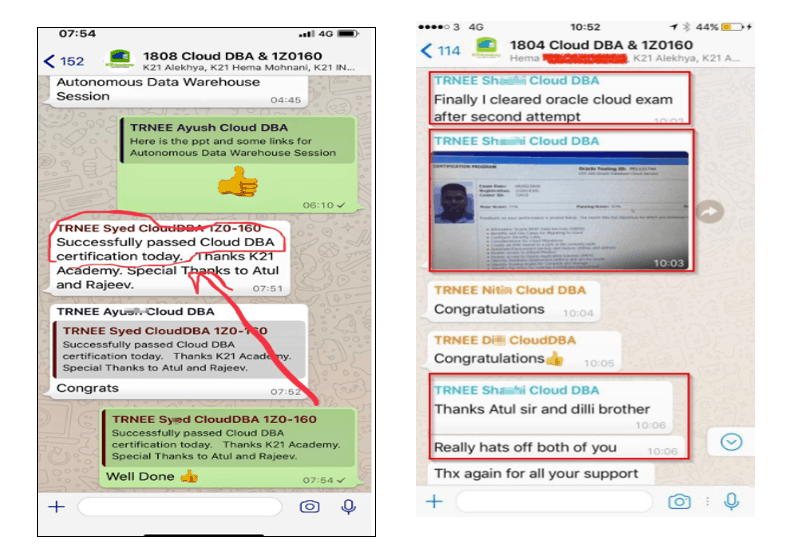
I am happy and proud to share with you that 100 of our students are Cloud DBA Certified, below are the Success stories of a few of them
Now it’s your turn to post your doubts in the comment section and let us know where you are facing challenges in Cloud DBA Certification
This post is from our Course “Oracle Database Cloud Service (DBCS) Certification (1Z0-160)” with 1 Year On-Job Support and 1 year Unlimited FREE Retakes (If you need to know more about this program then reach out to our team at contact@k21academy.com )
Related/Further Reading
- Database Editions in Cloud SE, EE, HP, EP
- Oracle PaaS Offerings
- Oracle Database Cloud Service (DBCS) Certification (1Z0-160) Live Training
- Oracle Database Cloud Service (DBCS) Certification (1Z0-160) Self-Paced training
- Oracle Cloud Certification (1Z0-160): Step by Step Activity Guides To Clear Exam
- Role of Oracle DBA in Cloud
- [Video] Create Oracle Database on Cloud Live Demo
- [Video] Build Oracle RAC on Oracle Cloud
Next Task For You
Get the FREE Copy of Step-By-Step Guide to Register for Oracle Cloud Trial Account in your inbox, Click Down the image below.

FREE Community

![Microsoft Agentic AI Business Solutions Architect [AB-100] | K21 Academy](https://test.k21academy.com/wp-content/uploads/2025/11/Microsoft-Agentic-AI-Business-Solutions-Architect-AB-100-Exam-Overview1.png)