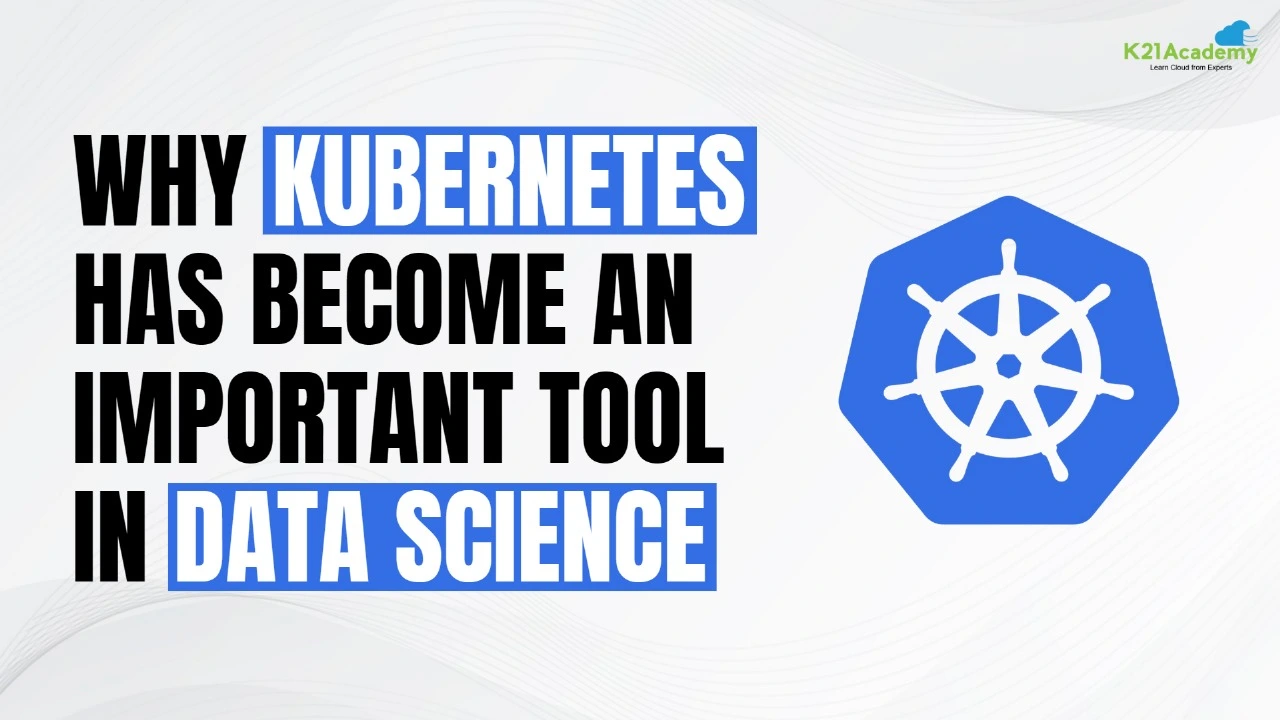



Kubernetes, a container orchestration tool, holds significant value not just in software development but also in the realm of Data Science. Its impact on application creation and deployment has been profound since its inception, garnering substantial interest from Data Scientists.
In this blog, we will learn what is the significance of K8s in Data science.
What is Kubernetes?
 “Kubernetes” is a Greek word, which means helmsman or pilot which also gives us an idea of how the logo was made. Now, let us come to the technical part of it since Docker has its own limitations, Kubernetes comes into the picture to fill the gaps in the Docker containerization process. K8s is a complete containerization orchestration, which provides the ability to run dynamically scaling, containerized applications, and utilizing an API for management. By doing a comparison of Docker & Kubernetes one can deduce the advantages of Kubernetes over other containerization orchestration.
Know more about Kubernetes
Kubernetes and Data Science
The Kubernetes user community consistently introduces new features beneficial for Data Science. These encompass declarative deployments, robust monitoring capabilities for every system component, continuous integration, and adaptable service routing.
Data Scientists encounter challenges akin to software engineers. They perform multiple experiments, execute repetitive tasks, track metrics, manage access and credentials, and streamline scaling. Kubernetes offers solutions for these challenges.
Batch job execution becomes valuable for data processing, testing, and ML model training and deployment in Machine Learning pipelines.
Microservices architectures simplify application structures, enhancing modularity and security for software components.
Declarative configurations streamline model creation across platforms by illustrating service connections. Customized workflows for container management become essential for specific experiments.
Kubernetes benefits Machine Learning engineers through projects like Kubeflow, enabling the utilization of frameworks such as JupyterHub, Tensorflow, PyTorch, or Seldon, ensuring portable workloads.
Integration with Spark enables the creation of a Spark driver within a Kubernetes pod, seamlessly executing applications via “executors” connected to Kubernetes pods.
The Role of Kubernetes Across Data Science Stages
Scalability and Resource Management
Kubernetes excels in efficiently managing computational resources, crucial for data scientists working with massive datasets or computationally intensive tasks. Its ability to dynamically allocate resources based on demand is invaluable, especially during the training of machine learning models that require substantial computational power.
Learn more about ReplicaSet in Kubernetes
Containerization for Enhanced Reproducibility
Containers are pivotal in maintaining consistency across different environments in data science workflows. They encapsulate applications and dependencies, ensuring reproducibility by packaging the entire workflow, from data preprocessing to model training and inference. Kubernetes’ orchestration capabilities enable seamless deployment and management of these containers across clusters, guaranteeing consistent and reproducible outcomes.
Facilitating Experimentation and Model Deployment
Data scientists continually iterate through various models and parameters to identify the most effective ones. Kubernetes simplifies this process by enabling rapid deployment and management of multiple model versions concurrently. Features like rolling updates and canary deployments allow efficient testing and comparison of different models in production-like environments, reducing risks and ensuring smooth transitions.
Collaboration and Workflow Automation
Kubernetes fosters collaboration among data science teams by providing a unified platform for sharing and deploying experiments. Integration with CI/CD pipelines automates deployment, facilitating seamless transitions from experimentation to production. This empowers data scientists to focus on refining models while Kubernetes manages deployment and scaling, streamlining the workflow.
Monitoring, Logging, and Debugging Capabilities
The Kubernetes ecosystem offers robust monitoring and logging tools that provide insights into application performance and health. These tools are invaluable for data scientists in debugging models, optimizing performance, and identifying workflow bottlenecks. Kubernetes-native monitoring solutions such as Prometheus and Grafana offer visibility into application behavior, enabling informed decisions to enhance performance.

Know more about Prometheus Monitoring
How can Kubernetes be used in Data Science?
Kubernetes finds multiple applications in Data Science endeavors. For instance, it facilitates the deployment of models for real-time inference, streamlining the process of scaling applications to manage increased workloads. This involves creating deployments and exposing them, allowing Kubernetes to automatically distribute traffic according to predefined configurations established by Data Scientists.
Another case involves leveraging Kubernetes for research and development (R&D) data analysis. By integrating native Spark capabilities with Kubernetes, Data Scientists gain access to a convenient self-service platform for Big Data analytics.
Furthermore, container orchestration proves highly advantageous for scientific research teams in fields like natural sciences. Containers enable the replication of scientific experiments, facilitating the reproduction of test outcomes across various environments and devices.
Conclusion
Kubernetes has transformed the data science landscape by providing a scalable, flexible, and efficient infrastructure for managing intricate workflows. Its capabilities in orchestrating containers, optimizing resource utilization, and simplifying deployment processes make it an indispensable tool for data scientists seeking enhanced productivity, collaboration, and reproducibility in their work.
As the field of data science continues to evolve, leveraging Kubernetes empowers data scientists to focus on innovation and experimentation, driving advancements in machine learning, artificial intelligence, and data-driven decision-making.
Frequently Asked Questions
What is Kubernetes, and why is it important in Data Science?
Kubernetes is an open-source container orchestration platform that automates the deployment, scaling, and management of containerized applications. In Data Science, Kubernetes has become crucial due to its ability to efficiently manage complex data pipelines, streamline deployment of machine learning models, and provide scalability and reliability for data-intensive workloads.
How does Kubernetes benefit Data Scientists?
Kubernetes simplifies the deployment and management of data science applications by allowing Data Scientists to package their workloads into containers and easily deploy them across different environments. It enables seamless scaling of resources, ensures high availability, and provides a consistent environment for running experiments and models.
Can Kubernetes help in managing diverse data sources in Data Science projects?
Yes, Kubernetes can manage diverse data sources by orchestrating containers that encapsulate different data processing tasks. It can efficiently handle data ingestion, preprocessing, and analysis across various sources while ensuring consistency and reliability.
How does Kubernetes aid in model deployment and serving in Data Science?
Kubernetes simplifies model deployment by providing a platform to containerize machine learning models. This allows for easy deployment, scaling, and management of models as microservices. Data Scientists can deploy models in a consistent manner, ensuring reproducibility and facilitating serving predictions at scale.
Related/References
- Subscribe to our YouTube channel on “Docker & Kubernetes”
- (CKA) Certification: Step By Step Activity Guides/Hands-On Lab Exercise
- Kubernetes Architecture | An Introduction to Kubernetes Components
- Docker & Certified Kubernetes Administrator (CKA) Training
- Create AKS Cluster: A Complete Step-by-Step Guide
- [Solved] The connection to the server localhost:8080 was refused – did you specify the right host or port?
- CKA/CKAD Exam Questions & Answers 2022
- Kubernetes Monitoring: Prometheus Kubernetes & Grafana Overview
- How To Setup A Three Node Kubernetes Cluster For CKA: Step By Step
Join FREE CLASS Masterclass
Discover the Power of Kubernetes, Docker & DevOps – Join Our Free Masterclass. Unlock the secrets of Kubernetes, Docker, and DevOps in our exclusive, no-cost masterclass. Take the first step towards building highly sought-after skills and securing lucrative job opportunities. Click on the below image to Register Our FREE Masterclass Now!

![Microsoft Agentic AI Business Solutions Architect [AB-100] | K21 Academy](https://test.k21academy.com/wp-content/uploads/2025/11/Microsoft-Agentic-AI-Business-Solutions-Architect-AB-100-Exam-Overview1.png)