




If you’re an IT professional, the term “Service mesh(SM)” has probably infiltrated your consciousness sometime over the past few years. Modern applications are frequently deconstructed in this manner, as a network of services, each executing a distinct business purpose. One service may need to request data from numerous other services in order to perform its role. But what if some services, such as the retailer’s inventory database, get overburdened with requests? Here’s where a service mesh may help.
In this Blog, I am going to cover:
- What is a service mesh?
- Microservices Vs Service mesh
- How a service mesh works
- Why adopt it?
- Key features of a service mesh
- Advantages and disadvantages of service mesh
- Service mesh tools
- Conclusion
What is a service mesh?
A service mesh is a network-based infrastructure layer that manages service-to-service communication. Separate portions of a program can interact with each other using this way. Cloud-based apps, containers, and microservices are frequently used in conjunction with SMs.
In an application, it manages the delivery of service requests. Service discovery, load balancing, encryption, and failure recovery are all common elements of a SM. The use of software controlled by APIs rather than hardware to achieve high availability is also widespread. Service meshes may improve service-to-service communication by making it more efficient, dependable, and secure.
Microservices Vs Service mesh
Developers may make changes to an app’s services without having to re-deploy the entire program using a microservices design. Individual microservices are produced by small teams with the freedom to select their own tools and coding languages, unlike app development in previous designs. Microservices, in general, are developed independently, communicate with one another, and can fail without causing an application-wide outage.

Source: RedHat
Microservices are made feasible via service-to-service communication. Without a service mesh layer, the logic regulating communication may be built into each service; but, as communication becomes more sophisticated, a SM becomes increasingly beneficial. A SM is a means to combine a large number of discrete services into a working application for cloud-native apps created with a microservices architecture.
How a service mesh works
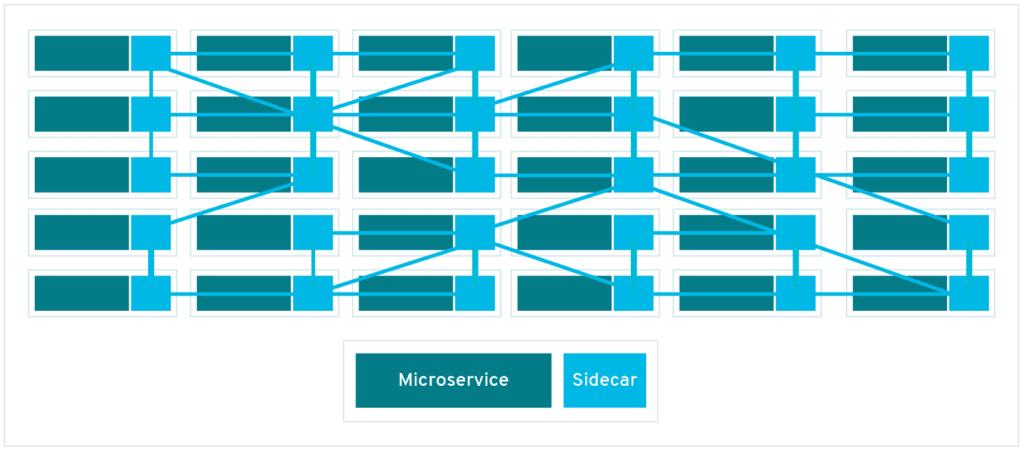
A service mesh architecture uses a proxy instance called a sidecar in whichever development paradigm is in use, typically containers and/or microservices. In a microservice application, a sidecar attaches to each service. In a container, the sidecar attaches to each application container, VM or container orchestration unit, such as a Kubernetes pod. Sidecars can take care of responsibilities that aren’t part of the main service, such as monitoring and security.
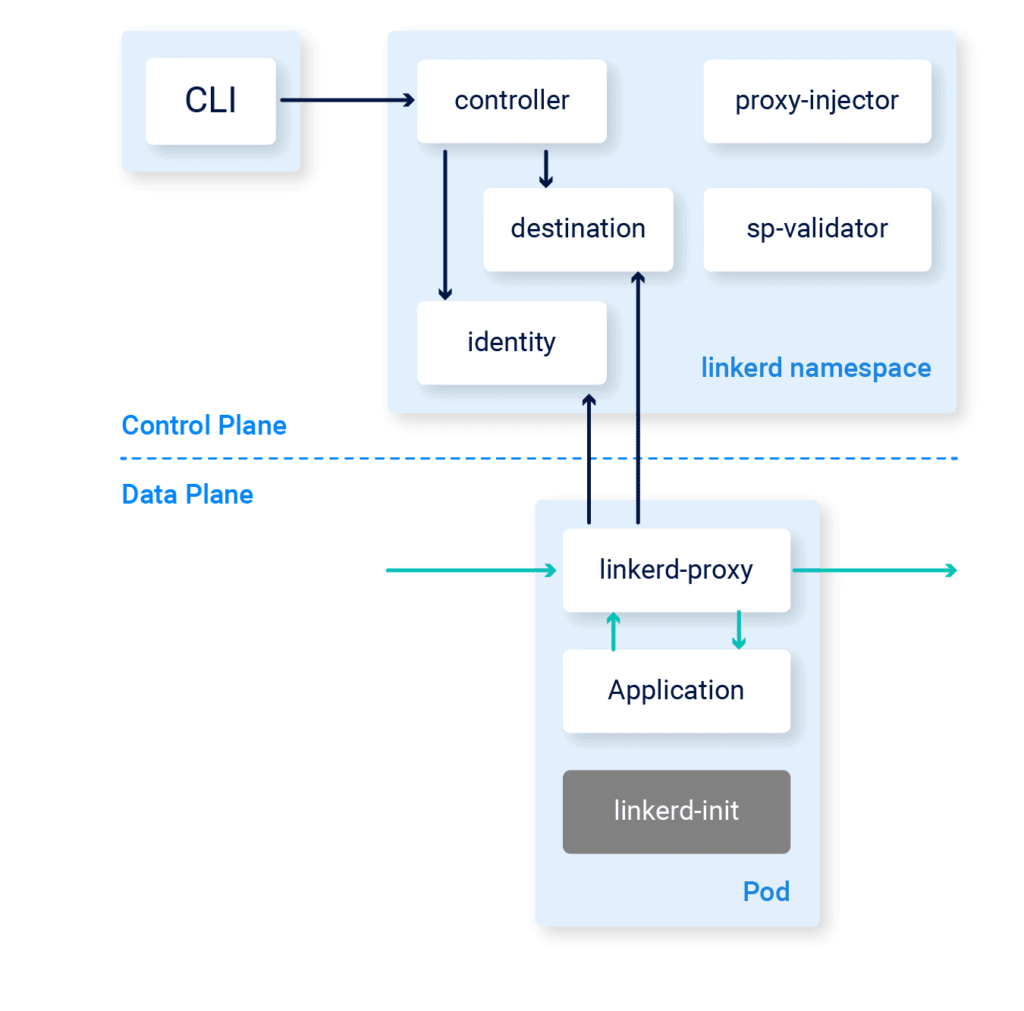
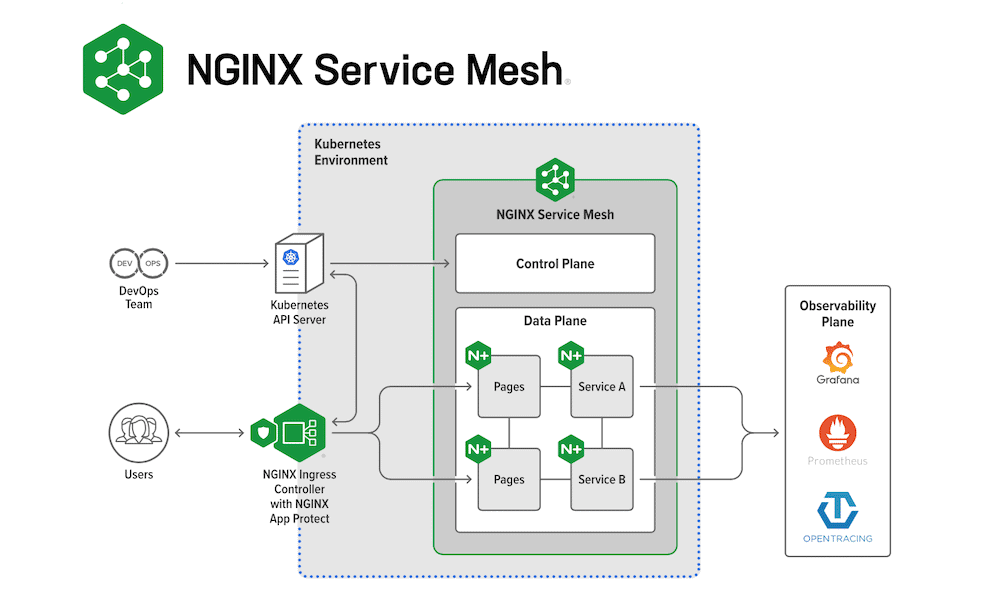
The data plane in a SM is made up of service instances, sidecars, and their interactions. The control plane is a separate layer that handles operations including generating instances, monitoring, and executing network management and security policies. For application management, control planes can link to a CLI or a GUI interface.
Source: RedHat
Why adopt it?
A microservices-based application may include dozens or even hundreds of services, each running in a live environment on its own instance. It’s difficult for developers to remember which components must communicate with one another, to maintain track of their health and performance, and to modify a service or component when something goes wrong.
Developers can isolate and control service-to-service connectivity in a specific infrastructure layer using a service mesh. The advantages of employing a service mesh to manage and monitor microservices engaged with an application grow along with the number of them.
Key features of a service mesh
A service mesh framework often includes a number of features that improve the reliability, security, and visibility of containerized and microservices communications.
Reliability: Service requests, rules, and settings are more efficient and reliable when communications are managed through sidecar proxies and the control plane. Load balancing and fault injection are two examples of specific capabilities.
Observability: Service mesh frameworks can reveal information about a service’s activity and health. To evaluate service health, the control plane can gather and aggregate telemetry data from component interactions, such as traffic and latency, distributed tracing, and access logs. Integration with third-party tools like Prometheus, Elasticsearch, and Grafana allows for even more monitoring and visualization.
Learn more about Observability
Security: Service mesh can automatically encrypt communications and transfer security policies from the network to the application and individual microservices, including authentication and permission. Using the control plane and sidecar proxies to centrally manage security policies allows you to keep up with the growing complexity of connections inside and across dispersed applications.
Advantages and disadvantages of service mesh
A service mesh addresses some, but not all, of the major challenges with managing service-to-service communication. The following are some of the advantages of it:
- Simplifies service communication in both microservices and containers.
- Communication failures are easier to identify since they occur on their own infrastructure layer.
- Encryption, authentication, and authorization are all supported security features.
- Allows for speedier application creation, testing, and deployment.
- Using sidecars adjacent to a container cluster to manage network services is a good idea.
The following are some of the disadvantages of it:
- Using a SM increases the number of runtime instances.
- Each service call must go via the sidecar proxy first, which adds an extra step.
- Integration with other services or systems, as well as routing type and transformation mapping, are not addressed by SMs.
Service mesh tools
According to a survey done in the middle of 2020, SM enterprise usage is still in its infancy and falls well behind that of containers. Based on poll responses, Istio, Linkerd, and HashiCorp Consul are the service meshes most commonly used in production.
Istio and Linkerd are more established in terms of service mesh adoption. Consul Connect, Kuma, AWS App Mesh, and OpenShift are just a few of the other alternatives. The following is a list of the top 5 service mesh tools:
1. Istio
Istio is a service mesh that was created by Google but is currently available as open source. It enables the connection, management, and security of microservices that interact with one another.
Source: istio.io
2. Linkerd
Linkerd is an open-source service mesh that runs on top of Kubernetes or a Mesos cluster and is meant for managing huge numbers of microservices in high-scale situations. It also delivers monitoring, tracing, routing, load balancing, and other features as well as automatic deployment upgrades across clusters
Source: linkerd.io
3. Consul connect
Hashicorp’s Consul connect is a service mesh solution. It was designed to facilitate service discovery, with the SM deployed on top of Consul, utilizing Consul Connect. This setup supports service discovery, configuration synchronization, and failure detection and can be implemented in production environments, whether Kubernetes is used or not.
4. Traefik Mesh
Traefik Mesh is a basic service mesh solution that is primarily used to balance the load. It is a plug-in for Traefik, a popular reverse proxy that assists in service discovery and routing across services in order to balance workloads.
5. Nginx Service Mesh (NSM)
Nginx service mesh is a lightweight service mesh for Kubernetes that provides encrypted traffic between containers in a zero-trust environment. It uses the data plane provided by Nginx Plus to control data traffic between containers.
Source: Nginx
Conclusion
A service mesh allows us to link microservices more quickly, easily, and reliably. Microservices, on the other hand, nearly always need to collaborate with other services and applications in order to build larger systems.
Frequently Asked Questions
What is a service mesh?
A service mesh is an infrastructure layer that manages service-to-service communication within a microservices architecture, providing features like load balancing, service discovery, and traffic management.
How does a service mesh work?
It typically uses a sidecar proxy pattern, where a lightweight proxy is deployed alongside each service instance to handle communication, allowing centralized management of traffic and policies.
What are the key features of a service mesh?
Key features include traffic management, service discovery, load balancing, failure recovery, observability (metrics, tracing), and security (encryption, authentication).
How does a service mesh improve security?
It provides features like mutual TLS for secure communication, fine-grained access control, and policies for encrypting traffic between services.
What is the difference between a service mesh and an API gateway?
A service mesh manages internal service-to-service communication, while an API gateway handles external traffic entering the system, providing a single entry point for clients.
What metrics should I monitor in a service mesh?
Key metrics include request latency, error rates, traffic volume, and service dependency maps, which help in diagnosing performance issues and understanding system health.
Related/References
- Visit our YouTube channel “K21Academy”
- Certified Kubernetes Administrator (CKA) Certification Exam
- (CKA) Certification: Step By Step Activity Guides/Hands-On Lab Exercise & Learning Path
- Certified Kubernetes Application Developer (CKAD) Certification Exam
- (CKAD) Certification: Step By Step Activity Guides/Hands-On Lab Exercise & Learning Path
- Create AKS Cluster: A Complete Step-by-Step Guide
- Container (Docker) vs Virtual Machines (VM): What Is The Difference?
- How To Setup A Three Node Kubernetes Cluster For CKA: Step By Step
Join FREE Masterclass of Kubernetes
Discover the Power of Kubernetes, Docker & DevOps – Join Our Free Masterclass. Unlock the secrets of Kubernetes, Docker, and DevOps in our exclusive, no-cost masterclass. Take the first step towards building highly sought-after skills and securing lucrative job opportunities. Click on the below image to Register Our FREE Masterclass Now!


![Microsoft Agentic AI Business Solutions Architect [AB-100] | K21 Academy](https://test.k21academy.com/wp-content/uploads/2025/11/Microsoft-Agentic-AI-Business-Solutions-Architect-AB-100-Exam-Overview1.png)