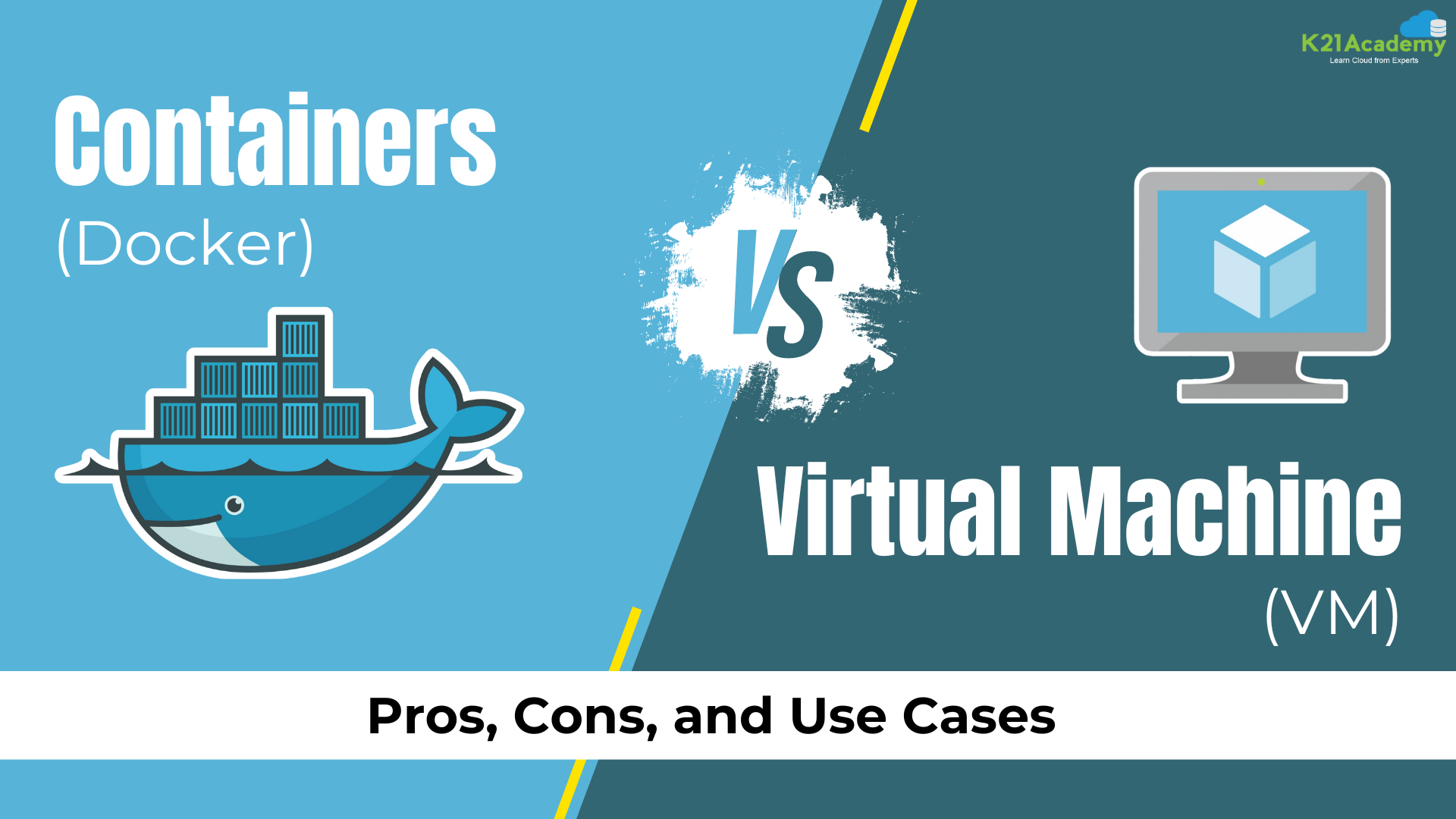



A couple of decades ago, it seemed impossible to run an application using just a tiny ~10 MB file. Today, Containers (Docker) and Virtual Machines (VMs) have made this possible, and understanding their differences is crucial for modern computing.
The development of VMs significantly enhanced our computing capabilities, allowing multiple OS instances to run on the same hardware.
In this blog, we’ll compare Containers and VMs, explaining their differences and highlighting their respective advantages.
Table of Contents
- Exploring Virtual Machines
- Virtual Machine: Architecture and Benefits
- Pros & Cons of VMs
- What Are Containers?
- How Do Containers Work?
- Pros & Cons of Containers
- Difference Between Physical Server and VM
- Container (Docker) vs Virtual Machine (VM)
- Conclusion: What is Better?
- Frequently Asked Questions
Note: We will refer to containers as Docker containers because they are widely used. Additionally, understanding Docker is essential for beginning your Kubernetes journey.
For a clear and concise explanation of Containers, check out this video. It covers the basics, architecture, and benefits of using Containers and Containerization, complementing the details in this blog.
Exploring Virtual Machines (VMs) ^

As server processing power and capacity increased over time, bare metal applications couldn’t fully utilize the new resources. This led to the invention of VMs, which solved many computing problems. A Virtual Machine is a software that emulates physical hardware or a computing system. In simple terms, a VM allows many separate computers to run on the hardware of a single computer.
VMs interact with physical computers using lightweight software layers called hypervisors. Hypervisors separate VMs from one another and allocate processors, memory, and storage between them. A VM may also include necessary system binaries and libraries to run applications. The host operating system (OS) is managed and executed through the hypervisor.
Virtual Machine’s Architecture and Benefits ^
Virtual machines (VMs) function through a structured architecture divided into four main components:
- Underlying System (Hardware/Infrastructure): This includes the physical machine and its operating system. Bare metal hypervisors operate directly on this layer without needing an additional OS.
- Hypervisor: Acting as an intermediary between hardware and infrastructure, the hypervisor manages and allocates resources.
- Multiple Virtual Machines: These utilize host resources and communicate with the hypervisor.
- Applications and Processes: These run on each guest OS within the VM.
 Architecture of a Virtual Machine
Proper configuration of the hypervisor precedes the deployment of virtual machines. Technologies like KVM, integrated into Linux, allow administrators to create VMs via command-line interfaces.
| Category | Pros | Cons |
|---|---|---|
| OS Environments | Enable multiple operating system environments on a single computer. | Running multiple VMs can lead to unstable performance. |
| System Reliability | Enhance system reliability by isolating crashes from the host OS. | VMs are generally less efficient and slower than physical machines. |
| Security | Provide security layers to prevent malware breaches on the host OS. | VMs can inherit vulnerabilities from the host machine. |
Popular VM providers:
VMware vSphere, Oracle VM VirtualBox, Xen, Microsoft Hyper-V, and Linux KVM.
What Are Containers? ^
Containers are like virtual compartments that can run software applications. Imagine them as small, self-contained boxes that hold everything an application needs to run smoothly, like the program itself and all the tools it requires.
Before containers became popular, Virtual Machines (VMs) were used. These were like complete computers within a computer, each running its operating system. While VMs are still important, containers are now widely used because they are much lighter and faster.
 Containers share the basic operating system of the computer they’re running on, which makes them very efficient. They are quick to start up and take up very little space, usually just a few megabytes. This efficiency makes them ideal for running anything from simple apps to large-scale software systems.
In essence, containers simplify how applications are managed and deployed, making them a popular choice in modern computing.
For more information about containers, Click Here
How Do Containers Work? ^
Containers need an operating system, along with supporting software and resources, to run a specific program. Inside a container, you can set up an environment template that ensures your application behaves consistently every time it runs.
 Architecture of a Container
Containers share the main operating system (called the “kernel”) of the computer they are on. Each container only needs the essential tools and libraries to function.
| Category | Pros | Cons |
|---|---|---|
| Lightweight | Containers can be very small, sometimes only 10MB, and you can control how much memory and processing power they use. | Dependency on Host OS: Containers rely on the main operating system of the host computer. |
| Fast Startup | Because they are small, containers start up quickly and can be scaled up (more containers added) quickly. | Security: Containers alone can’t provide strong security. |
| Great for CI/CD | Containers are perfect for Continuous Integration and Continuous Deployment, making it easier to update and release software. | Data Loss: If a container is deleted, any data inside it is lost unless you use Data Volumes to save the data. |
Popular Container Providers:
Docker, Rocket (rkt), Linux Containers (LXC), CRI-O, containerd.
Difference Between Physical Server And VM ^
A virtual machine (VM) acts as a copy of a physical computer. Virtual servers run multiple VMs on the same physical hardware in a multi-tenant environment, sharing resources. In contrast, a physical server usually runs a single application for a single user or tenant, with dedicated resources not shared with others.

| Aspect | Physical Host | Virtual Machines (VMs) |
| Performance | Dedicated to a single application, better performance | Shares resources among multiple applications, potentially lower performance |
| Cost | Expensive due to hardware/software upgrades and frequent failures | Cost-effective by distributing resources among multiple VMs |
| Disaster Recovery & High-Availability | Hard and costly to implement disaster recovery | Easier and more affordable, especially with cloud services in different regions |
| System Recovery | Restoring critical data/operations can take hours or days | Quick recovery using VM backups, minimizing downtime |
Containers (Docker) vs Virtual Machines (VM) ^
 When comparing Containers (like Docker) to Virtual Machines (VMs), the primary distinction lies in how they handle virtualization:
1. Operating System:
- VMs utilize a hypervisor to virtualize physical hardware, each running its own guest OS. This setup makes VMs heavier as they include both the OS and necessary hardware emulation.
- Containers, on the other hand, virtualize the operating system itself. They share the host OS kernel, resulting in lightweight instances containing only the application and its libraries.
2. Security:
- VMs offer strong isolation since each has its own OS, enhancing security by preventing direct interaction with the host kernel.
- Containers share the host OS kernel, posing potential security risks due to shared resources and dependencies.
3. Performance:
- Containers are lightweight and consume fewer resources compared to VMs, leading to better performance efficiency.
- VMs, being more resource-intensive due to their complete OS virtualization, typically exhibit lower performance efficiency.
4. Portability:
- Containers are highly portable because they do not require separate OS installations. This ease of portability facilitates deployment across different environments.
- VMs, with their self-contained OS installations, are less portable, making migration between different platforms more complex and time-consuming.

In essence, while VMs offer stronger isolation and security through complete OS virtualization, Containers prioritize lightweight efficiency and enhanced portability by leveraging shared OS resources. Each approach serves distinct needs based on application requirements and infrastructure considerations.
| Comparison | Container | Virtual Machines (VMs) |
| Boot-Time | Boots in a few seconds. | Takes a few minutes to boot. |
| Runs on | Uses the execution engine. | Uses the hypervisor. |
| Memory Efficiency | No need to virtualize, hence uses less memory. | Requires loading the entire OS before starting, hence less efficient. |
| Isolation | Prone to issues as there are no built-in isolation mechanisms. | Minimal interference due to efficient isolation mechanisms. |
| Deployment | Easy to deploy with a single containerized image usable across all platforms. | Deployment is lengthy as separate instances are needed for execution.. |
| Performance | Limited performance. | Offers native performance. |
To summarize everything we’ve covered about virtualization and containers in this blog, check out this short video. It sums up the differences and advantages of each in an easy-to-understand way.
Containers vs Virtual Machines: Conclusion and Future Outlook ^
Docker containers have become very popular for their fast startup times, efficient resource use, and easy integration with CI/CD processes. They are ideal for modern applications and scalable cloud-native services.
While some companies still use VMs for their security and isolation features, Docker is quickly becoming the preferred choice. Containers offer the flexibility and efficiency needed for today’s fast-paced development environments.
As more businesses adopt Docker and Kubernetes, containers are shaping the future of application deployment. For most modern needs, Docker is the way forward.
Frequently Asked Questions
Q1) How do Containers enhance the Continuous Integration and Continuous Deployment (CI/CD) process?
A)Containers make the CI/CD process much smoother by ensuring that the environment in which an application is developed, tested, and deployed remains consistent. This consistency solves the common problem of an application working on a developer's machine but failing elsewhere. Containers allow for rapid deployment and rollback, which means updates can be made quickly and issues can be fixed without delay. This reliability and speed are key for maintaining an effective CI/CD pipeline.
Q2) What are the primary security concerns when using Containers, and how can they be mitigated?
A) Containers have some security concerns because they share the host system’s kernel, which can lead to vulnerabilities. To reduce these risks, it's crucial to use trusted base images and keep them updated. Additionally, implementing strong access controls and using security tools to scan for vulnerabilities can help. Monitoring container activities with runtime security tools can also prevent unauthorized access and actions, adding an extra layer of protection.
Q3) Why might an organization choose Virtual Machines over Containers despite the latter's advantages?
A) An organization might choose Virtual Machines (VMs) over Containers for a few reasons. VMs provide stronger isolation because they run their own operating system, which can be crucial for security. Some older applications are designed to work with a full OS and might not be compatible with container environments. Additionally, certain industries have strict compliance requirements that VMs are better suited to meet due to their isolation and control capabilities.
Q4) How does the hypervisor in a Virtual Machine environment affect overall system performance and resource allocation?
In a VM environment, the hypervisor is a key component that manages resource allocation and ensures each VM runs independently. While this enables efficient use of physical hardware, the hypervisor also introduces some overhead, which can affect overall system performance. The type of hypervisor used and its configuration play a significant role in minimizing this impact, ensuring that resources are allocated effectively to maintain optimal performance.
Q5) What are the challenges of scaling applications with Containers compared to Virtual Machines?
A) Scaling applications with Containers involves managing many small, lightweight instances that can start and stop quickly. This provides flexibility and efficiency but also introduces complexity in orchestration, networking, and security. Tools like Kubernetes are essential to handle this complexity. On the other hand, scaling with VMs usually requires more significant resource allocation and longer setup times. Despite this, the stability and isolation provided by VMs can be beneficial for certain workloads and environments.
Related References
- Docker Tutorial for Beginners:
- Docker Architecture, Docker Engine Components, Container Lifecycle
- Docker Images: A Complete Guide For Beginners
- Learn Docker in 5 Hours
- Docker Networking | Introduction to Docker Network
- Kubernetes vs Docker – Understand the Difference
- Certified Kubernetes Administrator (CKA) Certification Exam
Next Task For You
Discover the Power of Kubernetes, Docker & DevOps – Unlock the secrets of Kubernetes, Docker, and DevOps in our exclusive, no-cost masterclass. Take the first step towards building highly sought-after skills and securing lucrative job opportunities. Click on the below image to Register Our FREE Masterclass Now!


![Microsoft Agentic AI Business Solutions Architect [AB-100] | K21 Academy](https://test.k21academy.com/wp-content/uploads/2025/11/Microsoft-Agentic-AI-Business-Solutions-Architect-AB-100-Exam-Overview1.png)