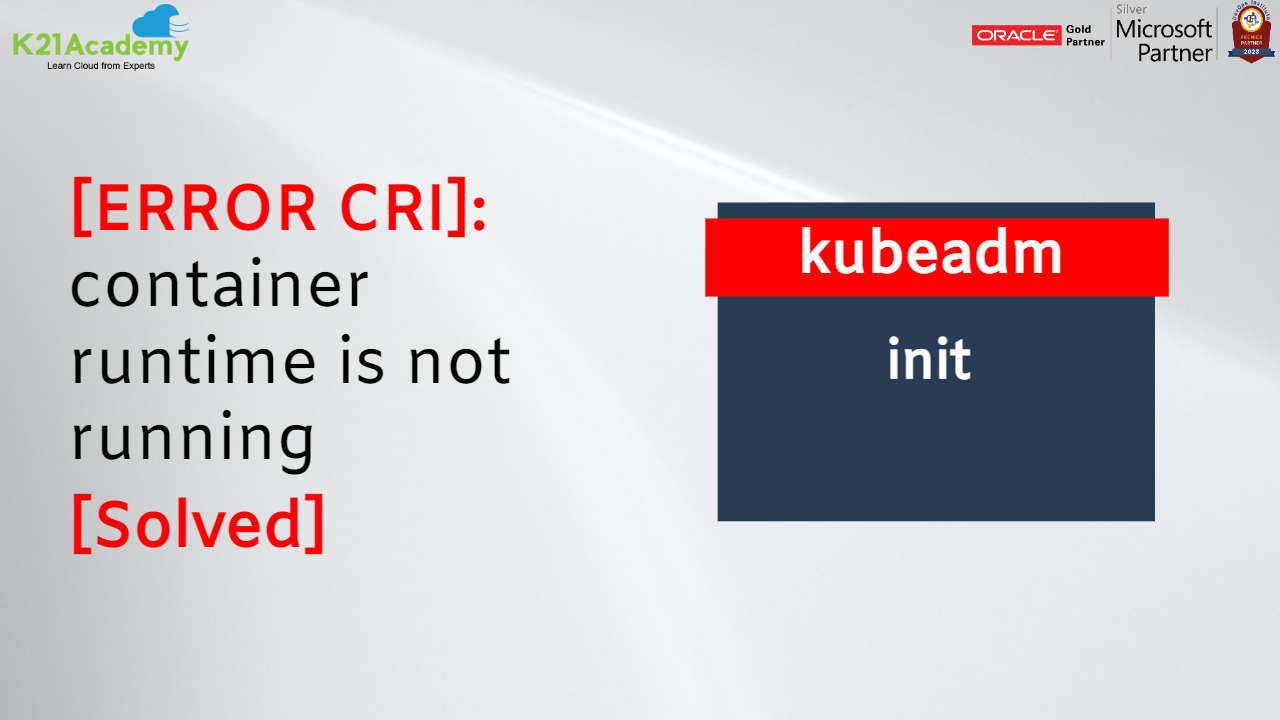


This blog post covers the issue and fix that very few of us encountered while performing the kubeadm init command. We often encounter the [Error CRI]: container runtime is not running during kubeadm init.
The complete error may look like the following, along with a warning sometimes.
$ kubeadm init

[WARNING Firewalld]: firewalld is active, please ensure ports [6443 10250] are open or your cluster may not function correctly
error execution phase preflight: [preflight]

Some fatal errors occurred: [ERROR CRI]: container runtime is not running Status from runtime service failed” err=”rpc error: code = Unimplemented desc = unknown service runtime.v1alpha2.RuntimeService”
[ERROR CRI]: container runtime is not running [Issue Encountered]
This is a common issue when you run the kubeadm init command while the CRI used is Containerd. In most cases, the issue is with the config.toml file.
Fix the Error
To fix the error you can delete the config.toml file and restart containerd then try the init command like below:
$ rm /etc/containerd/config.toml
$ systemctl restart containerd
$ kubeadm init
For the [WARNING Firewalld]: firewalld is active, please ensure ports [6443 10250] are open or your cluster may not function correctly, It seems that firewalld, a dynamic daemon to manage firewalls, is active on your system. This could potentially block communication between the nodes in your Kubernetes cluster. To resolve this issue, you need to ensure that the necessary ports are open in the firewall.
Also Check: Our previous blog post on How To Setup A Multi-Node Kubernetes Cluster on SUSE Linux
To enable the fulfillment of their tasks, nodes, containers, and pods must communicate across the cluster. Please use the following commands to open the listed ports.
Enter the following commands on the Master Node:
$ sudo firewall-cmd --permanent --add-port=6443/tcp
$ sudo firewall-cmd --permanent --add-port=2379-2380/tcp
$ sudo firewall-cmd --permanent --add-port=10250/tcp
$ sudo firewall-cmd --permanent --add-port=10251/tcp
$ sudo firewall-cmd --permanent --add-port=10252/tcp
$ sudo firewall-cmd --permanent --add-port=10255/tcp
$ sudo firewall-cmd –reload
Each time a port is added the system confirms with a Success message.

Enter the following commands on each worker node:
$ sudo firewall-cmd --permanent --add-port=10251/tcp
$ sudo firewall-cmd --permanent --add-port=10255/tcp
$ firewall-cmd --reload
You can also check a discussion thread on GitHub form here
To Download Kubernetes CKA Sample Exam Questions, Click here.
Frequently Asked Questions
What is kubeadm init?
kubeadm init is a command used to bootstrap a Kubernetes cluster. It initializes a master node and sets up the Kubernetes control plane components.
How do I use kubeadm init to set up a Kubernetes cluster?
You can use the kubeadm init command along with various flags to customize your Kubernetes cluster's configuration. For instance, you can specify the Pod network CIDR, the API server advertise address, or the token for joining nodes.
What is containerd?
containerd is an industry-standard core container runtime. It provides a reliable and high-performance runtime with an emphasis on simplicity, robustness, and portability.
How is containerd used in Kubernetes?
containerd is one of the container runtimes that can be used with Kubernetes. Kubernetes can be configured to use containerd as the container runtime instead of Docker. This allows for better integration with the Kubernetes ecosystem and provides more flexibility in managing containers.
Related Post
- [Solved] The connection to the server localhost:8080 was refused – did you specify the right host or port?
- [Solved] Error from server (ServiceUnavailable): the server is currently unable to handle the request (get nodes.metrics.k8s.io)
- How To Setup A Three Node Kubernetes Cluster For CKA: Step By Step
- Certified Kubernetes Administrator (CKA): Step-by-Step Activity Guide (Hands-on Lab)
- CKA Certification Exam (Certified Kubernetes Administrator)
- Kubernetes for Beginners – A Complete Beginners Guide
- Kubernetes Dashboard: An Overview, Installation, and Accessing
- CKA/CKAD Exam Questions & Answers 2022
- Docker Container Lifecycle Management: Create, Run, Pause, Stop And Delete
- CKA vs CKAD vs CKS – Differences & Which Exam is Best For You?
- Etcd Backup And Restore In Kubernetes: Step By Step
Join FREE Class
Discover the Power of Kubernetes, Docker & DevOps – Join Our Free Masterclass. Unlock the secrets of Kubernetes, Docker, and DevOps in our exclusive, no-cost masterclass. Take the first step towards building highly sought-after skills and securing lucrative job opportunities. Click on the below image to Register Our FREE Masterclass Now!


![Microsoft Agentic AI Business Solutions Architect [AB-100] | K21 Academy](https://test.k21academy.com/wp-content/uploads/2025/11/Microsoft-Agentic-AI-Business-Solutions-Architect-AB-100-Exam-Overview1.png)