


In the evolving world of artificial intelligence (AI), pre-trained models provide a valuable shortcut, enabling developers to integrate advanced capabilities without the need for extensive expertise in AI or machine learning. Google Cloud Platform (GCP) offers a suite of pre-trained APIs that cover a wide range of functionalities, making it easier for businesses to enhance their applications with powerful.
In this Blog we will Cover:
- What Are GCP Pre-Trained APIs?
- Key Features of GCP Pre-Trained APIs
- What are the Main Categories of Pre-Trained APIs in Google Cloud Platform (GCP)
- Example: How To Use Prebuild Vision API
- Conclusion
What Are GCP Pre-Trained APIs?
GCP’s pre-trained APIs are AI models that Google has developed and trained on vast datasets. These models are designed to perform specific tasks such as image recognition, language translation, and speech-to-text conversion. These APIs offer businesses the ability to leverage state-of-the-art AI without the need for building models from scratch, allowing faster time-to-market and reduced development costs.
Key Features of GCP Pre-Trained APIs
- Ease of Use: GCP pre-trained APIs provide a simple interface for developers, allowing them to call powerful AI functions with minimal setup.
- Scalability: These APIs are built on Google’s robust cloud infrastructure, ensuring that they can handle scaling demands as application usage grows.
- High Accuracy: Trained on vast and diverse datasets, these APIs offer high levels of accuracy, providing reliable results across a variety of use cases.
- Integration with Other GCP Services: GCP pre-trained APIs seamlessly integrate with other Google services like Cloud Storage, Big Query, and Vertex AI, enabling a smooth end-to-end development experience.
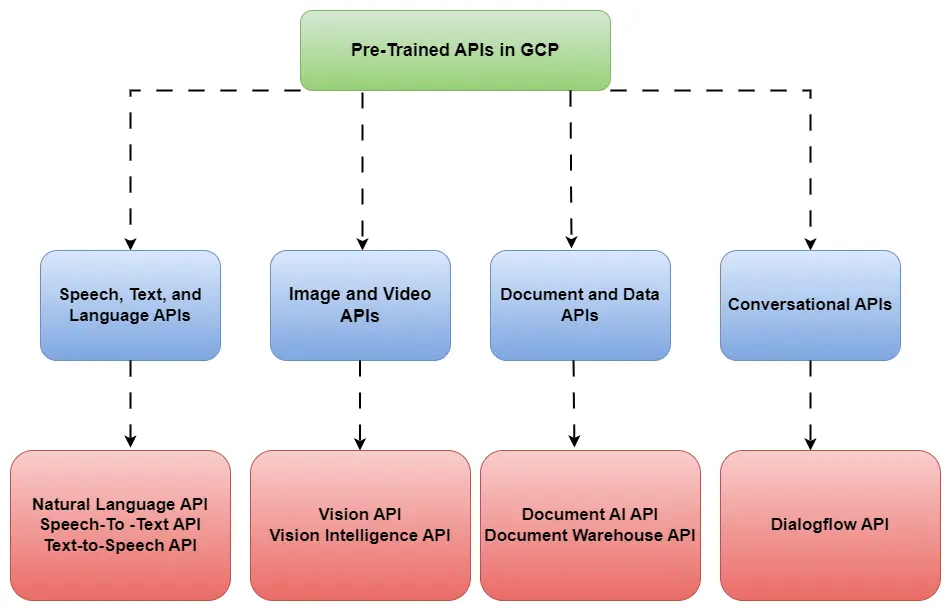
What are the Main Categories of Pre-Trained APIs in Google Cloud Platform (GCP)
Speech, Text, and Language APIs
These APIs focus on processing human language and speech, providing capabilities such as speech transcription, text-to-speech conversion, and natural language understanding. They enable applications to understand, interpret, and generate human language.
- Use Case: Automated Transcription for Media Companies
- How API helps : News organizations and media companies use the Speech-to-Text API to transcribe interviews, press conferences, and podcasts. This enables them to quickly generate text content from audio files, making it easier to create articles, improve SEO, and enhance accessibility for hearing-impaired audiences.
Image and Video APIs
These APIs provide tools for analyzing and processing visual data, allowing developers to integrate image and video analysis features into their applications. They enable capabilities such as object detection, facial recognition, and video content analysis.
- Use Case: Content Moderation for Social Media Platforms
- How API helps: Social media platforms like Facebook and Instagram utilize the Vision API for automatic content moderation. The API detects and flags inappropriate images or videos, ensuring that the platform adheres to community guidelines and enhancing user safety by preventing the sharing of harmful content.
Document and Data APIs
These APIs are designed to automate the extraction, processing, and management of data within documents. They use AI to convert unstructured data into structured information, making it easier to integrate document handling and data management capabilities into business applications.
- Use Case: Invoice Processing in Financial Services
- How API helps: Financial institutions leverage the Document AI API to automate the extraction of data from invoices. This reduces manual data entry, speeds up accounts payable processes, and enhances accuracy, allowing businesses to process payments faster and maintain better cash flow management.
Conversational APIs
These APIs are specialized for building intelligent chatbots, virtual agents, and voice applications. They leverage natural language understanding and machine learning to provide responsive, contextual interactions with users, improving customer support and user engagement.
- Use Case: Virtual Customer Assistants in E-commerce
- How API helps: Retailers like Sephora use conversational APIs to build virtual shopping assistants. These chatbots guide customers through product selections, answer questions about orders, and provide personalized recommendations based on user preferences, thereby enhancing the shopping experience and increasing customer satisfaction.
To know More About : Vertex AI in GCP
Example: How To Use Prebuild Custom Vision API
1. Navigate to Custom Vision Api pretrained by Google. You can directly test the Api with your own files.

2. You can Directly Upload Images from Your Local system to test with Pretrained-Vision Api, Upload an image from The system to test
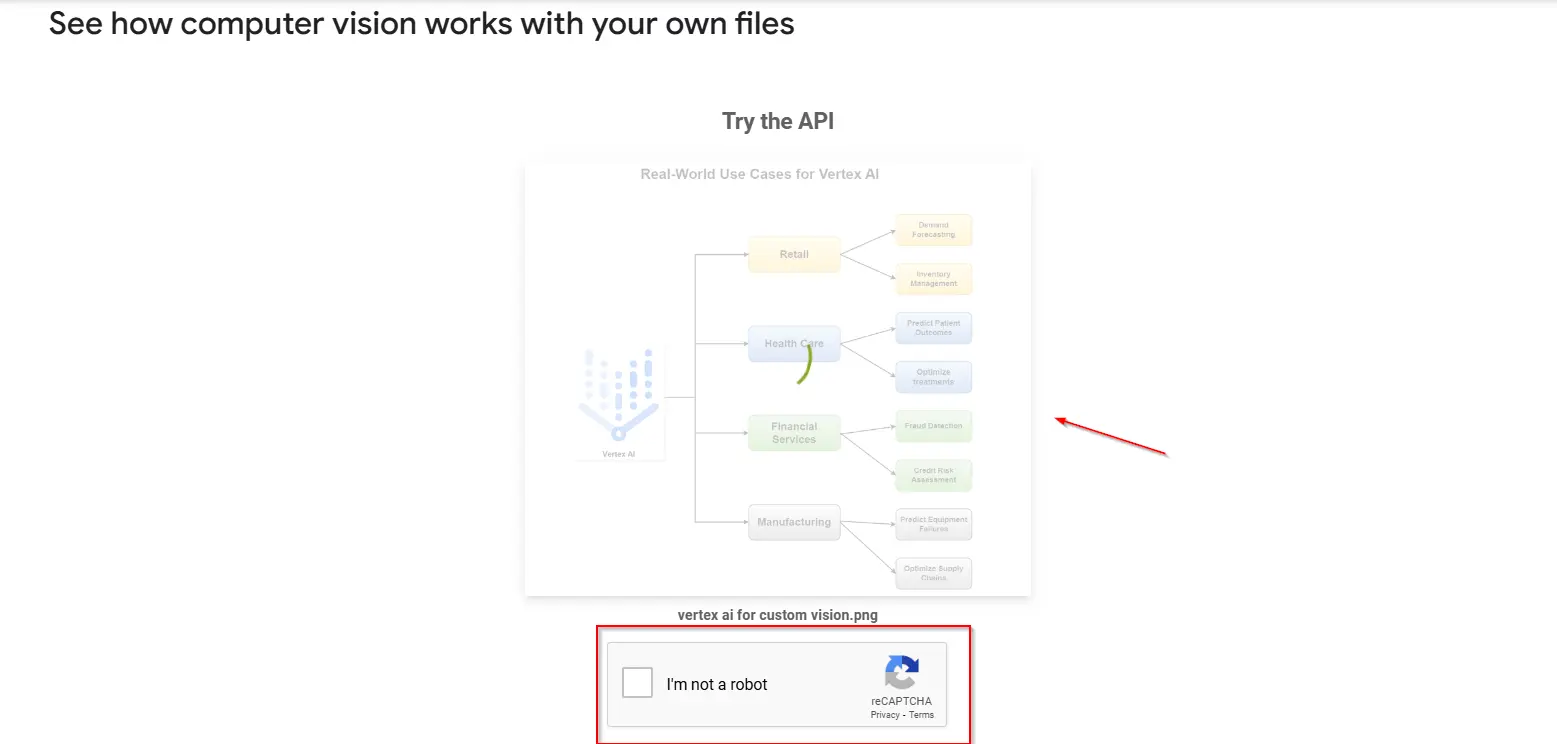
3. After Testing an Image we can see its properties, In pretrained API you will get Different Parameters to Check, Labels, Text, Properties, Safe Search. You can check them Accordingly.
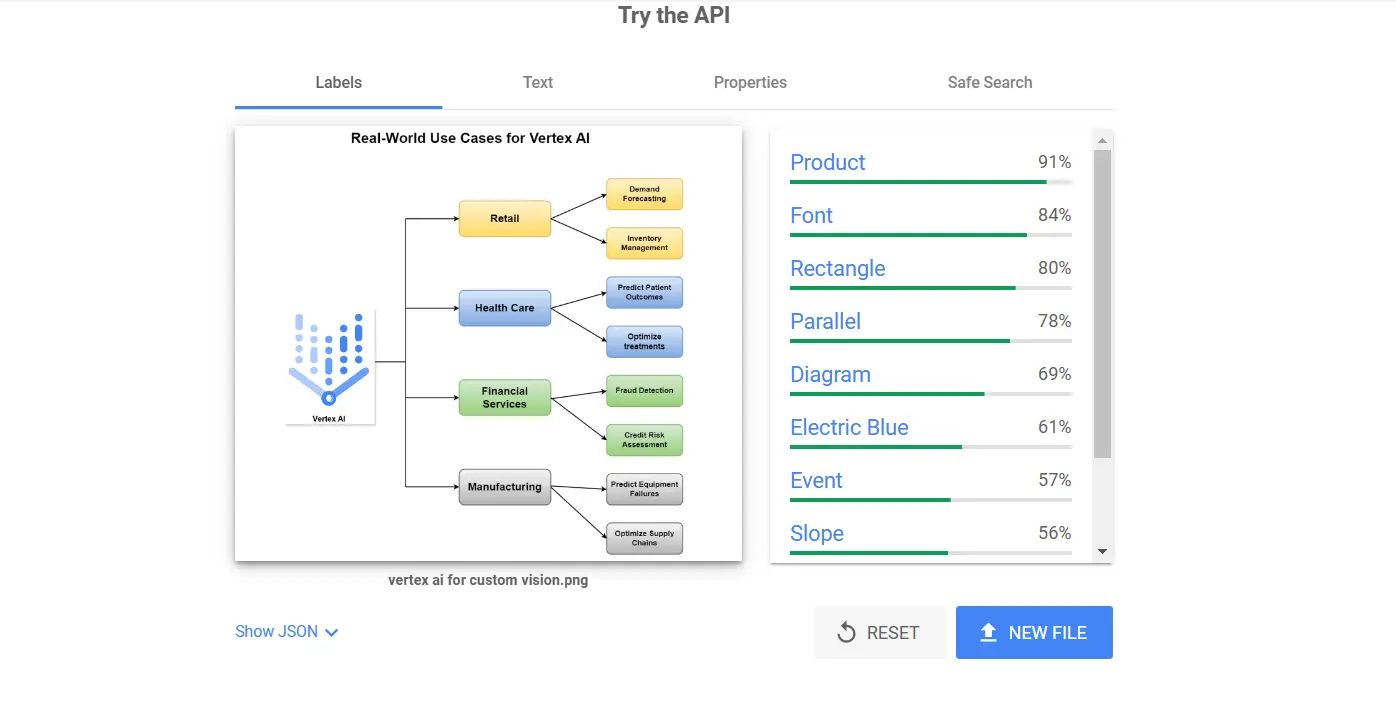
4. If you Directly want to extract text from the images you can click on the Text , it will Display the complete text that was present in the Images.

This way we can test the Pre-trained custom Vision Apis.
Conclusion
GCP’s pre-trained APIs are powerful tools that allow developers to add AI capabilities to their applications without building models from the ground up. From image recognition to language translation, these APIs streamline development processes and reduce time-to-market, providing scalable and efficient solutions for businesses of all sizes. Whether you’re an experienced developer or new to AI, GCP pre-trained APIs offer a gateway to harnessing the power of machine learning. By integrating these tools, you can focus on innovating and enhancing user experiences while Google Cloud handles the complexities of AI model development and scaling.
Frequently Asked Questions
What are pre-trained API models in GCP?
Pre-trained API models in GCP are AI services developed and trained by Google using large datasets. They provide developers with out-of-the-box capabilities like image recognition, natural language understanding, and speech-to-text conversion without needing to build or train models from scratch.
Can I customize the pre-trained models in GCP?
Yes, some GCP APIs, like AutoML, allow you to fine-tune models using your own datasets. This customization helps improve model performance based on specific use cases or requirements.
Are GCP’s pre-trained APIs secure?
Yes, GCP’s pre-trained APIs come with built-in security features, such as data encryption and access controls. They also comply with industry regulations (e.g., GDPR) to ensure data privacy and integrity.
Can these APIs be integrated with other GCP services?
Yes, GCP’s pre-trained APIs are designed to work seamlessly with other GCP services, such as Cloud Storage, BigQuery, and Vertex AI, enabling comprehensive, end-to-end solutions.
Do I need AI expertise to use these pre-trained APIs?
No, you don’t need advanced AI expertise. GCP’s pre-trained APIs are designed with simple interfaces and extensive documentation, making it easy for developers of any skill level to integrate AI capabilities into their applications.
Related References
- Join Our Generative AI Whatsapp Community
- Google Cloud Professional Machine Learning Engineer Certification: Everything You Need to Know
- Google AI/ML: Step-by-Step Activity Guide (Hands-on Lab) & Project Work for getting a higher paying Job & Certifications
- Introduction to AI/ML Services in Google Cloud Platform (GCP)
- Simplifying Machine Learning with Google Cloud Vertex AI: Key Tools & Real-World Applications
- Introduction to Generative AI and Its Mechanisms
- Mastering Generative Adversarial Networks (GANs)
- Generative AI (GenAI) vs Traditional AI vs Machine Learning (ML) vs Deep Learning (DL)
Next Task For You
Don’t miss our Exclusive Free Training on Mastering Google AI/ML and Generative AI. Gain expertise in advanced AI and Machine Learning technologies using Google’s powerful tools. Join a thriving community of learners and take the next step in advancing your career. Click the image below to reserve your spot!


![Microsoft Agentic AI Business Solutions Architect [AB-100] | K21 Academy](https://test.k21academy.com/wp-content/uploads/2025/11/Microsoft-Agentic-AI-Business-Solutions-Architect-AB-100-Exam-Overview1.png)