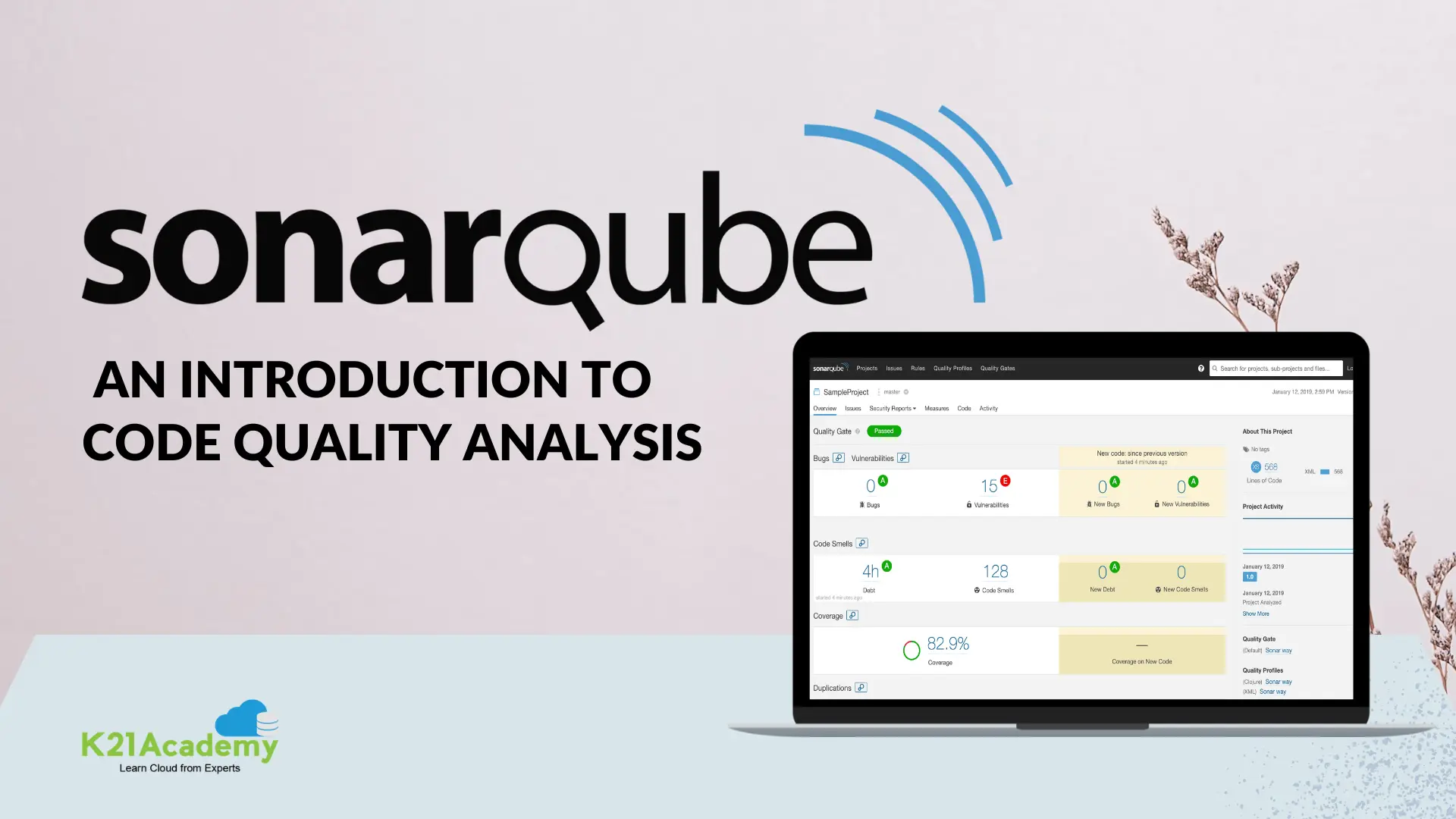




In the ever-evolving landscape of software development, ensuring code quality remains paramount. One powerful tool that has emerged as a cornerstone in this endeavor is SonarQube. With its comprehensive code analysis capabilities, SonarQube empowers developers to detect and rectify code issues early in the development cycle, leading to more robust, maintainable, and secure software.
This blog will explore:
- What is SonarQube?
- Features Of SonarQube
- Software Quality Measurement
- Dynamic Code analysis
- Static code analysis
- SonarQube Benefits
- Conclusion
- FAQs

What is SonarQube?
SonarQube is a comprehensive code quality management platform that conducts static and dynamic analysis of source code. It meticulously examines every aspect of the codebase, from minor styling choices to critical design errors, providing developers with actionable insights to enhance code quality continuously.
- SonarQube is an open source platform developed by SonarSource for continuously code quality control.
- It supports 30 major programming languages with various plugins.
- It acts as a code inspector, analyzing code to identify bugs, errors, problems, errors, duplications, and security vulnerabilities.
- SonarQube is developed using the Java programming language.
- Think of it as a digital assistant that helps programmers create reliable and secure software.
- SonarQube provides integration with various build tools such as Maven, Ant, Gradle, MSBuild and continuous integration (Azure DevOps, Atlassian Bamboo, Jenkins, Hudson, etc.
Features of SonarQube
- Comprehensive Analysis: SonarQube delves deep into the codebase, inspecting each layer from module to class level. It identifies various issues such as code duplication, lack of test coverage, and complex code structures.
- Code Reliability and Security: By flagging potential bugs, security vulnerabilities, and code smells, SonarQube helps enhance code reliability and fortify application security.
- Technical Debt Reduction: SonarQube assists in reducing technical debt by identifying and addressing areas of code complexity, duplication, and insufficient test coverage.
- Language Support: With support for over 27 programming languages including C, C++, Java, JavaScript, PHP, Python, and more, SonarQube caters to diverse development environments
- Continuous Improvement: By enabling continuous measurement of code quality over time, SonarQube facilitates ongoing improvement efforts. Its rich history of code analysis allows developers to track progress and identify trends.
- Code Reliability and Security: SonarQube ensures code reliability and security by identifying vulnerabilities and potential security threats early in the development cycle. It helps in reducing technical debt by promoting clean and maintainable code practices.
- CI/CD Integration: SonarQube seamlessly integrates with CI/CD pipelines, providing feedback during code review with branch analysis and pull request decoration. This integration streamlines development workflows and enhances collaboration among team members.
Software Quality Measurement
When creating software, the code should have the following characteristics:
- The code should follow a specific convention
- The code should be following established good practices and have been followed
- Checked for potential bugs and performance, security, or vulnerabilities issues
- Is the code duplicated anywhere
- Does the code make logical sense, or is it too complex
- Does the public API have good documentation and comments
- Does the code have unit tests
- Doe the code follow good software design and architecture principles.
Dynamic code analysis
Code Analysis relies on studying how the code behaves during execution. The objective is to find errors in a program while it is running, rather than by repeatedly examining the code offline. Some things that Dynamic code analysis does are
- Code Coverage: Computing how much a piece of code gets tested by test suites
- Memory error detection: Checking whether or not memory leaks or errors occur
- Fault localization: Locating the buggy code to a specific location
- Invariant Inference: Observes the values that the program computes, and then report properties that were true over the observed executions, and this likely true over all executions.
- Security Analysis: Detect security problems.
- Concurrency errors: Dynamic Uses runtime error detection to expose defects such as race conditions, exceptions, resource and memory leaks, and security attack vulnerabilities
- Program slicing: Consists of reducing the program to the minimum form that still produces the selected behavior.
- Performance Analysis: dynamically tracing software applications at runtime and captures data that can be used to analyze and identify the causes of poor performance.
Static Code Analysis
Static code analysis is done without executing any of the code. It is a collection of algorithms and techniques to analyze source code to automatically find potential errors and poor coding practices. This is done with compiler errors and run-time debugging techniques such as white box testing. Static code analysis is also considered a way to automate code review process. The tasks involved in static code analysis can be divided as such:
- Detecting errors in programs
- Recommendations on code formatting with a formatter
- Metrics computation, which gives you back a rating on how well your code is.
SonarQube Benefits
So, why we need SonarQube?
- So why not just existing and proven tools and configure them in the CI server ourselves? Well for SonarQube there are a lot of benefits:
- CI tools do not have a plugin which would make all of these tools work easily together
- CI tools do not have plugins to provide nice drill-down features that SonarQube has
- CI Plugins does not talk about overall compliance value
- CI plugins do not provide managerial perspective
- There is no CI plugin for Design or Architectural issues
- CI plugins do not provide a dashboard for overall project quality
Conclusion
SonarQube empowers developers to elevate their code quality standards and build robust, maintainable software. Its comprehensive analysis capabilities, coupled with actionable insights, make it an indispensable tool for modern development teams striving for excellence.By incorporating SonarQube into their development processes, teams can proactively address issues, mitigate risks, and deliver high-quality software that meets the demands of today’s dynamic market. Embrace SonarQube, and unlock the full potential of your codebase.
FAQs
What is code quality analysis?
Code quality analysis is the process of evaluating and assessing the quality of software code based on various criteria such as readability, maintainability, efficiency, and adherence to coding standards and best practices.
How does SonarQube differ from other code quality tools?
SonarQube offers a comprehensive set of features and capabilities for code quality analysis, including support for a wide range of programming languages, customizable rulesets, and integrations with popular development tools. Its open-source nature and active community make it a popular choice among developers.
Is SonarQube suitable for small development teams?
Yes, SonarQube is suitable for development teams of all sizes. Its scalability and flexibility make it adaptable to the needs of small, medium, and large organizations alike.
Can SonarQube detect all types of code issues?
While SonarQube is proficient at detecting a wide range of code issues, including bugs, vulnerabilities, and code smells, it may not catch every possible issue. Manual code reviews and human judgment are still essential for comprehensive code quality assurance.
Is SonarQube only for specific programming languages?
No, SonarQube supports a wide range of programming languages, including Java, C/C++, C#, JavaScript, Python, and Ruby, among others. This versatility makes it suitable for diverse development environments and technology stacks.
Related/References
- [DOFD] DevOps Foundation Certification Exam: Everything You Need To Know
- [AZ-400] Microsoft Azure DevOps Certification Exam: Everything You Need To Know
- [AZ-400] Roles and Responsibilities As An Azure DevOps Engineer
- Certified Kubernetes Administrator (CKA) Certification Exam: Everything You Must Know
Next Task For You
Begin your journey towards becoming a DevOps Expert and earn a lot more by landing a high-paying job.
Join FREE CLASS to learn more about the DevOps Roles and Responsibilities, Job opportunities related to DevOps in the market, and what to study Including Hands-On labs and projects you must perform to get your Dream job.
Click on the below image to Register for Our FREE Class on Mastering DevOps on Cloud: How to Build In-Demand Skills and Land High-Paying Jobs


![Microsoft Agentic AI Business Solutions Architect [AB-100] | K21 Academy](https://test.k21academy.com/wp-content/uploads/2025/11/Microsoft-Agentic-AI-Business-Solutions-Architect-AB-100-Exam-Overview1.png)