

This blog post is the eighth blog Microsoft Azure Fundamentals Certification Series(AZ-900) of Topic 2: Core Cloud Services.
Read our blog if you have not gone through the previous Topic 2.3 Azure Core Services: Compute, Network, Storage & Database.
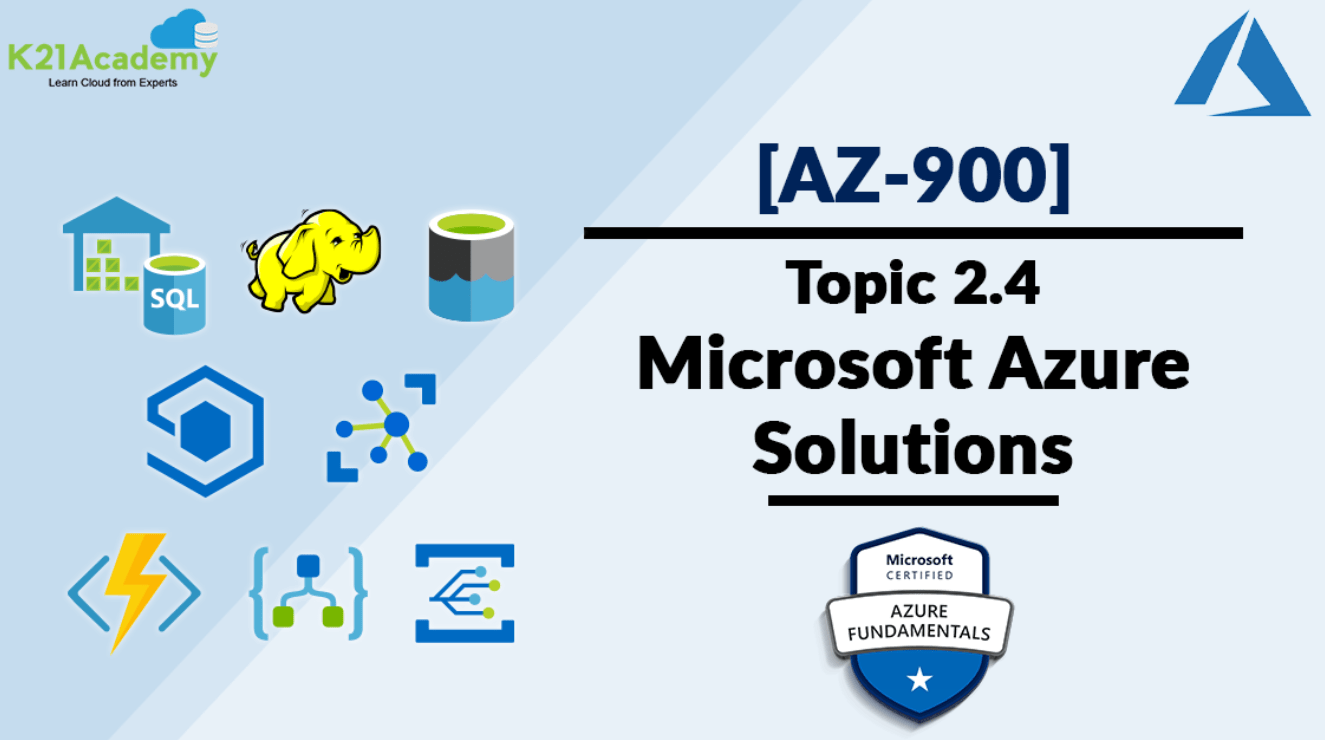
In this blog post, we’ll cover Topic 2.4 Microsoft Azure Solutions which includes IoT, Big Data Analysis, Machine Learning & Serverless.
Azure IoT
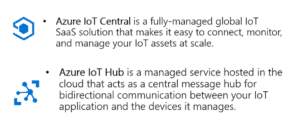
- The Azure Internet of Things (IoT) is a collection of Microsoft-managed cloud services that connect, monitor, and control billions of IoT assets.
- An IoT solution is made up of one or more IoT devices that communicate with one or more back-end services hosted in the cloud.
- Azure Majorly offers two IoT services: Azure IoT Central & Azure IoT Hub.
Note: An IoT Device is typically made up of a circuit board with sensors attached that use WiFi to connect to the internet.
Azure Big Data Analytics
- Big Data refers to the huge amount of data that you cannot analyze through conventional means in the desired time frame.
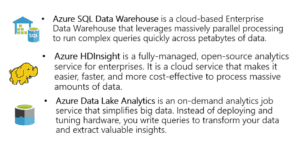
- Azure offers various Big Data Analytics services depending on the use case such as Azure SQL Data Warehouse aka Azure Synapse Analytics, Azure HDInsight, Azure Data Lake Analytics, Azure Databricks, etc.
Note: Azure SQL Data Warehouse is used for storing the relational database.
Note: Blobs can also be used to store big data.
Also check: Microsoft Free Certification in Microsoft Ignite 2020
Azure Machine Learning & Artificial Intelligence
- Through AI, machines can analyze images, comprehend speech, interact in natural ways & make predictions using data, and imitate intelligent human behavior.
- Azure machine learning services allow you to create, test, manage, deploy, migrate, or monitor ML models in a scalable cloud-based environment.
- You can train your model over the local machine and then deploy it on the cloud.
- Azure offers computing services like Azure Databricks, Azure Machine Learning Compute, and advanced hyperparameter tuning services.
- Azure Azure Databricks is a fully managed, fast, easy and collaborative Apache Spark-based analytics platform
- Azure Machine Learning is a Python-based machine learning service with automated machine learning and edge deployment capabilities.
- ONNX is an open-source model format and runtime for machine learning which enables you to easily move between the frameworks and hardware platforms of your choice.
- Azure Machine Learning Studio is a GUI-based integrated development environment for constructing and operationalizing Machine Learning workflow.
Check out: Everything you need to know about Microsoft Azure Dashboard
Azure Serverless
- Serverless computing enables developers to build applications faster by eliminating the need for them to manage infrastructure.
- With serverless applications, the cloud service provider automatically provisions, scales and manages the infrastructure required to run the code.
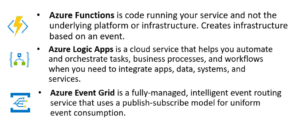
- Azure Serverless solutions are divided into various platforms. Some services for serverless compute are Azure Functions, Azure App Service & Serverless Kubernetes and workflow & integration are Azure Logic Apps & Azure Event Grid.
Sample Questions
Here are a few sample questions from the Microsoft Azure Fundamentals Certification Exam[AZ-900] that you should be able to solve after reading this blog.
Q1: Your company plans to deploy an Artificial Intelligence (AI) solution in Azure. What should the company use to build, test, and deploy predictive analytics solutions?
A. Azure Logic Apps
B. Azure Machine Learning Studio
C. Azure Batch
D. Azure Cosmos DB
Correct Answer: B
Explanation: Azure Machine Learning Studio offers a development environment for constructing and operationalizing Machine Learning workflow
Q2. Your company plans to deploy several million sensors that will upload data to Azure.
You need to identify which Azure resources must be created to support the planned solution. Which two Azure resources should you identify?
A. Azure Data Lake
B. Azure Queue storage
C. Azure File Storage
D. Azure IoT Hub
E. Azure Notification Hubs
Correct Answer: B & D
Explanation: When there are millions of messages from sensors, we need a place for them to wait before it hits a target product. Hence Queue storage is used. The devices used here are sensors which are IoT devices, therefore, IoT Hub service is used.
Related/References
- [AZ-900] Microsoft Azure Certification Fundamental Exam: Everything You Must Know
- Learn how to create a Free Microsoft Azure Trial Account
- [AZ-900] Microsoft Azure Fundamentals: Topic 1.1 Overview & Benefits
- [AZ-900] Microsoft Azure Fundamentals: Topic 1.2 CapEx vs OpEx Model
- Topic 1.3 [Video]Cloud Service Model: SaaS | PaaS | IaaS
- Topic 1.4 Cloud Deployment Models: Public, Private & Hybrid
- Topic 2.1 Azure Architecture: Region, Availability Zone & Geography
- Topic 2.2 Azure Resource Groups, ARM & ARM Template
- Topic 2.3 Azure Core Services: Compute, Network, Storage & Database
Next Task For You
Begin your journey toward Mastering Azure Cloud and landing high-paying jobs. Just click on the register now button on the below image to register for a Free Class on Mastering Azure Cloud: How to Build In-Demand Skills and Land High-Paying Jobs. This class will help you understand better, so you can choose the right career path and get a higher paying job.


![Microsoft Agentic AI Business Solutions Architect [AB-100] | K21 Academy](https://test.k21academy.com/wp-content/uploads/2025/11/Microsoft-Agentic-AI-Business-Solutions-Architect-AB-100-Exam-Overview1.png)