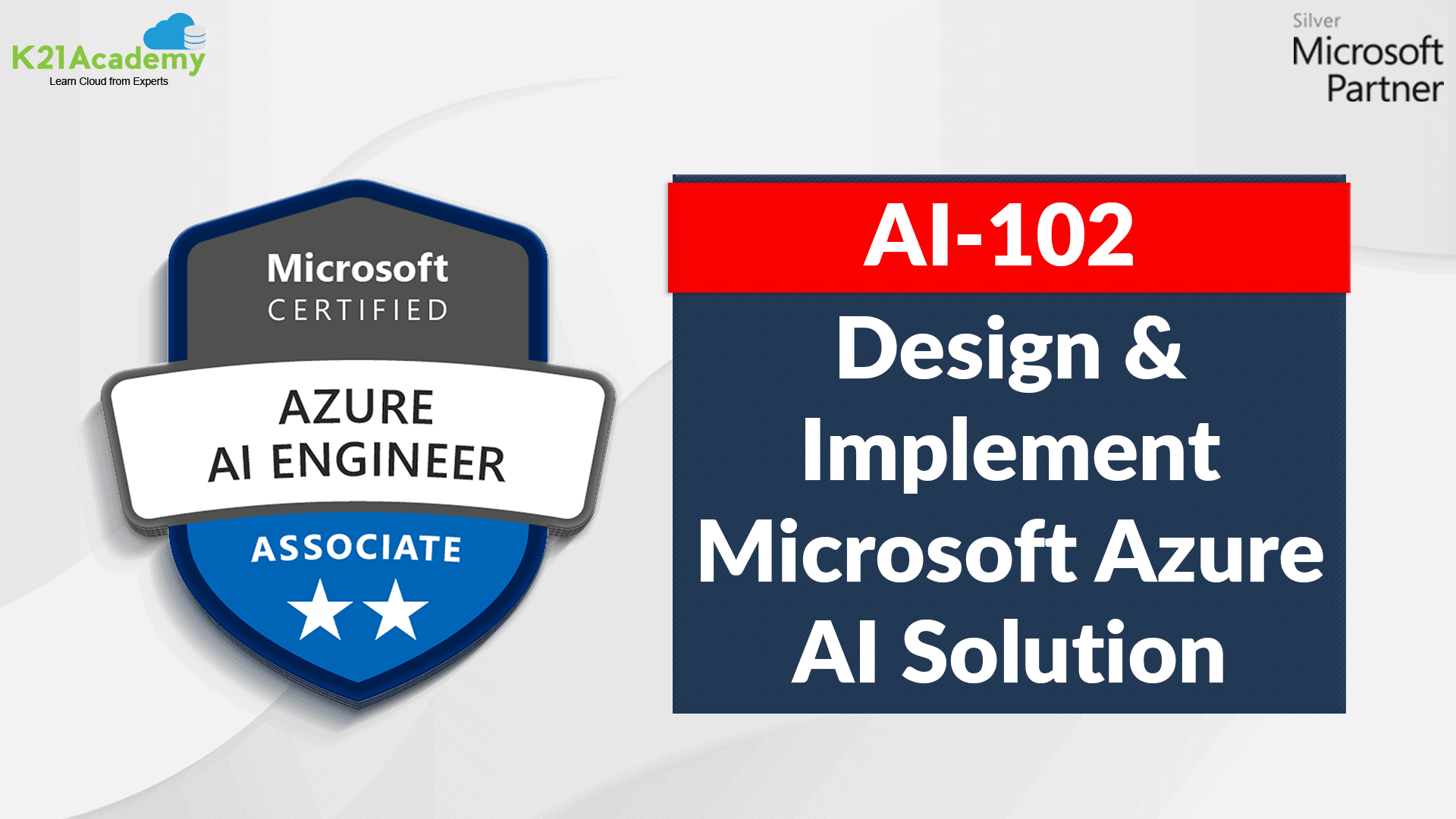


Getting ready for the Microsoft Azure AI Engineer Associate Certification AI 102 exam? This blog covers everything you need to know to not only pass the exam but also excel in your role as an AI Engineer using Azure.
The AI-102 Microsoft Azure AI Engineer Associate exam is a key milestone for anyone aspiring to build a career in AI engineering on Azure. This certification validates your ability to design, implement, and manage AI solutions using Azure Cognitive Services, Azure AI Search, and Azure OpenAI or Azure AI Foundry.
With organizations increasingly adopting AI technologies, the demand for skilled AI professionals is growing rapidly. Earning the AI-102 certification not only demonstrates your expertise but also enhances your credibility, making you a sought-after Azure AI Engineer in the job market.
The topics covered in this blog are:
- Who is an Azure AI Engineer?
- Why You Should Learn AI?
- AI-102 Certification Benefits
- Skills Measured in Exam AI-102
- Prerequisites for AI-102 Exam
- Exam Details
- AI-102 Hands-On Guides
- Who Is This Certification for?
- How to Register for the AI-102 Exam
- Post-Exam Considerations
- Exam Retake Policy
- Frequently Asked Questions
Who Is An Azure AI Engineer?
- As an Azure AI engineer, you build, manage, and deploy AI solutions that leverage Azure Cognitive Search, Azure Cognitive Services, and Microsoft Bot Framework.
- You engage in all stages of AI solutions development—from requirements definition and design to development, maintenance, deployment, monitoring, and performance tuning.
- Your colleagues include solution architects, and you use your skills to translate their vision.
- You also work with IoT specialists, data scientists, data engineers, and AI developers to develop end-to-end AI solutions.
- You’re using REST-based APIs and Software Development Kit (SDKs) to build natural language processing, computer vision, knowledge mining, and conversational AI solutions on Azure.
Why You Should Learn AI?
As per recent reports, the global Artificial Intelligence (AI) market is projected to reach $250+ billion by 2027, which indicates that the world is gearing up for a future powered by AI.
To embrace this AI revolution, organizations are looking for AI Engineers who can develop, integrate, design, and deploy AI solutions on different tech platforms. Therefore, it has become important for professionals to have relevant IT certifications & knowledge in the AI domain that can validate their skills and expertise before the employer.
AI-102 Certification Benefits
- By taking up the certification, you’ll learn to plan, build, and manage knowledge mining, conversational AI, computer vision, and NLP solutions on Azure.
- Candidates get to work with data scientists, solution architects, AI developers, IoT specialists, and data engineers to translate their vision into developing end-to-end AI solutions.
- By earning the AI-102 certification, you will be able to show the employer your ability to develop AI solutions on Azure to the employer.
- This training will help in getting high-paying jobs available for Microsoft-certified Azure AI Engineer Associates.
- Upon earning an AI-102 certification, 26 percent report job promotions, and 35 percent of technical professionals say getting certified led to salary or wage increases.
- Updating your profile with an AI-102 certificate will advance your job profile and increase your chances of getting chosen.
Enroll Now & Build Real-World Azure AI Skills

Skills Required for AI-102 Exam
![Azure AI Engineer Learning Path [AI-102]](https://k21academy.com/wp-content/uploads/2024/06/Image-update.jpg)
1. Plan and manage an Azure AI solution (20–25%)
- Select the appropriate Azure AI Foundry services
- Select the appropriate service for a generative AI solution
- Select the appropriate service for a computer vision solution
- Select the appropriate service for a natural language processing solution
- Select the appropriate service for a speech solution
- Select the appropriate service for an information extraction solution
- Select the appropriate service for a knowledge mining solution
- Plan, create, and deploy an Azure AI Foundry service
- Plan for a solution that meets Responsible AI principles
- Create an Azure AI resource
- Choose the appropriate AI models for your solution
- Deploy AI models using the appropriate deployment options
- Install and utilize the appropriate SDKs and APIs
- Determine a default endpoint for a service
- Integrate Azure AI Foundry Services into a continuous integration and continuous delivery (CI/CD) pipeline
- Plan and implement a container deployment
- Manage, monitor, and secure an Azure AI Foundry Service
- Monitor an Azure AI resource
- Manage costs for Azure AI Foundry Services
- Manage and protect account keys
- Manage authentication for an Azure AI Foundry Service resource
- Implement AI solutions responsibly
- Implement content moderation solutions
- Configure responsible AI insights, including content safety
- Implement responsible AI, including content filters and blocklists
- Prevent harmful behavior, including prompt shields and harm detection
- Design a responsible AI governance framework
2. Implement generative AI solutions (15–20%)
- Build generative AI solutions with Azure AI Foundry
- Plan and prepare for a generative AI solution
- Deploy a hub, project, and necessary resources with Azure AI Foundry
- Deploy the appropriate generative AI model for your use case
- Implement a prompt flow solution
- Implement a RAG pattern by grounding a model in your data
- Evaluate models and flows
- Integrate your project into an application with Azure AI Foundry SDK
- Utilize prompt templates in your generative AI solution
- Use Azure OpenAI in Foundry Models to generate content
- Provision an Azure OpenAI in Foundry Models resource
- Select and deploy an Azure OpenAI model
- Submit prompts to generate code and natural language responses
- Use the DALL-E model to generate images
- Integrate Azure OpenAI into your own application
- Use large multimodal models in Azure OpenAI
- Implement an Azure OpenAI Assistant
- Optimize and operationalize a generative AI solution
- Configure parameters to control generative behavior
- Configure model monitoring and diagnostic settings, including performance and resource consumption
- Optimize and manage resources for deployment, including scalability and foundational model updates
- Enable tracing and collect feedback
- Implement model reflection
- Deploy containers for use on local and edge devices
- Implement orchestration of multiple generative AI models
- Apply prompt engineering techniques to improve responses
- Fine-tune a generative model
3. Implement an agentic solution (5–10%)
- Create custom agents
- Understand the role and use cases of an agent
- Configure the necessary resources to build an agent
- Create an agent with the Azure AI Foundry Agent Service
- Implement complex agents with Semantic Kernel and Autogen
- Implement complex workflows, including orchestration for a multi-agent solution, multiple users, and autonomous capabilities
- Test, optimize, and deploy an agent
4. Implement computer vision solutions (10–15%)
- Analyze images
- Select visual features to meet image processing requirements
- Detect objects in images and generate image tags
- Include image analysis features in an image processing request
- Interpret image processing responses
- Extract text from images using Azure AI Vision
- Convert handwritten text using Azure AI Vision
- Implement custom vision models
- Choose between image classification and object detection models
- Label images
- Train a custom image model, including image classification and object detection
- Evaluate custom vision model metrics
- Publish a custom vision model
- Consume a custom vision model
- Build a custom vision model code first
- Analyze videos
- Use Azure AI Video Indexer to extract insights from a video or live stream
- Use Azure AI Vision Spatial Analysis to detect the presence and movement of people in video
5. Implement natural language processing solutions (15–20%)
- Analyze and translate text
- Extract key phrases and entities
- Determine the sentiment of the text
- Detect the language used in the text
- Detect personally identifiable information (PII) in text
- Translate text and documents by using the Azure AI Translator service
- Process and translate speech
- Integrate generative AI speaking capabilities in an application
- Implement text-to-speech and speech-to-text using Azure AI Speech
- Improve text-to-speech by using Speech Synthesis Markup Language (SSML)
- Implement custom speech solutions with Azure AI Speech
- Implement intent and keyword recognition with Azure AI Speech
- Translate speech-to-speech and speech-to-text by using the Azure AI Speech service
- Implement custom language models
- Create intents, entities, and add utterances
- Train, evaluate, deploy, and test a language understanding model
- Optimize, backup, and recover the language understanding model
- Consume a language model from a client application
- Create a custom question answering project
- Add question-and-answer pairs and import sources for question answering
- Train, test, and publish a knowledge base
- Create a multi-turn conversation
- Add alternate phrasing and chit-chat to a knowledge base
- Export a knowledge base
- Create a multi-language question answering solution
- Implement custom translation, including training, improving, and publishing a custom model
6. Implement knowledge mining and information extraction solutions (15–20%)
- Implement an Azure AI Search solution
- Provision an Azure AI Search resource, create an index, and define a skillset
- Create data sources and indexers
- Implement custom skills and include them in a skillset
- Create and run an indexer
- Query an index, including syntax, sorting, filtering, and wildcards
- Manage Knowledge Store projections, including file, object, and table projections
- Implement semantic and vector store solutions
- Implement an Azure AI Document Intelligence solution
- Provision a Document Intelligence resource
- Use prebuilt models to extract data from documents
- Implement a custom document intelligence model
- Train, test, and publish a custom document intelligence model
- Create a composed document intelligence model
- Extract information with Azure AI Content Understanding
- Create an OCR pipeline to extract text from images and documents
- Summarize, classify, and detect attributes of documents
- Extract entities, tables, and images from documents
- Process and ingest documents, images, videos, and audio with Azure AI Content Understanding
Get Certified as an Azure AI Engineer
Prerequisites For The AI 102
Candidates for this exam should have at least beginner-level knowledge in any one of the following programming languages. You don’t need to be an expert—just enough to understand and follow the code examples in the labs:
- C#
- Python
This foundational knowledge will help you comfortably work through the hands-on labs and apply the concepts in real-world Azure AI scenarios.
Exam Details
- Certification Name: Azure AI Engineer Associate
- Exam Cost: $165 USD (Price based on the country or region in which the exam is proctored)
- Languages: English, Japanese, Chinese (Simplified), Korean, German, French, Spanish, Portuguese (Brazil), Arabic (Saudi Arabia), Russian, Chinese (Traditional), Italian, Indonesian (Indonesia)
- Duration: 100 minutes

AI-102 Hands-On Guide
Hands-on labs are an essential part of preparing for the AI-102 Microsoft Azure AI Engineer exam. They provide a practical environment where you can apply the theoretical concepts, experiment with Azure AI services, and build real-world solutions. By working through these labs, you not only reinforce your learning but also gain the confidence to tackle exam scenarios effectively.
To help you practice and master all the relevant topics, we have compiled a dedicated blog featuring a complete list of hands-on labs along with detailed descriptions and key takeaways for each activity.
For a detailed list of the labs, descriptions, and key takeaways, please check out our dedicated blog:
Get Microsoft Certified with K21 Academy’s AI-102 Course – Hands-On Azure AI Labs Included
Who is this certification for?
After all this, you’ll be waiting to know if you’re the one for this AI 102 certification, right? Well, here is your answer to that,
- Candidates who are interested in Artificial Intelligence, Machine Learning, & Data Science.
- Data Scientist, Database Engineer, and Business Intelligence professionals.
- IT professionals who have a detailed knowledge of languages, such as SQL, Python, or Scala.
- People who are good at computer vision, natural language processing, knowledge mining, and conversational AI solutions on Azure.
How to Register for the AI-102 Exam
Registering for the AI-102 Microsoft Azure AI Engineer exam is a straightforward process. Follow these steps to get started:
-
Create a Microsoft Learn Account:
Before you can register for the exam, you’ll need a Microsoft Learn account. If you don’t already have one, go to the Microsoft Learn site and sign up for free. -
Visit the Microsoft Certification Exam Registration Page:
Navigate to the Microsoft Certifications page and search for the AI-102: Microsoft Azure AI Engineer Associate exam.
Post-Exam Considerations
After completing the AI-102 Microsoft Azure AI Engineer exam, there are a few key steps to take to ensure you continue advancing your career in AI engineering:
- Review Your Results:
Upon receiving your results, take the time to assess your performance. Whether you passed or need to retake the exam, understanding your strengths and areas for improvement is crucial. - Update Your Resume and LinkedIn Profile:
Earning the AI-102 certification significantly enhances your professional profile. Make sure to update your resume and LinkedIn to showcase this accomplishment, and highlight the skills you gained through the certification process. - Apply Your Skills in Real-World Projects:
While the certification is a great achievement, practical experience is just as important. Leverage the knowledge you gained from the labs and apply it to real-world projects, whether through personal initiatives, freelancing, or a new job role. - Stay Updated with Azure AI:
AI and cloud technologies evolve rapidly. Continuously upgrade your knowledge by engaging with the latest updates on Azure AI services, participating in relevant forums, and following Microsoft’s announcements. - Pursue Further Certifications:
If you’re looking to deepen your expertise, consider pursuing additional Azure certifications or other AI-related qualifications, such as the Azure AI Fundamentals or Azure Data Engineer certifications. - Join the Azure AI Community:
Becoming a part of the Azure AI community can provide ongoing support, resources, and networking opportunities to help you continue growing in your career.
Exam Retake Policy
- If a candidate does not clear the passing line on an exam on the first attempt, the candidate must wait at least 24 hours before retaking the exam.
- If the candidate does not achieve a passing score on the second attempt also, he/she should re-access their training and must wait at least 14-day days.
- At last, a candidate has a maximum of 5 retakes allowed in a year.
Frequently Asked Questions
Can I take this exam online?
Yes. Online delivered exams—taken from your home or office—can be less hassle, less stress, and even less worry than traveling to a test center—especially if you’re adequately prepared for what to expect.
When will I get my exam results?
The rescore process starts on the day an exam goes live, and final scores for beta exams are released approximately 10 days after that.
What is the duration?
The duration of the exam is 100 Minutes.
Next Task For You
Elevate your career with our Azure AI/ML and Data Science training programs. Gain access to hands-on labs, practice tests, and comprehensive coverage of all exam objectives.
Whether you aim to become a Microsoft Certified: Azure AI Engineer, Azure AI Fundamentals, or Azure Data Scientist, click the Image Below to get started.
Start Your Azure AI Journey Today


![Microsoft Agentic AI Business Solutions Architect [AB-100] | K21 Academy](https://test.k21academy.com/wp-content/uploads/2025/11/Microsoft-Agentic-AI-Business-Solutions-Architect-AB-100-Exam-Overview1.png)