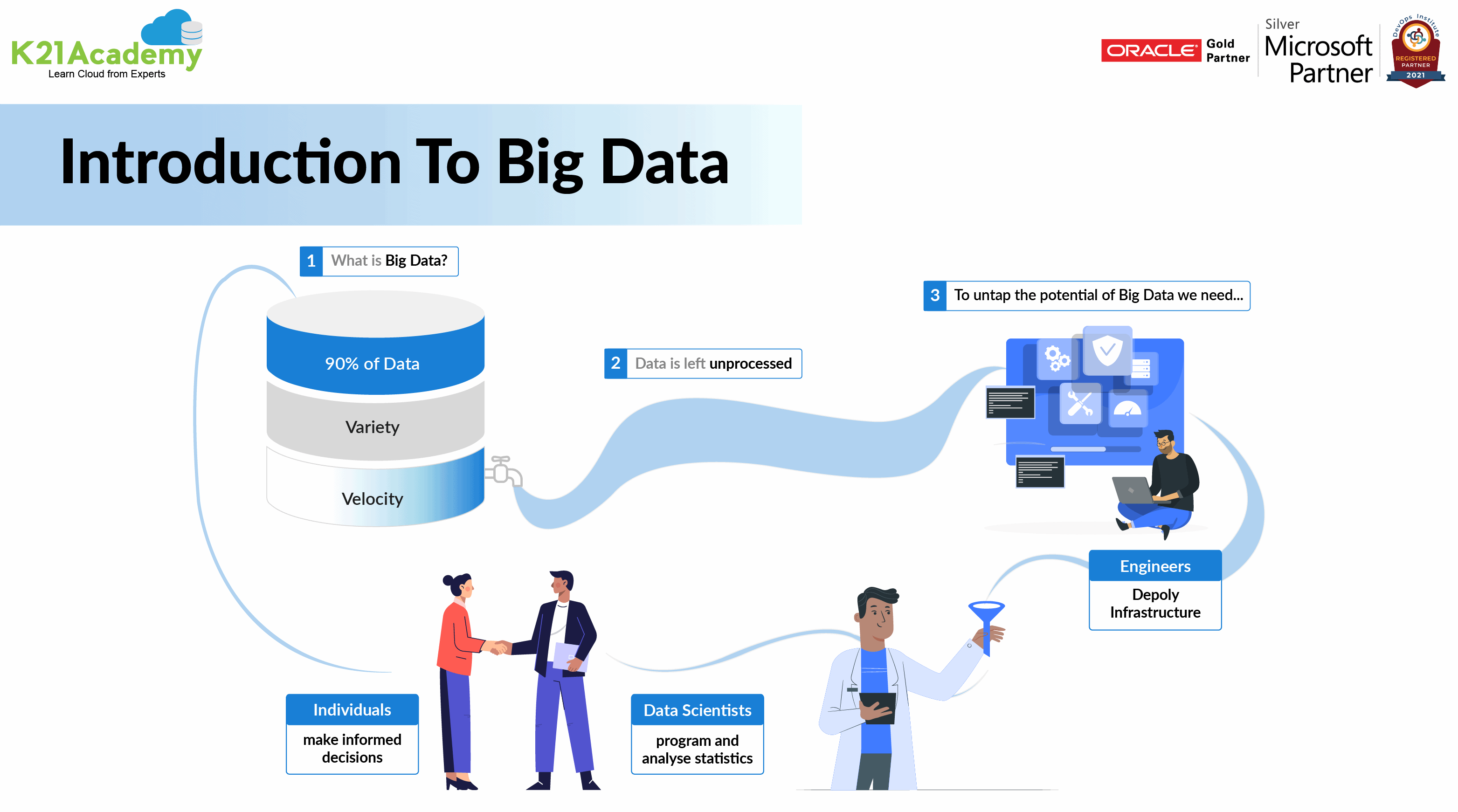





In today’s data-driven society, data pervades every part of our lives. The volume of data on Earth doubles around every two years, emphasizing its relevance. “Big Data” refers to huge amounts of organized and unstructured data that standard data management solutions struggle to manage owing to its quantity and complexity.
Topics we’ll cover :
- What is Big Data
- Types Of Big Data
- What can you do with big data
- Properties Of Big Data
- Big Data Projects
- Examples of Big Data
- Conclusion
What Is Big Data
 Big Data is a collection of data that is huge in volume, yet growing exponentially with time. It is data with so large a size and complexity that none of the traditional data management tools can store it or process it efficiently. Big data is also data but with a huge size. With the growth of technologies and services, this large data is produced that can be structured, semi-structured, and unstructured from different sources.
Types Of Big Data
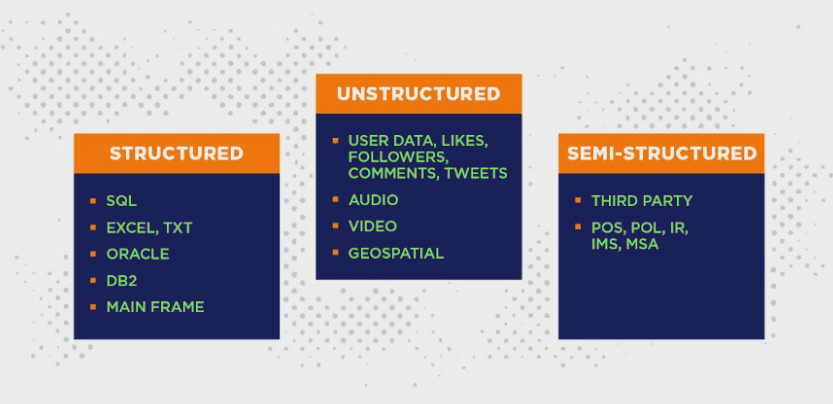 1. Structured Data
The data that can be stored, accessed, and processed in the form of fixed format is terminated as structured data. Generally, the structured data is coded using the page markup on the page that the information applies to.
Example:
2. Semi-Structured
The Semi-Structured data can contain both forms of data but has some structure. it lacks a fixed or rigid schema. This type of data is generally found in XML Files.
3. Unstructured Data
The Unstructured data can be in an unknown form i.e. not organized in a predefined manner. A typical example of unstructured data is a heterogeneous data source containing a mixture of simple text, videos, and images.
What Can You Do With Big Data
It assists with advancing business tasks, smoothing out the whole lifecycle of the business from unrefined substance to the final result. Large Data frameworks give answers quicker to businesses to make the right information-driven decisions. It works on the nature of service and assists with understanding the mentality of the client. It tailor-makes the product and service as per the needs of the client.
Properties Of Big Data
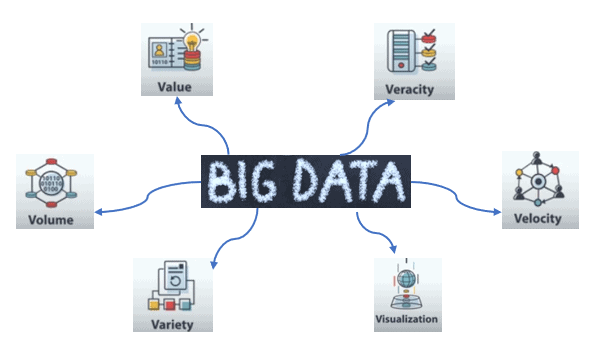
Big data can be described by the following characteristics:
- Volume: The amount of data is the most defining characteristic of Big Data. Enterprises collect data from various sources including business transactions, smart (IoT) devices, industrial equipment, videos, social media, and more. Dealing with potential petabytes or exabytes of data requires specialized storage, management, and analysis technologies.
- Velocity: Data is being generated at unprecedented speeds and must be dealt with in a timely manner. Velocity refers to the rate at which data flows from various sources like business processes, machines, networks, social media feeds, mobile devices, etc. The ability to manage this speed is crucial for real-time decision-making and processing.
- Variety: Data comes in various formats – structured data, semi-structured data, and unstructured data. Structured data follows a model and is easily searchable, whereas unstructured data, such as emails, video, and audio, lacks a defined model. Semi-structured data lies in between and includes formats like XML and JSON. Handling this variety involves extracting data and transforming it into a cleaner format for analysis.
- Veracity: The quality of collected data can vary greatly, affecting accurate analysis. Veracity refers to the uncertainty of data, which can be due to inconsistency and incompleteness, ambiguities, latency, deception, and model approximations. Ensuring the veracity of data is critical as it affects the decision-making process in businesses.
- Value: The final V stands for value. It’s critical to assess whether the data that is being gathered is actually valuable in decision-making processes. The main goal of businesses investing in big data technologies is to extract meaningful insights from collected data that lead to better decisions and strategic business moves. The value is all about turning data into a competitive advantage.
Additional V: Viability
- Viability: Some frameworks include an additional V – Viability. This focuses on ensuring that the data being used is suitable for the questions being asked in the analysis process. It examines the relevance of data in the context of the hypotheses being tested or the insights businesses aim to glean from the data.
Big Data Projects
Big Data is an essential part of the organization. To understand Big Data in the real world. let’s focus on some projects

1. Hadoop YARN Project
In the Hadoop ecosystem, it decouples from the MapReduce application for computing big data. This will include working on the Hadoop central resource manager. Some of the aspects are:
- Data Importing
- Appending the data and using Sqoop to bring data to HDFS
- Determining end-to-end transaction flow.
2. Hive Table Partitioning Project:
This generally involves working with the HIVE data table for the partitioning of data. With the partitioning, the data can be read, deployed on HDFS, and can be made to run the MapReduce jobs faster. There are different ways of partitioning.
- Dynamic Partitioning
- Manual Partitioning
- Bucketing
Examples Of Big Data
![Examples of Big Data sources [1] | Download Scientific Diagram](https://www.researchgate.net/publication/324230350/figure/fig1/AS:636311799087104@1528719963622/Examples-of-Big-Data-sources-1.png)
- Healthcare: Wearable devices send real-time health data to providers, aiding in proactive disease management and predictive analytics for patient care optimization.
- Retail: Big Data helps retailers personalize shopping experiences by analyzing transaction data and online browsing behaviors, leading to tailored promotions and efficient inventory management.
- Financial Services: Banks use Big Data for real-time fraud detection and risk management by analyzing transaction patterns, and enhancing credit risk assessments.
- Telecommunications: Telecom companies optimize network quality and improve customer service by analyzing call data and network traffic, which also supports targeted advertising.
- Transportation and Logistics: GPS and traffic data help optimize delivery routes and schedules, reducing costs and improving service efficiency.
- Manufacturing: Sensors on equipment allow predictive maintenance and optimized production schedules, minimizing downtime.
- Energy: Energy companies monitor and optimize usage using data from smart meters to predict demand and adjust supply, reducing waste.
- Entertainment and Media: Platforms like Netflix and Spotify analyze user interactions to recommend content and make strategic content decisions.
Conclusion
Today Big Data has plagued each industry that we can think of. Because of this, there is an immense change in the manner we direct business. Today clients have developed super-requesting and large information unrest has just energized their inclination for better products and services. A huge information examination is an entire space in itself where significant experiences are gotten from enormous information utilizing different real-time analytical tools.
Frequently Asked Questions
What does variability mean in the context of Big Data?
In Big Data, variability refers to the fluctuations and inconsistencies in data formats, origins, and meanings over time, often arising from diverse sources. These challenges complicate integration, analysis, and the delivery of reliable insights. Understanding variability is essential for organizations to develop robust strategies and tools, enabling them to adapt to the dynamic nature of Big Data and leverage it effectively.
What is Data and How is it Defined?
Data is the foundation of digital operations, comprising quantities, characters, or symbols processed by computers. It is transmitted as electrical signals and stored using magnetic (hard drives), optical (CDs, DVDs), or mechanical methods. Beyond numbers and text, data encompasses multimedia and complex databases, driving the digital experiences we rely on daily.
How can Big Data technologies enhance operational efficiency?
Big Data enhances business operations by streamlining processes from raw materials to final products. It enables faster decision-making, improves service quality, and tailors products to client needs. By creating staging areas for organizing new data and integrating with data warehouses, businesses prioritize critical information, reduce costs, and optimize performance. This strategic approach ensures efficiency and customer-focused service delivery.
How can Big Data technologies enhance operational efficiency?
Big Data technologies are transforming customer service by enabling businesses to analyze consumer responses using advanced systems and natural language processing. This enhances service quality, improves understanding of customer preferences, and allows for personalized products and services. By replacing traditional feedback methods, data-driven approaches ensure impactful interactions, boosting customer satisfaction and loyalty.
Related Links/References:
- AWS Certified Data Engineering Associate DEA-C01
- Amazon Athena: Exploring Cloud Data Insights
- Get Started with AWS: Creating a Free Tier Account
- AWS Glue: Overview, Features, Architecture, Use Cases & Pricing
- AWS Data Engineer: Hands-On Labs & Projects
Next Task For You
Begin your journey toward becoming an AWS Data Engineering Program Bootcamp by clicking on the image below and joining the waitlist.


![Microsoft Agentic AI Business Solutions Architect [AB-100] | K21 Academy](https://test.k21academy.com/wp-content/uploads/2025/11/Microsoft-Agentic-AI-Business-Solutions-Architect-AB-100-Exam-Overview1.png)