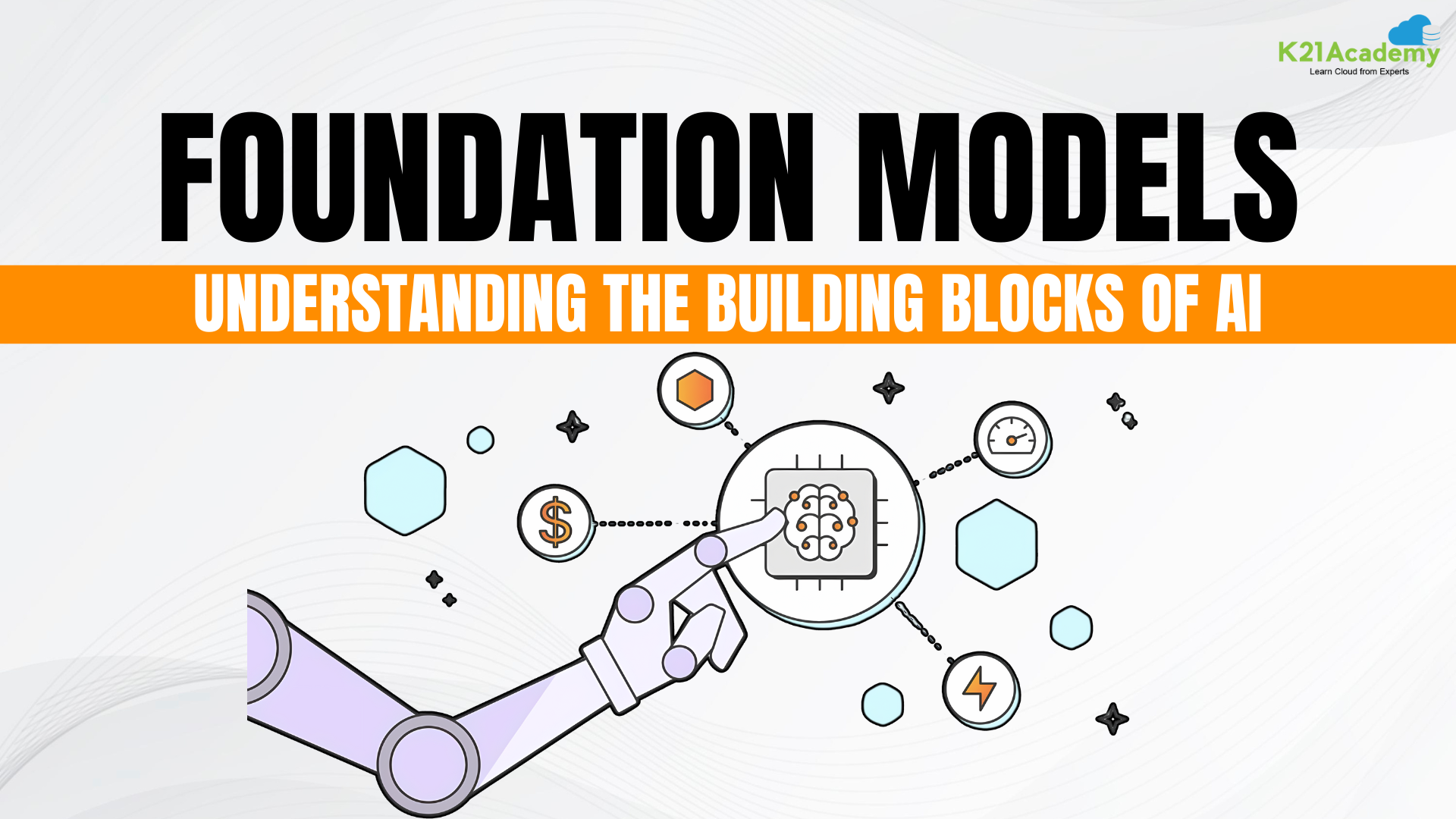





“Have you ever wondered how AI systems can understand and generate human-like text, create art, or even write code?” The answer lies in Foundation Models. These models are the backbone of many modern AI applications and transform how we interact with technology.
Artificial Intelligence (AI) is revolutionizing industries, and at its core are foundation models. These powerful, pre-trained models have enabled major advancements in machine learning and natural language processing. Foundation models are large machine learning models that can be adapted for various tasks, serving as a versatile base for numerous AI applications.
 These models are crucial because they provide a strong starting point for many AI tasks, reducing the need for extensive, task-specific training. This adaptability allows for efficient AI applications in diverse fields, from content generation to complex data analysis. Understanding foundation models is essential for anyone interested in AI, as they drive innovation and efficiency across multiple sectors.
Table of Contents
- Understanding Foundation Models in AI
- The Process of Creating Foundation Models
- Exploring Different Types of Foundation Models
- Building Foundation Models: Key Steps and Techniques
- Challenges and Limitations of Foundation Models
- The Future of Foundation Models in AI
- Conclusion
- Frequently Asked Questions
Understanding Foundation Models in AI ^
Foundation models (FMs) are large AI models already trained on vast data. They act as a solid starting point for various AI tasks, reducing the need for specific training.
These models are designed to be flexible. They learn general patterns from large datasets, making them adaptable to many tasks with minimal extra training.
 Key Characteristics:
- Large Scale: These models are trained on massive datasets, including text, images, and videos. Examples include Amazon Bedrock and Amazon Titan from AWS. Bedrock makes these models easily accessible, while Titan handles tasks like text generation and translation.
- Versatility: After initial training, these models can be fine-tuned for specific tasks, such as content creation, summarization, code generation, and answering questions. AWS services like Amazon CodeWhisperer generate code snippets, and Amazon Polly converts text to speech.
- Efficiency: Using pre-trained models saves time and resources. For instance, Amazon Comprehend extracts insights from text data, and Amazon Lex creates conversational interfaces for applications.
In essence, foundation models provide a strong base for building advanced AI systems, driving innovation and efficiency across various fields.
The Process of Creating Foundation Models ^
Unlabeled Data: FM’s start with a lot of unlabeled data. This includes raw information like text, images, and videos without labels. Unlabeled data is easier to collect than labeled data and is useful for training large AI models.
 Pretraining: Pretraining is an important step where the model is trained on large datasets to learn general patterns in the data. This involves processing large amounts of data, such as text from the internet, to understand context and relationships. The goal is to develop a model that can handle a wide range of information. AWS uses services like Amazon SageMaker to help with this large-scale training.
To know more about Amazon Sagemaker Click Here
Adaptation: Once trained, The models can be fine-tuned for specific tasks using smaller, labeled datasets and prompts. This process tailors the model to perform specific functions effectively. For example, Amazon Bedrock allows developers to easily adapt pre-trained models for their needs.
Broad Range of Tasks: Pretrained models can handle many tasks such as content summarization, content generation, code generation, and question answering. For example, Amazon CodeWhisperer helps in generating code, and Amazon Polly converts text into natural-sounding speech, showing the wide applicability of foundation models across different areas.
Exploring Different Types of Foundation Models ^
Code Generation: Foundation models can write code snippets, making work easier for developers. For example, Amazon CodeWhisperer helps developers by generating code directly within their coding environment. This speeds up coding tasks and reduces the time needed to write complex code.
 Content Generation: Foundation models can create different types of content, from text to images. Amazon Polly uses these models to turn text into lifelike speech, which is useful for making audio content like podcasts and voiceovers. These models can also generate engaging written content, helping in fields like marketing and content creation.
 Content Summarization: Foundation models can shorten long texts, making information easier to understand. Amazon Comprehend uses these models to find key insights and relationships in text data, helping businesses quickly grasp large amounts of information. This is especially useful for summarizing reports, articles, and other long documents.
To know more about Amazon Comprehend Click Here
Question and Answer: Foundation models power chatbots and virtual assistants by providing accurate answers to user questions. Amazon Lex builds conversational interfaces using these models, allowing natural language interactions. This technology is widely used in customer service, helping businesses quickly and efficiently respond to customer queries.
To learn about Amazon Lex Click Here
Building Foundation Models: Steps and Techniques ^
Pretraining with Unlabeled Data: Foundation models begin by learning from large amounts of data that haven’t been labeled. This data includes text, images, and videos from various sources. The model looks for general patterns and relationships in this data. For example, it processes text to understand context and meaning. This step is essential because it builds the model’s basic knowledge. AWS services like Amazon SageMaker help with this large-scale training, making the models strong and adaptable.
 Large Model Architecture: These models are built with a large structure that includes billions of settings (parameters). These settings help the model remember and understand more complex information from the training data. Bigger models can capture more detailed patterns, making them more effective for different tasks. The extensive training on large datasets allows these models to perform well with little extra training.
Training Infrastructure: Creating foundation models needs a lot of powerful computers and software. Amazon SageMaker provides the tools to build, train, and use these large models. Good infrastructure ensures efficient processing of huge amounts of data and supports the complex calculations needed during training. This setup is crucial for developing high-quality foundation models capable of various AI tasks.
Challenges and Limitations of Foundation Models ^

Data Quality:
- Ensuring the training data is of high quality is crucial for the models to work well.
- Poor-quality data can lead to models that are inaccurate or biased.
- It’s important to carefully select and prepare data to keep the models reliable and accurate.
Ethical Considerations:
- Addressing ethical issues is vital when developing FM’s
- Key concerns include data privacy, training data bias, and AI’s potential misuse.
- Developers must consider these ethical issues to ensure responsible AI practices and build trust in AI systems.
Practical Limitations:
- Developing FMs requires a lot of technical resources and expertise.
- They need powerful computers and large-scale data storage, which can be challenging to manage.
- Fine-tuning and maintaining these models also require ongoing effort and expertise, making it resource-intensive for organizations.
The Future of Foundation Models in AI ^
 Advancements: As AI technology keeps improving, foundation models will become more powerful and efficient. They will handle more complex tasks and understand data better. New designs and training methods will make these models even more important for AI applications.
Research Areas: Future research will aim to make these models work better and cost less to train. Important areas include creating energy-efficient training methods, making models easier to understand, and dealing with ethical and bias issues. This research will help ensure that FM’s are both powerful and fair.
Impact: As FM’s improve, their impact on technology and society will increase. They will drive innovation in many industries, such as healthcare and finance, by enabling more advanced AI applications. The ongoing development of these models will change how we use technology and solve problems.
Conclusion ^
Foundation models are changing the field of AI by providing a strong and flexible base for many uses. Trained on huge amounts of data, these models are efficient, adaptable, and perform well. They can generate content, write code, summarize information, and answer questions, making them key to modern AI innovations.
As AI advances, FM’s will become even more important in driving technology forward in various industries. By understanding and using these models, developers, and businesses can discover new possibilities and create more advanced AI solutions.
Frequently Asked Questions
Q1) What are foundation models in AI, and why are they important?
Ans: FMs are large, pre-trained machine learning models that can be adapted for various tasks. They are important because they save time and resources by providing a strong starting point for many AI applications. These models have already learned general patterns from vast amounts of data, making them versatile and efficient for tasks like text generation, code writing, and content summarization.
Q2) How do tools like ChatGPT and Bard use foundation models?
Ans: Tools like ChatGPT and Bard use FMs to understand and generate human-like text. These models are trained on massive datasets that include a wide range of text from the internet. This pretraining helps them grasp language patterns, context, and meanings, enabling them to generate coherent and relevant responses to user queries.
Q3) How does AWS use foundation models, and which tools use them?
Ans: AWS uses foundation models across various services to enhance their functionality and efficiency.
For example:
• Amazon Bedrock: Makes foundation models easily accessible for developers to build and scale generative AI applications.
• Amazon Titan: Provides foundation models used for tasks like text generation, translation, and more.
• Amazon SageMaker: Facilitates the building, training, and deployment of machine learning models, including foundation models.
• Amazon CodeWhisperer: Uses foundation models to assist developers by generating code snippets directly within their integrated development environment (IDE).
• Amazon Polly: Converts text into natural-sounding speech using foundation models.
• Amazon Comprehend: Extracts insights and relationships from text data.
• Amazon Lex: Builds conversational interfaces using foundation models for natural language interactions.
Q4) Can foundation models be used for tasks other than text generation?
Ans: Yes, foundation models can be used for a variety of tasks beyond text generation. They can be adapted for image recognition, speech synthesis, code generation, and even complex problem-solving. For instance, Amazon Polly uses foundation models to convert text into natural-sounding speech, and Amazon CodeWhisperer helps developers by generating code snippets.
Q5) Why is pretraining on large datasets necessary for foundation models?
Ans: Pretraining on large datasets is necessary because it allows the models to learn a wide range of patterns, structures, and relationships in the data. This extensive training helps the models understand the context and make accurate predictions or generate relevant content. Without pretraining, the models would require much more time and data to learn these patterns from scratch.
Related References
- Join Our Generative AI Whatsapp Community
- Introduction To Amazon SageMaker Built-in Algorithms
- Introduction to Generative AI and Its Mechanisms
- Mastering Generative Adversarial Networks (GANs)
- Exploring Large Language Models (LLMs)
- The Essentials of Prompt Engineering
- Demystifying Natural Language Processing (NLP)
- Generative AI for Kubernetes: K8sGPT Insights
Next Task For You
Ready to take your AI and machine learning skills to the next level? Our AWS AI/ML training program covers everything you need to excel, including comprehensive exam objectives, hands-on labs, and practice tests. Whether you’re aiming to become an AWS Certified AI Practitioner, an AWS Certified ML Engineer, or specialize in AWS Certified Machine Learning, we have the resources to help you succeed.
Join our waitlist today and be the first to access our training program. Click the image below to secure your spot and start your journey toward AWS certification success!


![Microsoft Agentic AI Business Solutions Architect [AB-100] | K21 Academy](https://test.k21academy.com/wp-content/uploads/2025/11/Microsoft-Agentic-AI-Business-Solutions-Architect-AB-100-Exam-Overview1.png)