


Artificial Intelligence (AI), Machine Learning (ML), and Generative AI (Gen AI) are revolutionising industries—and that’s not just hype. Consider this: between January and April 2025, AI-related job postings more than doubled, skyrocketing from 66,000 to nearly 139,000 as businesses rush to scale generative AI capabilities and retool their data infrastructure Aura Blog. At the same time, nearly 78% of organisations reported using AI by 2024, up from just 55% the year before Stanford HAI. In the UK alone, over 11,000 AI-related job vacancies have been identified recently, and approximately 69% of them focus on AI-related technical roles such as data engineers, Python engineers, and ML specialists IT Pro.
These statistics speak volumes: the AI era isn’t looming—it’s already here, and it’s reshaping career landscapes across the globe. For beginners, career shifters, or those aiming for high-paying tech roles, mastering the right AI, ML, and Gen AI skills is no longer optional—it’s essential.
This article lays out a comprehensive roadmap to help you thrive in this booming field. You’ll discover which core technical skills (like programming, data handling, deep learning, and LLMs) will get you noticed, why Gen AI roles demand additional specialised expertise, what tools you’ll need, and the leading career paths you can pursue. Whether you’re starting from scratch or pivoting from another field, this guide will equip you with the knowledge and direction you need to make that transition—and succeed.
Table of Contents:
- Overview of AI, ML, and Gen AI
- The Importance of AI, ML, and Generative AI
- Roles and Responsibilities in AI, ML, and Gen AI
- Core Technical Skills for AI, ML, and Gen AI Roles
- Key Applications and Use Cases
- Specialised Skills for Gen AI
- Tools and Libraries for AI, ML, and Gen AI
- Ethical Considerations and Challenges
- Future Trends and Developments
- Career Paths in AI, ML, and Gen AI
- How to Start a Career in AI, ML, and Gen AI
- Conclusion
- Frequently Asked Questions(FAQs)
Overview of AI, ML, and Gen AI
Before diving into the skillsets, it is important to differentiate between AI, ML, and Gen AI, as each plays a distinct role in shaping the future of work.

Artificial Intelligence (AI): AI is the overarching field that focuses on building intelligent systems capable of mimicking human decision-making and problem-solving. Think of applications such as self-driving cars, chatbots, and fraud detection systems.
Machine Learning (ML): ML is a subset of AI. Instead of explicitly programming machines, ML algorithms learn from data patterns. For example, Netflix recommending shows or an email system detecting spam relies on ML models trained on large datasets.
Generative AI (Gen AI): The newest frontier in AI, Gen AI involves models that can create new content—whether it is text, music, code, or even images. Tools like ChatGPT, DALL·E, and MidJourney are prime examples. These systems rely on deep neural networks and large language models (LLMs) to generate human-like content, opening up new industries and career paths.
Relevance to Careers: While traditional AI and ML focus on optimisation and prediction, Gen AI extends into creativity and innovation. This makes it essential for professionals to not only understand classic ML but also master generative models and LLMs. The demand for specialists in this space is expected to grow exponentially as industries adopt Gen AI solutions for automation, personalisation, and content creation.
The Importance of AI, ML, and Generative AI
Artificial Intelligence (AI) simulates human intelligence through machines designed to perform tasks that typically require human cognition. The significance of AI lies in its ability to automate complex processes, analyze vast amounts of data, and make predictions with remarkable accuracy. AI has become indispensable in various sectors by enhancing productivity and driving innovation.
Related Readings: What is Generative AI & How It Works?
1. Automation and Efficiency
AI automates repetitive and mundane tasks, thus freeing up human resources for more complex and creative endeavors. For instance, AI-driven robots can handle manufacturing tasks with precision and efficiency. Similarly, AI algorithms can automate data entry and customer service inquiries.
2. Data Analysis and Insights
Moreover, AI systems excel at analyzing large datasets and uncovering patterns that human analysts might miss. This capability is crucial in fields like finance, healthcare, and marketing. In these areas, data-driven insights can lead to better decision-making and strategic planning.

3.Image and Speech Recognition
In addition, ML algorithms enable technologies such as facial recognition and voice assistants. For instance, ML models can accurately identify individuals in images and process spoken commands, facilitating seamless interaction with devices.
4. Predictive Maintenance
In industries such as manufacturing and transportation, ML predicts equipment failures before they occur. This capability reduces downtime and maintenance costs by addressing issues proactively.
Generative AI refers to AI systems capable of generating new content, including text, images, and music, based on input data. Unlike traditional AI systems that classify or analyze existing data, Generative AI creates original content, which is transformative for creative industries and personalization.
5. Content Creation and Innovation
Generative AI is used to produce content such as articles, art, and music. For example, AI can generate realistic images of people who don’t exist or compose music that mimics various styles, offering new possibilities for artists and content creators.
Related Readings: Generative AI on AWS
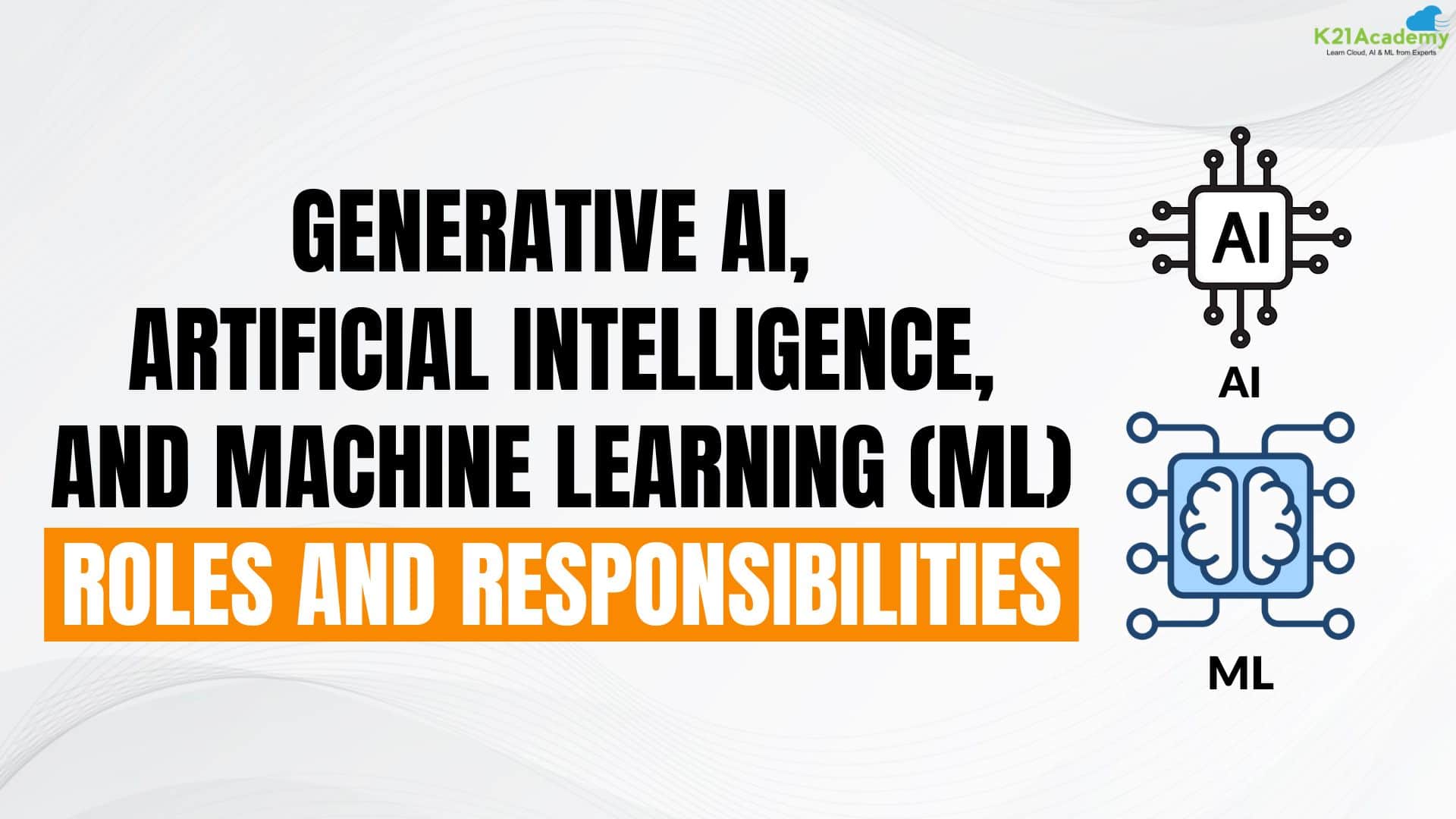
Roles and Responsibilities in AI, ML, and Gen AI
AI Engineers are responsible for designing and implementing AI models and systems. Their role encompasses several key tasks:
Related Readings: AWS AI, ML, and Generative AI Services and Tools
1. Algorithm Development
AI engineers create algorithms that enable machines to perform tasks intelligently. This involves selecting appropriate models, fine-tuning hyperparameters, and ensuring algorithm efficiency.

2. Model Training
They train AI models using large datasets to ensure that the systems learn and perform accurately. Training involves iterating over different configurations to achieve the desired performance.
3. Integration and Deployment
Furthermore, AI engineers integrate AI solutions into existing systems and deploy them in real-world environments. They ensure that these solutions operate seamlessly and deliver the intended outcomes.
4. ML Engineer Responsibilities
They Focus on building and maintaining machine learning models. AI engineer roles and responsibilities include:
- Research, modify, and implement data science and analytics prototypes.
- Develop methods and strategies for machine learning applications.
- Use test results for statistical analysis to enhance models.
- Search for available online training datasets.
- Train and retrain machine learning systems and models as needed.
- Improve and expand existing machine learning frameworks and libraries.
- Create machine learning applications tailored to client or customer requirements.
- Explore, test, and implement relevant ML tools and algorithms.
- Assess the effectiveness of ML algorithms for specific applications and rank them by success potential.
- Analyze and visualize data to identify inconsistencies that could impact model performance in real-world scenarios.
5. Data Preprocessing
ML engineers prepare and preprocess data for model training. This involves cleaning, transforming, and structuring data to enhance model accuracy and performance.
6. Model Selection and Tuning
They select suitable ML algorithms and fine-tune them for specific tasks. This includes adjusting parameters and optimizing algorithms to achieve the best results.
7. Model Building and Evaluation
They build predictive models using statistical and machine learning methods. Data scientists evaluate model performance using metrics and ensure that models provide reliable predictions.

8. Business Insights
Furthermore, data scientists translate data insights into actionable business recommendations. They work closely with stakeholders to align data-driven strategies with organizational goals.
Generative AI Specialists work on developing and fine-tuning AI systems that create new content. Their tasks include:
9. Model Development
They design and implement generative models such as GANs (Generative Adversarial Networks) and VAEs (Variational Autoencoders). This involves training these models to produce high-quality, original content.
10. Content Optimization
Generative AI specialists refine models to enhance the quality and relevance of generated content. They ensure that the content meets specific criteria and serves its intended purpose effectively.
Related Readings: Generative AI (GenAI) vs Traditional AI vs Machine Learning (ML) vs Deep Learning (DL)
Core Technical Skills for AI, ML, and Gen AI Roles
To excel in AI, ML, and Generative AI roles, professionals should possess the following skills and qualifications:

To succeed in AI-related careers, you need a strong foundation in both technical and analytical skills. Let’s break down the most critical ones.
1. Programming Languages
At the heart of AI is programming. Python dominates the AI/ML ecosystem due to its simplicity, readability, and extensive libraries such as TensorFlow, PyTorch, and Scikit-learn. R is widely used for statistical analysis and data visualisation, while Java and C++ are preferred in enterprise environments requiring high performance.
2. Mathematics & Statistics
Mathematics forms the backbone of AI. You need a strong grasp of:
- Linear Algebra (matrix operations for neural networks).
- Calculus (optimisation techniques for training models).
- Probability & Statistics (understanding uncertainty and data distributions).
These concepts are not just academic—they are essential for understanding how algorithms learn and make decisions.
3. Data Handling & Preprocessing
Raw data is messy. To train effective AI models, you must know how to clean, transform, and preprocess data. Libraries like Pandas and NumPy are indispensable for tasks such as handling missing values, normalising features, and converting unstructured data into usable formats.
4. Machine Learning Algorithms
Every AI engineer should master:
- Supervised Learning (classification, regression).
- Unsupervised Learning (clustering, dimensionality reduction).
- Reinforcement Learning (training models with reward systems).
- Deep Learning (multi-layered neural networks).
Understanding when to use each algorithm is crucial for problem-solving in real-world projects.
5. Deep Learning
This subset of ML powers Gen AI. Neural networks such as CNNs (image recognition), RNNs (time series prediction), LSTMs (sequential data), and GANs (generative models) are vital for advanced AI applications.
6. NLP & LLMs
Natural Language Processing (NLP) enables machines to understand human language. With the rise of LLMs like GPT and BERT, professionals must understand concepts such as tokenisation, embeddings, and attention mechanisms. These skills are particularly critical for Gen AI careers.
7. Model Deployment & Cloud Platforms
Building models is only half the battle. The ability to deploy them at scale using Flask, FastAPI, or cloud platforms like AWS SageMaker, Azure ML, and Google Cloud AI is essential. ModelOps tools ensure that deployed models remain efficient, secure, and up-to-date.
Key Applications and Use Cases
AI, ML, and Generative AI have a wide range of applications that impact various industries:
1. Healthcare Transformation
AI and ML are revolutionizing healthcare by improving diagnostics, personalized medicine, and predictive analytics. AI-driven systems can analyze medical images, predict patient outcomes, and assist in drug discovery, enhancing patient care and treatment efficiency.
2. Financial Innovations
In the financial sector, AI algorithms are used to detect fraudulent activities, automate trading, and provide personalized financial advice. AI-driven systems can analyze transaction patterns, identify anomalies, and offer tailored investment recommendations.

3. Retail Enhancements
AI enhances customer experiences through personalized recommendations, chatbots, and inventory management. ML algorithms help in predicting demand, optimizing supply chains, and providing targeted marketing strategies, leading to improved customer satisfaction and operational efficiency.
4. Content Creation Revolution
Generative AI transforms content creation by generating text, images, and videos. This technology enables new forms of creative expression, personalized content, and automated media production, offering innovative solutions for artists and content creators.
5. Automotive Industry Advancements
AI and ML play a crucial role in autonomous vehicles by enabling features like self-driving, collision avoidance, and route optimization. These technologies improve safety, efficiency, and the overall driving experience.
Specialised Skills for Gen AI
Gen AI requires a slightly different skillset compared to traditional AI or ML roles.
1. Generative Models
Techniques such as GANs (Generative Adversarial Networks) and VAEs (Variational Autoencoders) allow AI to generate new images, music, and even synthetic datasets. These models go beyond prediction—they create.
2. Large Language Models (LLMs)
LLMs like GPT-4 and BERT are the backbone of Gen AI. They are used in chatbots, content generation, summarisation, and translation. Understanding how they function and how to fine-tune them for domain-specific tasks is highly valuable.
3. Prompt Engineering & Fine-Tuning
Prompt engineering is the art of designing effective inputs to get desired outputs from LLMs. Fine-tuning involves adapting pre-trained models for specific industries (e.g., legal, medical). This skill is in high demand for companies deploying customised Gen AI solutions.
4. Transfer Learning & Pre-trained Models
Instead of training from scratch, professionals leverage pre-trained models and adapt them through transfer learning. This significantly reduces training costs and time.
5. AI Ethics & Bias Mitigation
With Gen AI generating content autonomously, ethical concerns arise. Understanding how to identify and mitigate bias in models, ensuring transparency, and designing AI systems responsibly are essential skills for long-term success.
Tools and Libraries for AI, ML, and Gen AI
Your toolkit will determine your efficiency as an AI professional.
1. Essential Libraries for AI/ML
- TensorFlow & PyTorch: Deep learning frameworks.
- Keras: Simplified neural network building.
- Scikit-learn: ML algorithms and evaluation.
- Pandas & NumPy: Data handling and preprocessing.
2. Gen AI Specific Tools
- OpenAI API: Access to models like GPT.
- Hugging Face Transformers: Pre-trained LLMs.
- DALL·E & MidJourney: Image generation tools.
Cloud Platforms for AI
Cloud services like AWS SageMaker, Azure ML, and Google Cloud AI provide infrastructure for deploying and scaling AI solutions.
Big Data & Data Science Tools
AI thrives on big data. Tools like Hadoop, Spark, and Kafka help manage and process large-scale datasets.
Ethical Considerations and Challenges
As AI and ML technologies advance, ethical considerations become increasingly important:
 1. Bias and Fairness
AI systems can inadvertently perpetuate biases present in training data, leading to unfair outcomes. Ensuring fairness and inclusivity in AI models is crucial to prevent discrimination and promote equitable treatment.
2. Privacy and Security
The use of personal data in AI systems raises concerns about data privacy and security. Implementing robust data protection measures, such as encryption and anonymization, is essential to safeguard individuals’ privacy.
3. Transparency and Accountability
The “black box” nature of some AI models can make it challenging to understand how decisions are made. Promoting transparency and interpretability in AI systems is important for accountability and trust.
4. Job Displacement and Reskilling
Automation driven by AI and ML could lead to job displacement in certain sectors. Addressing these concerns through reskilling and upskilling initiatives is vital to ensure that workers can transition to new roles and opportunities.
5. Ethical AI Development
Developing ethical guidelines and frameworks for AI deployment is crucial to ensure responsible use. This includes addressing issues related to consent, accountability, and the societal impact of AI technologies.
Future Trends and Developments
Looking ahead, several trends are expected to shape the future of AI, ML, and Generative AI:

1. Advancements in AI Models
AI models will continue to evolve, becoming more sophisticated and capable of handling complex tasks and improving accuracy. Innovations in deep learning and neural networks will drive advancements in AI capabilities.
2. Integration with Emerging Technologies
AI will increasingly integrate with technologies like IoT and blockchain, creating new possibilities for automation, data analysis, and security. These integrations will enable more seamless and intelligent systems.
3. Personalization and Human-AI Interaction
AI systems will become more personalized, adapting to individual preferences and behaviors. Improved human-AI interaction will enhance user experiences and enable more intuitive and natural interfaces.
4. Ethical and Responsible AI
There will be a growing focus on developing ethical and responsible AI systems. This includes addressing biases, ensuring transparency, and promoting fairness to build trust and accountability in AI technologies.
5. Generative AI Innovations
Generative AI will continue to evolve, leading to new applications in creative fields, content generation, and virtual environments. Innovations in generative models will offer new ways to create and interact with digital content.
Career Paths in AI, ML, and Gen AI
The career opportunities within AI, ML, and Gen AI are vast and growing rapidly. From entry-level roles to senior leadership positions, this field offers diverse job paths for individuals with varying skillsets. Let’s break down the major career tracks you can pursue.
1. Job Roles in AI
- AI/ML Engineer: Responsible for designing, training, and deploying machine learning models. These professionals work closely with data scientists to bring models into production and ensure scalability.
- Data Scientist: Often called the “backbone of AI,” data scientists focus on data analysis, visualisation, and model building to uncover insights and drive decision-making.
- AI Product Manager: Manages the development and deployment of AI-powered products. They balance technical requirements with business needs, making sure AI tools align with company goals.
- Gen AI Engineer: A specialised role focusing on developing and fine-tuning generative AI models such as GPT, DALL·E, or custom LLMs for specific applications like content creation or chatbots.
2. Senior & Leadership Roles
Once you gain experience, you can move into higher-level roles that demand both technical expertise and strategic vision:
- AI/ML Architect: Designs large-scale AI systems and ensures integration with existing enterprise infrastructure.
- Director of AI / Chief AI Officer: Leads the AI strategy for organisations, managing teams and aligning AI initiatives with company growth.
- Senior Data Scientist: Takes ownership of advanced modelling projects, often guiding junior team members while tackling complex business problems.
3. Emerging Roles in Gen AI
As Gen AI becomes mainstream, new roles are surfacing:
- Prompt Engineers: Specialists who craft effective prompts to optimise outputs from LLMs.
- AI Trainers: Professionals who refine AI outputs and train models with human feedback.
- Conversational AI Designers: Build human-like dialogue systems for chatbots and virtual assistants.
- AI Ethics Specialists: Focus on governance, bias detection, and responsible AI deployment.
4. Salary Expectations
AI careers are among the most lucrative in tech. Salary ranges vary by region, role, and experience, but here’s a snapshot of average annual salaries in the UK (2025 estimates):
| Role | Average Salary Range (UK) |
|---|---|
| AI/ML Engineer | £50,000 – £85,000 |
| Data Scientist | £45,000 – £80,000 |
| AI Product Manager | £60,000 – £95,000 |
| Gen AI Engineer | £55,000 – £90,000 |
| AI Architect | £75,000 – £120,000+ |
| Chief AI Officer | £120,000 – £200,000+ |
With demand continuing to surge, these numbers are expected to rise, making AI one of the most rewarding career paths of the decade.
How to Start a Career in AI, ML, and Gen AI
Getting started in AI may feel overwhelming due to its breadth, but with the right approach, anyone can transition into this field. Whether you are a student, a working professional, or a career changer, here’s a roadmap to help you enter AI successfully.
1. Building a Strong Foundation
- Educational Path: While a degree in computer science, engineering, or mathematics is helpful, it is not mandatory. Many professionals successfully enter AI through bootcamps, online certifications, and self-learning.
- Mathematics & Programming: Focus on mastering Python, linear algebra, calculus, and probability. These are non-negotiable building blocks for AI.
2. Hands-On Experience
Employers value practical skills over theory. Start with small projects and gradually move to complex ones:
- Participate in Kaggle competitions to apply ML algorithms in real-world problems.
- Build GitHub repositories showcasing your AI/ML projects.
- Contribute to open-source AI projects, which not only enhance skills but also build your professional network.
3. Certifications & Programmes
Online platforms offer structured learning paths:
- Coursera & edX: Courses on AI, ML, and Gen AI by leading universities.
- Udemy & DataCamp: Affordable skill-focused programmes.
- Specialist Programmes: K21 Academy and other niche institutions offer tailored AI/ML certifications aligned with industry demands.
4. Networking & Mentorship
Your network can significantly accelerate your career. Join AI communities on:
- LinkedIn: Follow AI thought leaders, engage in discussions.
- Slack/Discord Groups: Many AI communities offer mentorship and job opportunities.
- Meetups & Conferences: Attending AI summits provides exposure to cutting-edge trends and professionals in the field.
The fastest way to transition into AI is through a combination of learning, building projects, and networking. Instead of waiting until you feel “ready,” start experimenting today—practical experience is the most powerful teacher.
Conclusion
Artificial Intelligence, Machine Learning, and Generative AI are reshaping industries, creating a wave of opportunities for those who have the right skills. From programming in Python and mastering data handling to building deep learning models and fine-tuning large language models, the demand for skilled AI professionals continues to rise. Unlike many traditional fields, AI offers a career path that is not only high-paying but also dynamic, creative, and future-proof.
If you are aiming to transition into AI, the key is to start with the basics—mathematics, programming, and foundational AI concepts—before moving into advanced topics like NLP, Gen AI, and model deployment. Practical projects, competitions, and hands-on experimentation will set you apart, while certifications and networking will strengthen your credibility.
The most exciting part about AI careers is their constant evolution. New roles such as prompt engineers, conversational AI designers, and AI ethics specialists didn’t exist a few years ago but are now highly sought after. This highlights the importance of continuous learning and adaptability.
So, whether you are just starting your journey or planning to pivot from another industry, the opportunities in AI are limitless. Begin today, build steadily, and stay curious—the future of work is AI-driven, and you have the chance to be at the forefront of it.
Frequently Asked Questions
1. How do I transition into a career in AI or machine learning?
Start by learning the fundamentals of programming (Python is the best starting point) and mathematics (linear algebra, calculus, probability). Enrol in beginner-friendly AI/ML courses, participate in Kaggle competitions, and build personal projects to showcase your skills. Networking, mentorship, and certifications will also help accelerate the transition.
2. Do I need a computer science degree to start a career in AI?
Not necessarily. While a computer science degree is beneficial, many AI professionals come from varied backgrounds like physics, business, or even humanities. What matters most is your ability to demonstrate practical skills through projects, certifications, and a portfolio.
3. What are the best programming languages for AI roles?
Python is the dominant language due to its simplicity and powerful AI/ML libraries like TensorFlow, PyTorch, and Scikit-learn. R is popular for statistical analysis, while Java and C++ are often used in enterprise-level AI solutions that require high performance.
4. How important is mathematics for AI and ML careers?
Mathematics is extremely important. Concepts like linear algebra, probability, and calculus underpin how machine learning algorithms work. While you can begin building models using libraries, understanding the maths will allow you to troubleshoot, optimise, and innovate more effectively.
5. What is the future of Gen AI job roles in 2025 and beyond?
Gen AI is set to expand rapidly, creating roles that didn’t exist before—such as prompt engineers, AI trainers, and AI ethics specialists. With industries adopting generative tools for automation, creativity, and decision-making, Gen AI will generate some of the most exciting and high-paying roles in the tech industry.
Next Task For You
Don’t miss our EXCLUSIVE Free Training on Generative AI on AWS Cloud! This session is perfect for those pursuing the AWS Certified AI Practitioner certification. Explore AI, ML, DL, & Generative AI in this interactive session.
Click the image below to secure your spot!

![Microsoft Agentic AI Business Solutions Architect [AB-100] | K21 Academy](https://test.k21academy.com/wp-content/uploads/2025/11/Microsoft-Agentic-AI-Business-Solutions-Architect-AB-100-Exam-Overview1.png)