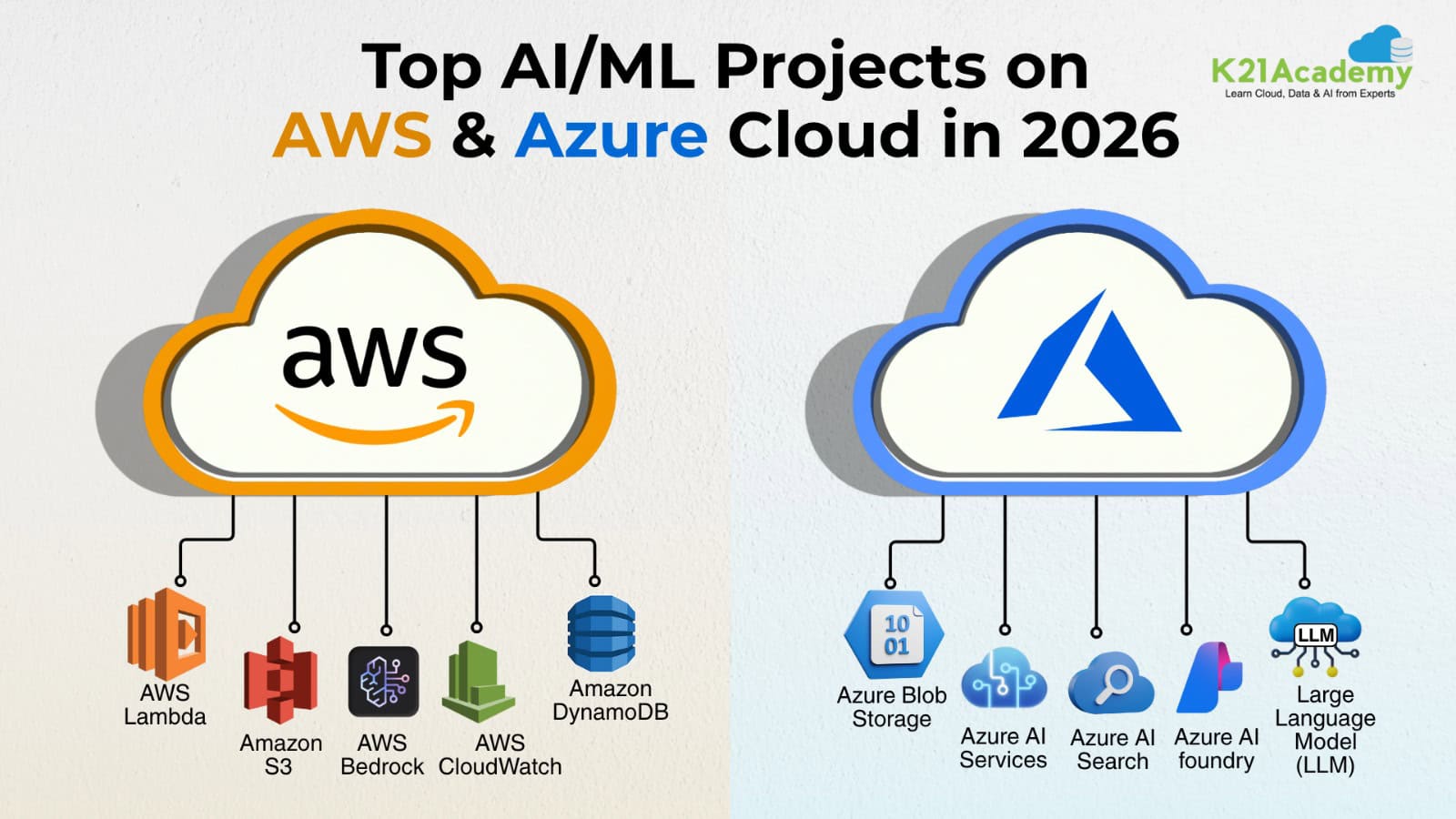



AI and Machine Learning (ML) are evolving at rapid speed, and businesses are increasingly turning to cloud platforms like AWS and Azure to drive innovation and scale their solutions. Whether you’re just starting your AI/ML journey or looking to take your skills to the next level, hands-on, real-world projects are the key to unlocking your potential. With powerful tools and services from AWS and Azure, you can dive into generative AI, machine learning models, and data engineering to create impactful, cutting-edge applications.
In this blog, we’ll take a closer look at the Top AI/ML Projects to Tackle in 2026 using the latest AWS and Azure technologies. These projects are designed to help you sharpen your technical skills, build a standout portfolio, and catch the eye of future employers. Ready to explore the exciting world of cloud-powered AI? Let’s dive in!

- The Power of AWS & Azure for AI/ML Projects
- Azure AI/ML Projects in 2026
- AWS AI/ML Projects in 2026
- Key Takeaways from AWS & Azure AI/ML Projects
- How to Get Started with AWS & Azure AI/ML Projects
- Conclusion
- Frequently Asked Questions

The Power of AWS & Azure for AI/ML Projects:
Both AWS and Azure are leading cloud platforms that provide powerful tools and services to build scalable and secure AI/ML solutions. These platforms offer a robust set of features that make them the go-to choices for AI and machine learning professionals. Here’s how both platforms stand out for AI/ML development:
-
AWS (Amazon Web Services): AWS has an extensive portfolio of AI/ML services, including SageMaker, Comprehend, Lex, and Rekognition, enabling developers to build, train, and deploy machine learning models at scale. AWS also excels in MLOps (Machine Learning Operations), automating workflows and making it easy to manage AI solutions across different environments.
-
Azure: Azure provides an integrated suite of AI/ML tools like Azure Machine Learning, Azure Databricks, and Azure Cognitive Services. These tools cater to various AI/ML applications, from predictive analytics to intelligent automation, and are seamlessly integrated with Microsoft’s ecosystem, making Azure an excellent choice for enterprise-level solutions.
Both platforms offer unmatched flexibility, security, and scalability, making them the ideal choice for developing real-world AI/ML applications.
Related Reading : AWS AI/ML: Hands-On Labs & Projects for High-Paying Careers in 2025
Azure AI/ML Projects in 2026 :
1.Chatbot Using Azure AI Search and OpenAI With Our Own Data

Project Overview
Creating an intelligent chatbot is one of the most exciting applications of AI today. In this project, we combine Azure AI Search and Azure AI Foundry to build a chatbot that can understand natural language and provide accurate responses based on your own data. Unlike traditional chatbots that rely on pre-programmed scripts, this bot leverages AI search to gather insights from vast amounts of data, making it more adaptive and smarter over time. It serves as a bridge to enhance user experience by providing context-specific answers, ensuring that the data from your own systems and knowledge base is put to effective use.
Key Features
- Natural Language Understanding – The chatbot is powered by OpenAI and can understand user queries and provide context-aware responses.
- AI Search Integration – Integrating Azure AI Search allows the bot to efficiently search through your data, ensuring highly accurate and relevant responses.
- Custom Data Support – It can be trained on your proprietary data, making it highly specific to your organization’s needs.
- Continuous Learning – As users interact with the bot, it learns and improves its performance, providing better user satisfaction over time. However, it’s important to note that continuous learning in the traditional sense, such as real-time adaptation to new data, typically requires a retraining pipeline. You can integrate fresh data into the chatbot by periodically fine-tuning the model to ensure the bot remains up to date with evolving information.
Technologies Used
- Azure AI Search – Powers intelligent search capabilities within your data.
- OpenAI API – Used for natural language processing and understanding.
- Azure Functions – Helps in orchestrating the bot logic and managing backend processes.
- Azure Cognitive Services – Enhances the bot’s capabilities with AI-powered language understanding.
- Azure Blob Storage – Allows for scalable and secure storage of unstructured data.
Skills to Develop
- Natural Language Processing – Understand how language models work to interpret and generate human-like responses.
- Data Integration – Learn how to integrate your own datasets for creating tailored experiences.
- AI Ethics – Understand the responsibility of using data to create a fair, unbiased, and safe AI environment.
Advantages
- Improved Customer Experience – Chatbots can engage with users 24/7, providing fast and personalized interactions.
- Reduced Support Load – Automates common queries, freeing up human agents for more complex issues.
- Scalability – Easily scales as your data grows, offering high availability and performance.
2.Synthetic Data Generation with LLM

Project Overview
Synthetic data is becoming an essential tool in AI/ML development. This project uses Large Language Models (LLMs) to generate synthetic datasets that mimic real-world data but are completely artificial. These datasets can be used for training models when real data is scarce or difficult to obtain. By leveraging Azure’s AI tools and LLM capabilities, this project helps you generate realistic, privacy-compliant data for model training and testing.
Key Features
- Data Augmentation – Use synthetic data to expand your training datasets, making AI models more robust.
- Privacy Preservation – Since the data is generated synthetically, it eliminates privacy concerns while training AI models.
- High-Quality Data Generation – LLMs are trained to generate diverse and realistic data that replicates patterns in real-world data.
- Cost-Effective – Avoid the costs and time associated with collecting and processing real data.
- Data Augmentation: Using synthetic data to augment training datasets is a well-established practice to increase model robustness when real data is scarce. The key benefit here is expanding data variety without additional data collection.
- Privacy Preservation: This is one of the major advantages of using synthetic data, particularly when working with sensitive information, such as in healthcare or finance. By generating data artificially, you can avoid privacy concerns associated with real user or customer data.
- High-Quality Data Generation: LLMs like OpenAI’s GPT models are designed to generate diverse, high-quality data that can replicate real-world patterns. The key here is to ensure the data generated is coherent and realistic, which the LLM excels at.
- Cost-Effective: Generating synthetic data can be much cheaper than gathering real-world data, especially in environments where data collection is expensive or time-consuming. This is particularly useful for scaling AI models without the associated costs of data procurement.
Technologies Used
- Azure AI – Azure provides powerful AI capabilities and is well-suited for managing and running synthetic data generation projects. It enables seamless integration with other Azure services such as Azure Cognitive Services and Azure Machine Learning for scaling and management.
- Azure Machine Learning – Azure ML is perfect for managing AI/ML workflows, including the orchestration of synthetic data generation pipelines. This technology ensures that your synthetic data generation process is scalable, reproducible, and reliable.
- OpenAI API – The OpenAI API powers the LLM for generating synthetic data. You can use GPT models or other fine-tuned LLMs to generate realistic data points, and the integration with Azure makes it easy to scale the process.
Skills to Develop
- Synthetic Data Creation – Learn to use LLMs for generating training data and how it can be used in real-world AI models.
- Data Ethics – Gain a deep understanding of how to use synthetic data responsibly and within privacy regulations.
- Model Testing – Learn how to test AI models effectively using both real and synthetic data.
Advantages
- Data Accessibility – Synthetic data opens up opportunities for AI development when real data isn’t available.
- Bias Reduction – Synthetic data can be designed to reduce biases present in the original data.
- Improved Model Accuracy – More diverse training data can help models generalize better, reducing overfitting.

3.Building RAG Application with Langchain

Project Overview
Building a RAG (Retrieval-Augmented Generation) application is an exciting challenge where you combine the power of retrieval-based and generation-based models to improve AI model performance. This project uses Langchain, a framework designed for working with AI models like OpenAI, to build intelligent applications that can retrieve relevant information and generate contextually accurate answers. RAG applications are ideal for tasks where the model needs to provide up-to-date information or answer complex queries from large datasets.
Key Features
- Retrieval-Augmented Generation – Enhances generated content with relevant data retrieved from an external source.
- Dynamic Querying – The model can query external databases, documents, or APIs in real-time to generate responses.
- Multi-Source Integration – Combines data from multiple sources for richer, more accurate answers.
- Improved Accuracy – By augmenting generated content with retrieved data, the application improves accuracy and relevance.
Technologies Used
- Langchain – The core framework used to build the RAG application.
- OpenAI API – Powers the generation part of the model.
- Azure Cognitive Search – Used for retrieving relevant information from large datasets.
- Azure Functions – Orchestrates the integration between data retrieval and response generation.
Skills to Develop
- Langchain Development – Learn how to build robust and scalable applications using Langchain.
- Data Integration – Master the art of integrating different data sources to enhance AI output.
- Advanced AI Concepts – Explore retrieval-augmented generation and how it improves AI response accuracy.
Advantages
- Faster, More Accurate Responses – The combination of retrieval and generation ensures the AI model provides the best of both worlds.
- Real-Time Data Access – Ideal for applications that need up-to-date information, such as financial or medical domains.
- Customizable Solutions – Can be tailored to specific industries, making it flexible and powerful.
4.Crafting Smart Ads with AI

Project Overview
In this project, we will build a system that automatically generates personalized ads for a fashion store’s inventory by leveraging Azure Cosmos DB to store product data and OpenAI models (GPT-4) to generate text. DALL-E 3 will create ad visuals, and a semantic search process will match the right products to the right advertisements.
Key Features
- Personalized Ads – Ads are tailored to the interests and behavior of users, maximizing relevance.
- AI Optimization – Machine learning models continuously learn and optimize ads for better performance.
- Audience Segmentation – Ads are directed at specific audience segments based on data insights.
- Dynamic Content Creation – Automatically generates multiple variations of ads for A/B testing and optimization.
- Automated Ad Generation – GPT-4 generates ad copy automatically, and DALL-E 3 creates images for the ads based on product descriptions.
- Semantic Product Matching – The system uses vector similarity search in Azure Cosmos DB to match products to the generated ads, ensuring the content is highly relevant.
- Interactive Ad Creation – Gradio UI makes the process simple and fast for users to generate personalized ads at the click of a button.
- AI-Powered Visuals – DALL-E 3 enhances the ad creation process by generating photorealistic product images based on textual descriptions.
Technologies Used
- Azure Machine Learning – Powers the AI models behind personalized ad targeting.
- Azure Cognitive Services – Used for analyzing user data and extracting actionable insights.
- Power BI – Visualizes ad performance data for actionable insights.
- Azure OpenAI (GPT-4) – Used for generating ad text automatically.
Skills to Develop
- Machine Learning for Marketing – Learn how to use AI for targeting and optimizing digital ads.
- Audience Segmentation – Understand how to effectively segment your audience for better ad performance.
- Data-Driven Decision Making – Learn to make decisions based on AI-generated insights for marketing campaigns.
- AI-Generated Content – Learn to use GPT-4 for text generation and DALL-E 3 for image generation to create personalized ads.
- Vector Search & Embeddings – Master the use of Azure Cosmos DB for semantic search and vector similarity to match products to ads.
- Interactive Application Development – Gain hands-on experience integrating Gradio for creating user-friendly interfaces for ad generation.
Advantages
- Higher Engagement – Personalized ads lead to better user engagement and conversion rates.
- Cost-Effective – Optimized ad campaigns reduce wastage and improve ROI.
- Data-Driven Optimization – Continuously improve ad performance with data-driven insights.
5.Multimodal RAG Agents Using Azure OpenAI

Project Overview
Building Multimodal RAG Agents combines the power of text, images, and other data types into a single intelligent agent. By leveraging Azure OpenAI and the RAG framework, this project aims to create agents that can process and respond to different types of inputs (text, images, voice) while retrieving relevant information from databases or external sources. These agents can be used in customer support, content generation, or even in healthcare applications.
Key Features
- Multimodal Inputs – The agent processes text via GPT-4, images via Azure AI Vision, and can be extended for voice using Azure Cognitive Services Speech.
- Dynamic Information Retrieval – The agent performs semantic searches using Azure AI Search and retrieves relevant documents, images, or data from external sources.
- Adaptive Responses – The agent adapts its responses based on the input type, whether it’s text, image, or future support for voice inputs.
- Cross-Platform Integration – Can be deployed on websites, mobile apps, and voice assistant platforms, ensuring accessibility and scalability.
Technologies Used
- Azure OpenAI – Powers the multimodal capabilities and generation engine.
- Langchain – Manages the RAG framework for dynamic information retrieval.
- Azure Cognitive Services – Includes Azure AI Vision for image captioning and OCR and Azure Speech Services for voice recognition (if integrated).
- Azure Functions – Orchestrates the agent’s operations, triggers external APIs, and manages workflows across the agent’s functionalities.
Skills to Develop
- Multimodal AI – Learn how to integrate text (using GPT-4), images (using Azure AI Vision), and eventually voice to build rich AI interactions.
- AI Agent Development – Master the use of Langchain for building dynamic retrieval-augmented systems, integrating with Azure AI Search and OpenAI models.
- Cross-Platform AI Integration – Gain experience deploying AI agents on web applications, mobile apps, and voice interfaces for wide accessibility.
Advantages
- Enhanced User Experience – Enhanced User Experience is valid, but highlight the multimodal capabilities and the ability to provide contextual answers based on real-time data.
- Flexible Applications – Flexible Applications could mention use cases in urban safety, customer support, and e-commerce, as those are key benefits.
- Efficient and Scalable – Scalable deployment using Azure’s robust cloud infrastructure.
AWS AI/ML Projects in 2026 :
1.Creating a Visual Ad for Dog Food using AWS Rekognition and Polly

Project Overview
In this project, we’ll use AWS Rekognition to analyze images of dogs and AWS Polly to create a voiceover for a dog food ad. The goal is to generate personalized and dynamic visual ads that are both engaging and relevant to the target audience. By analyzing dog images and customer preferences, AWS can help us craft a more compelling ad campaign that resonates with pet owners.
Key Features
- Image Analysis – AWS Rekognition identifies key features in dog images, such as breed and expression, to personalize the ad’s visual appeal.
- Voiceover Generation – AWS Polly converts written ad scripts into realistic speech, allowing for dynamic audio narration.
- Personalized Ads – Based on customer behavior, the ad can target different dog breeds or types, improving relevance.
- Automated Ad Generation – Use AWS services to automatically generate new ad visuals and voiceovers in real-time.
Technologies Used
- AWS Rekognition – Analyzes dog images and identifies key features to personalize ads.
- AWS Polly – Creates lifelike voiceovers for the ad.
- AWS Lambda – Orchestrates ad creation workflows, such as connecting image analysis with voice generation.
- Amazon S3 – Stores the generated visuals and voiceovers for easy retrieval and use.
Skills to Develop
- Image Recognition – Learn to use computer vision tools for analyzing and categorizing images.
- Voice Synthesis – Create engaging, personalized audio using AWS Polly.
- Marketing Automation – Automate the generation of dynamic ad content for targeted campaigns.
Advantages
- Enhanced Engagement – Personalized visuals and voiceovers lead to a higher level of engagement with the audience.
- Time and Cost Efficiency – Automating ad creation reduces the time and cost traditionally associated with manual ad production.
- Scalability – Easily generate hundreds of personalized ads for various audiences.
2.Evaluating AWS Bedrock Models

Project Overview
AWS Bedrock offers a powerful suite of generative AI models, allowing you to create and deploy models for a variety of use cases. In this project, we’ll evaluate multiple AWS Bedrock models to understand their performance, accuracy, and scalability. By testing different models in real-world scenarios, we’ll identify which ones are best suited for specific tasks, from natural language understanding to image generation.
Key Features
- Model Evaluation – Compare different AWS Bedrock models based on key metrics like accuracy, speed, and reliability.
- Performance Tuning – Learn to fine-tune models for better performance based on your use case.
- Scalability Testing – Evaluate how each model performs under heavy workloads or large-scale environments.
- Real-World Use Case Testing – Apply models to real-world data to gauge their practical effectiveness.
Technologies Used
- AWS Bedrock – Provides the foundation for deploying and testing generative AI models.
- Amazon S3 – Stores model data and performance metrics.
- AWS Lambda – Orchestrates the evaluation and comparison process.
- AWS CloudWatch – Monitors model performance and resource usage during evaluation.
Skills to Develop
- Generative AI – Understand how to use and evaluate generative models for different use cases.
- Model Optimization – Learn how to fine-tune AI models to suit specific needs and improve their performance.
- Cloud Performance Monitoring – Develop skills to monitor and scale AI models effectively using AWS tools.
Advantages
- Improved Model Selection – Evaluate multiple models to choose the best one for your specific task.
- Scalability – Ensure that your chosen models can scale with the demands of your application.
- Cost Efficiency – Fine-tuning and optimizing models can help reduce AWS costs by using only the most efficient models.

3.AI Stylist: Creating Personalized Outfit Recommendations

Project Overview
Fashion meets AI in this project, where we build an AI Stylist that provides personalized outfit recommendations based on user preferences and past purchase data. By leveraging AWS Personalize, we can use machine learning to analyze customer behavior and recommend outfits tailored to their style, body type, and preferences.
Key Features
- Personalized Recommendations – AWS Personalize recommends outfits based on user history, preferences, and style preferences.
- Fashion Trend Analysis – The AI stylist can analyze current fashion trends and incorporate them into recommendations.
- User Profiling – The system builds a unique profile for each user, improving the quality of recommendations over time.
- Scalable Deployment – Easily deploy and scale the system to recommend outfits for a large user base.
Technologies Used
- AWS Personalize – Powers the recommendation engine by analyzing user preferences.
- AWS S3 – Stores outfit data and user profiles.
- Amazon DynamoDB – Stores user interactions and behaviors for analysis.
- AWS Lambda – Integrates user data with the recommendation engine and updates profiles.
Skills to Develop
- Recommendation Systems – Learn to design and deploy personalized recommendation systems.
- Fashion Data Analysis – Understand how to analyze user data and trends to improve recommendation accuracy.
- Machine Learning in Retail – Explore the potential of AI in improving retail experiences and sales.
Advantages
- Personalized Shopping Experience – Customers enjoy a tailored shopping experience that fits their unique preferences.
- Increased Sales – Personalized recommendations can increase conversion rates and average order values.
- Customer Retention – Providing relevant and engaging recommendations helps retain loyal customers.
4.Real-Time Stock Data Processing with AWS Kinesis

Project Overview
In this project, we’ll use AWS Kinesis to process real-time stock market data, enabling users to monitor stock prices and trends instantly. By building a real-time data pipeline, you can process vast amounts of stock data and trigger actions based on certain thresholds—such as sending alerts when stock prices hit specific values.
Key Features
- Real-Time Data Streaming – AWS Kinesis ingests and processes stock data as it arrives in real-time.
- Alerting System – Configure automatic alerts based on predefined conditions, such as stock price changes.
- Data Visualization – Visualize live stock data using dashboards and real-time graphs for easy monitoring.
- Scalability – The system can scale to handle thousands of stock data points without latency issues.
Technologies Used
- AWS Kinesis – Streams and processes real-time data.
- Amazon CloudWatch – Monitors the performance and health of the real-time data stream.
- AWS Lambda – Automates the triggering of alerts and actions based on stock data.
- Amazon S3 – Stores processed stock data for historical analysis.
Skills to Develop
- Real-Time Data Processing – Learn to build scalable, low-latency data pipelines using AWS Kinesis.
- Alerting Systems – Configure and deploy real-time alerting systems for live data monitoring.
- Cloud Scaling – Understand how to scale data processing systems to handle large, streaming datasets.
Advantages
- Instant Decision Making – Real-time stock data enables quick decision-making for traders and investors.
- Automated Alerts – Set up notifications for key price points, minimizing the need for manual monitoring.
- Scalable and Efficient – AWS Kinesis handles high throughput and large-scale data streams with ease.
5.Predicting Customer Churn Using ML Model on AWS SageMaker

Project Overview
In this project, we’ll use AWS SageMaker to build a machine learning model that predicts customer churn. By analyzing historical customer data, we can identify patterns and behaviors that indicate when a customer is likely to leave. This prediction can help businesses take proactive steps to retain customers and improve satisfaction.
Key Features
- Customer Segmentation – Identify high-risk customers based on behavior patterns and demographics.
- Churn Prediction – Build and train a machine learning model to predict customer churn with high accuracy.
- Proactive Retention – Use the model’s predictions to trigger retention campaigns or personalized offers to prevent churn.
- Model Evaluation – Evaluate the model’s performance using precision, recall, and F1 scores.
Technologies Used
- AWS SageMaker – Powers the model training and deployment for churn prediction.
- AWS Lambda – Triggers retention strategies or alerts based on churn predictions.
- Amazon S3 – Stores customer data and model output for further analysis.
- Amazon RDS – Stores structured customer data for analysis and model training.
Skills to Develop
- Machine Learning Model Training – Learn how to build and evaluate models for predicting customer behaviors.
- Customer Analytics – Gain insights into customer behavior and how to use this data to drive business decisions.
- Data Science in Business – Understand how machine learning can be applied to solve real-world business problems.
Advantages
- Customer Retention – Predicting and preventing churn can help businesses retain valuable customers and reduce acquisition costs.
- Improved Marketing – Focus retention efforts on high-risk customers, increasing their lifetime value.
- Actionable Insights – Leverage data-driven insights to make informed business decisions.
Key Takeaways from AWS & Azure AI/ML Projects
-
Master Cloud AI Tools
Get hands-on with AWS SageMaker, Azure Machine Learning, and other powerful AI services to build and deploy production-ready models. From personalized chatbots to churn prediction, you’ll learn how to create AI-driven applications that solve real-world business problems.
-
Real-Time Data Processing & Model Optimization
Learn to process real-time data with AWS Kinesis or Azure Cognitive Search, and fine-tune models for accuracy and performance. You’ll gain experience in scaling AI solutions and ensuring they work efficiently at any level.
-
End-to-End AI Solutions
These projects will teach you to build complete AI systems—whether it’s generating personalized ads, predicting customer behavior, or processing multimodal inputs like text and images. You’ll gain the skills needed to take AI solutions from concept to deployment.
-
Security & Ethical AI
With projects focused on IAM, data privacy, and bias mitigation, you’ll learn to create AI solutions that are not only effective but also ethical and secure, meeting enterprise-grade standards.
-
Industry-Relevant Experience
These projects aren’t just theoretical—they reflect real-world use cases in e-commerce, finance, marketing, and customer service, preparing you for the challenges of building AI solutions that drive business value.
Related Readings: Amazon Bedrock Explained: A Comprehensive Guide to Generative AI
Related Readings: AWS AI, ML, and Generative AI Services and Tools
How to Get Started with AWS & Azure AI/ML Projects
Choose Your Platform
- AWS and Azure both offer powerful cloud services for AI/ML development. AWS has a more comprehensive set of tools for ML workflows and MLOps, while Azure provides excellent integration with Microsoft’s AI technologies and is perfect for enterprise-level applications.
Set Up Your Environment
- AWS: Start with AWS Free Tier to get hands-on experience with various services like Sage Maker, Comprehend, and Recognition.
- Azure: Use the Azure Free Account to access services like Azure Machine Learning and Azure Data bricks.
Work on Projects
- Start building real-world projects like those mentioned above. Use AWS AI/ML Hands on Labs or Azure AI/ML Hands on Labs to follow guided tutorials and get hands-on experience.
Get Certified
- After completing your projects, consider getting certified in AI/ML on AWS or Azure. Certifications like AWS Certified AI Practitioner (AIF-C01) or Azure AI Engineer (AI-102) can greatly enhance your employability.
Related Readings: Amazon SageMaker AI For Machine Learning: Overview & Capabilities
Conclusion
As you immerse yourself in these AI/ML projects on AWS and Azure, you’ll not only refine your technical skills but also build a robust portfolio that highlights your expertise. Whether you’re aiming to advance in your current role or make a seamless transition into AI, these hands-on projects will equip you with the practical experience necessary to excel in the ever-evolving field of AI.
Start now, and embark on an exciting journey into the world of AI and machine learning in 2026. With these powerful cloud platforms at your disposal, the opportunities for growth and innovation are limitless!
Frequently Asked Questions
Start by signing up for a free account on AWS or Azure, explore their AI/ML services, and follow hands-on labs to gain practical experience.
Basic knowledge of Python and machine learning concepts helps, but many tools like AWS SageMaker and Azure ML offer low-code or no-code options for beginners.
Yes, both platforms offer services like AWS Lex and Azure Bot Services to easily build, deploy, and manage AI chatbots.
Some top projects include building AI chatbots, fraud detection systems, predictive analytics models, image recognition, and generative AI applications using tools like AWS SageMaker, Azure ML, and AWS Bedrock.
While coding knowledge (especially in Python) is beneficial, both AWS and Azure offer low-code or no-code solutions like SageMaker Canvas and Azure ML that make it easy to build AI models without extensive programming experience. How do I get started with AWS or Azure AI/ML?
Do I need coding skills for AWS AI/ML projects?
Can I build AI chatbots on AWS or Azure?
What are the best AI/ML projects to work on in AWS and Azure?
Do I need coding experience for AWS or Azure AI/ML?

![Microsoft Agentic AI Business Solutions Architect [AB-100] | K21 Academy](https://test.k21academy.com/wp-content/uploads/2025/11/Microsoft-Agentic-AI-Business-Solutions-Architect-AB-100-Exam-Overview1.png)