



Machine Learning isn’t just a tech buzzword anymore—it’s the quiet powerhouse running behind the scenes of your favorite apps, financial tools, healthcare systems, and even marketing campaigns. Simply put, it’s a branch of AI that teaches computers to learn from data and get better over time—without someone having to spell out every instruction.
By 2025, the ML landscape has changed significantly. Computing power is more affordable than ever, data is expanding at breakneck speed, and smart system development tools are more sophisticated (and user-friendly) than ever. In addition to being faster, today’s machine learning platforms are also more user-friendly, cloud-based, and frequently have integrated “agentic” features that aid in automating the entire AI lifecycle.
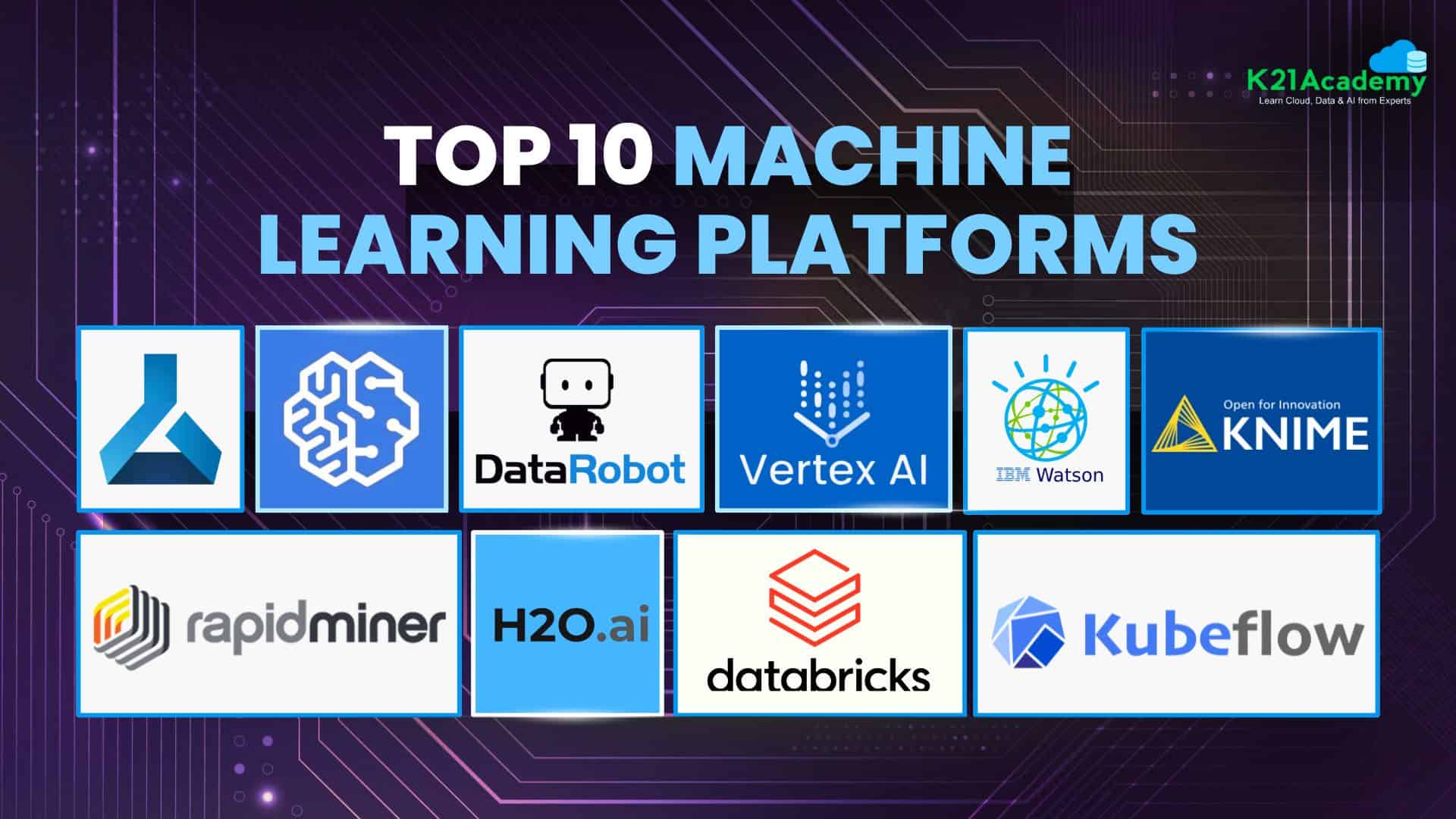
In this blog, we’ll dive into the top 10 machine learning platforms of 2025—the ones helping businesses turn ideas into intelligent, scalable AI solutions faster than ever.
Table of Contents:
- What is Machine Learning?
- Introduction to ML platforms
- 10 Popular Machine Learning Platforms
- Conclusion

What is Machine Learning?

Before we dive in, let’s ensure we’re on the same page.
Machine learning is a subset of artificial intelligence that allows computers to learn and improve without being explicitly programmed. It involves developing models and algorithms capable of analysing data, identifying patterns, and making decisions based on that data.
In simple language, it is a state-of-the-art application of artificial intelligence that gives the ability to the system to learn and improve automatically through experiences.
Introduction to ML platforms
A machine learning platform is essentially a toolbox that equips data scientists and developers with the necessary resources to create, manage, and deploy machine learning models. This platform simplifies the process of implementing machine learning, providing an integrated space for tasks like data handling, algorithm selection, model training, validation, and deployment. It’s like a one-stop shop for all your machine learning needs!
10 Popular Machine Learning Platforms
Starting your machine learning journey can be both exciting and overwhelming. It’s crucial to choose straightforward tools and here is a list of 10 popular ML platforms:
1. Google Vertex AI

Overview
Google Vertex AI is a unified ML platform that allows data scientists and engineers to build, deploy, and scale ML models faster by using AutoML or custom training.
Key Features
- Unified API for AutoML and custom models
- Integration with BigQuery, Dataproc, and GenAI (Gemini)
- Built-in MLOps pipeline (Vertex Pipelines)
- Model monitoring & feature store
- Support for large foundation models (via Gemini 1.5)
Pricing
- Vertex AI Workbench: Free tier available; pay-as-you-go pricing starts at $0.10/hour.
- Training & Prediction: Varies by instance type (e.g., n1-highmem-8 starts at ~$0.38/hour).
- AutoML: Charged per node hour (e.g., ~$3.15/node hour for image models).
Related Readings: Custom Jobs in Vertex AI: Customize, Train, and Deploy Your Models
2. AWS SageMaker

Overview
Amazon SageMaker is a comprehensive ML service that covers everything from data preparation to model deployment. It is deeply integrated with the AWS ecosystem, making it ideal for large-scale cloud-native ML solutions.
Key Features
- SageMaker Studio for end-to-end development
- Built-in algorithms and pre-built notebooks
- SageMaker Autopilot for AutoML
- Model tuning, deployment, and monitoring
- Access to foundation models via Amazon Bedrock
Pricing
- Notebook instances: Start at ~$0.07/hour
- Training: Depends on instance type and duration
- SageMaker Autopilot: Starting at $0.0036 per second of processing
- Inference: Starting from ~$0.0004/second (real-time inference)
3. H2O.ai (Driverless AI)

Overview
H2O.ai provides both open-source tools and enterprise-grade AutoML platforms. Driverless AI is their flagship product for automating feature engineering, model building, and interpretability.
Key Features
- Automatic feature engineering
- XAI tools (Shapley values, decision plots)
- Support for GPU acceleration
- Seamless integration with Python and R
- Model deployment with REST APIs
Pricing
- Open-source version (H2O-3): Free
- Driverless AI: Subscription-based (starts at ~$30,000/year for enterprises)
4. Microsoft Azure Machine Learning

Overview
Azure Machine Learning offers a collaborative environment with support for automated ML, deep learning, MLOps, and responsible AI. It’s especially powerful for enterprises already using Microsoft services.
Key Features
- AutoML with model explanation and responsible AI dashboards
- Code-first and no-code development options
- Azure ML Designer (drag-and-drop interface)
- MLflow integration and MLOps pipelines
- Scalable compute clusters and notebooks
Pricing
- Basic tier: Free to start
- Enterprise-tier: Pay-as-you-go for compute, storage, and training
5. Kubeflow

Overview
Kubeflow is an open-source MLOps framework for running machine learning pipelines on Kubernetes. It is ideal for developers who want complete control over their ML stack.
Key Features
- Pipeline orchestration and experiment tracking
- Katib for hyperparameter tuning
- KFServing for model serving
- Notebook support (Jupyter, VS Code)
- Built-in authentication and RBAC
Pricing
- Free and open-source
- Requires Kubernetes infrastructure (cloud or on-premise)
- Deployment costs depend on infrastructure (e.g., GKE, AKS, EKS pricing)
6. Databricks (with MLflow)

Overview
Databricks combines the power of Apache Spark with collaborative notebooks and MLflow for model tracking, training, and lifecycle management.
Key Features
- Unified data and AI platform
- Native support for big data + ML (Spark MLlib)
- MLflow for model management and deployment
- AutoML and hyperparameter tuning
- Lakehouse architecture for unified analytics
Pricing
- Standard plans: Pay-as-you-go based on Databricks units (DBUs)
- Typical costs: $0.27 to $0.55/DBU per hour
- Free community edition available
Related Readings: Prepare Data for Machine Learning with Azure Databricks
7. RapidMiner

Overview
RapidMiner is a visual ML platform aimed at both beginners and advanced analysts. It provides prebuilt templates, drag-and-drop workflows, and enterprise integrations.
Key Features
- 1500+ pre-built algorithms and functions
- Automated data prep and visualization
- Visual workflows with minimal coding
- Real-time model scoring and deployment
- Connectors to databases, Hadoop, Spark, etc.
Pricing
- Starter (Free): Up to 10,000 data rows
- Professional: Starts at $2,500/user/year
- Enterprise: Custom pricing for large teams
8. DataRobot

Overview
DataRobot is an enterprise AutoML platform that automates the entire machine learning lifecycle—from data ingestion to deployment and monitoring.
Key Features
- Drag-and-drop interface with no-code/low-code support
- AutoML with explainable AI (XAI)
- Time-series forecasting, anomaly detection
- Model monitoring and retraining automation
- Strong governance and compliance tools
Pricing
- Pricing depends on data volume, users, and features
- Offers limited trials with demo datasets
9. KNIME Analytics Platform

Overview
KNIME is a free, open-source platform for building data science workflows using a visual, modular interface. It also supports Python, R, and Spark extensions.
Key Features
- Drag-and-drop workflow builder
- Wide plugin ecosystem for ML, NLP, image processing
- Python, R, Java integration
- Workflow automation and scheduling
- Scalable execution with KNIME Server
Pricing
- KNIME Desktop: Free
- KNIME Server: Starting at ~$10,000/year (for team collaboration and automation)
10. IBM Watson Studio

Overview
Watson Studio combines data science, ML, and AI model development with enterprise-grade compliance and explainability features.
Key Features
- AutoAI for model automation
- Visual drag-and-drop model builder
- Open-source libraries (scikit-learn, PyTorch, TensorFlow)
- Tools for explainable and trusted AI
- Hybrid/multi-cloud support
Pricing
- Lite plan: Free (10 capacity unit-hours/month)
- Standard plan: Starts at $99/month
- Enterprise: Custom pricing for large organizations
Conclusion
The machine learning ecosystem in 2025 is incredibly diverse. Whether you need a low-code AutoML tool, an enterprise-ready MLOps suite, or an open-source customizable framework, there’s a platform designed for your specific needs.
If you’re just starting out, machine learning platforms like RapidMiner, KNIME, or H2O.ai are great. For advanced teams and big data workflows, Databricks, Vertex AI, and SageMaker shine.
Frequently Asked Questions
What are the components of a machine learning platform?
Key components include data management tools, a variety of prebuilt and custom algorithm options, model training and validation capabilities, and model deployment and monitoring.
Can I use a machine learning platform without any programming knowledge?
Knowing the fundamentals of programming can greatly improve your use and understanding of machine learning platforms, even though some of them have automated functions and user-friendly interfaces that require no programming expertise. It's helpful to have some programming expertise because certain complex tasks may involve coding.
Are machine learning platforms only for large enterprises?
No, machine learning platforms serve a wide range of users, from small startups and individual researchers to major corporations. These platforms are appropriate for all kinds of users because to their scalability, which enables them to manage projects of all sizes and complexity.

![Microsoft Agentic AI Business Solutions Architect [AB-100] | K21 Academy](https://test.k21academy.com/wp-content/uploads/2025/11/Microsoft-Agentic-AI-Business-Solutions-Architect-AB-100-Exam-Overview1.png)