

The quest for a solution starts with the problem. Similarly, every data science project starts with the problem that enthusiasts like you aim to solve. Data Science is not all rainbows and unicorns, as it needs you to walk through the real-world task and use cases. Too often, Data scientists look around to solve their problems with Python. Python for Data Science is an unbeatable combination for today’s data scientists.
So in the following blog, we will see how python has made Data Science tasks easier and faster.
- What is Data Science?
- Python as a Language
- Data Science with Python
- Why Python for Data Science?
- Python Libraries for Data Science
- Conclusion
What is Data Science?
One of the hottest tech fields to be in right now! Agree? If you don’t believe let me show you some stats. Glassdoor ranks Data Science as the top job in demand, and even the U.S. Bureau of Labor Statistics says that data science will create around 11 million jobs by 2026. And if you look at the salary figure, Data scientists earn $113,000 per annum on average in US, and in India, it goes to Rs. 907,000 per annum on average.
Data Science is the field where data is at supremacy. One needs to deal with the vast amount of data, modern techniques and algorithms to deliver valuable insights and information. The significant component of Data Science tasks uses Machine Learning for predictive models.
Data Science is loaded with opportunities and major career prospects. Look at the various field where Data Science aid its contribution; you will not find any field that is not used: banking, logistics, manufacturing, airlines, technology, and healthcare.
Python as a Language
Python is a free, object-oriented, functional programming language that came in 1989 by Guido Van Rossum. The language got its name just for Rossum’s affinity towards the “Monty Python’s Flying Circus”. The motto that makes python one of my favourite languages emphasises the “Don’t Repeat Yourself (DRY)” principle.
Who uses Python majorly? The short answer: Data Scientist. And as of April 2021, 70% of data scientists reported using Python for their task. And it can be simply put that demand for python experts is rising and will continue to rise.
And Do you know, companies like Google, Youtube, Facebook, Instagram, Netflix, and NASA use python for many purposes like research, server-side, data analysis, forecasting, etc. Python can handle every job, from data cleaning to data visualisation to website development to executing embedded systems, all under unified language.
Data Science with Python
It is rightly said, data is an asset in today’s world and can take you to greater heights; if you know how to extract relevant information. And hence comes Python in the frame to help us to extract insights and visualise data.
- Data exploration & analysis.
- Pandas, NumPy, SciPy act as a helping hand from Python’s Standard Library.
- Data visualisation. A pretty self-explanatory name that helps in converting data into colourful visualisation in the form of graphs, charts and so on
- Matplotlib, Seaborn, is very helpful for this visualisation task.
What are the advantages of using Beautiful Soup for data extraction from HTML and XML files?
Beautiful Soup is a powerful Python library for parsing and extracting data from HTML and XML files. Its advantages include easy navigation of nested elements, handling of malformed markup, and compatibility with different parsers. It’s lightweight, well-documented, and simplifies tasks like web scraping and data extraction for developers.
How does Selenium automate tasks in web-based data science applications?
Selenium automates web-based tasks by simulating user interactions with web elements like buttons, forms, and links. In data science applications, it can extract dynamic data from websites, perform web scraping, and automate repetitive tasks such as filling out forms or navigating pages, making data collection more efficient.
Why is Python preferred for Data Science?
Python has grabbed attention as an attractive language due to Dynamic Typing, Self-sufficient libraries, powerful frameworks, and excellent community support.
Python is preferred for advanced data work under the umbrella of Machine Learning. Almost anything related to AI is the implementation of Machine Learning, and not to mention, a lot of Machine Learning tasks are done with python.
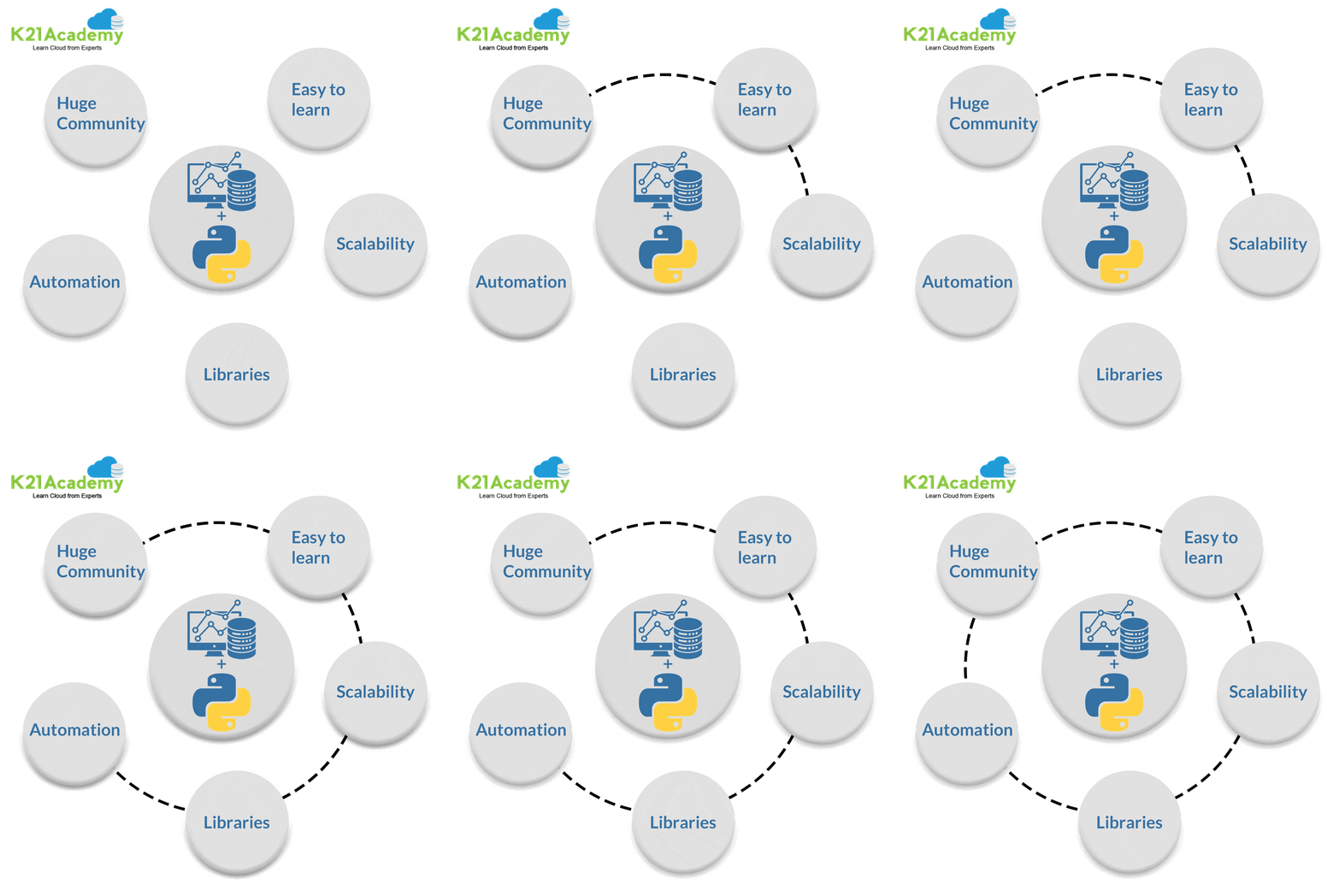
Python has other advantages too that put it ahead in the race; its capabilities to integrate with PaaS providers. This dynamic language is easy to learn and enables quick improvement; see the example below.
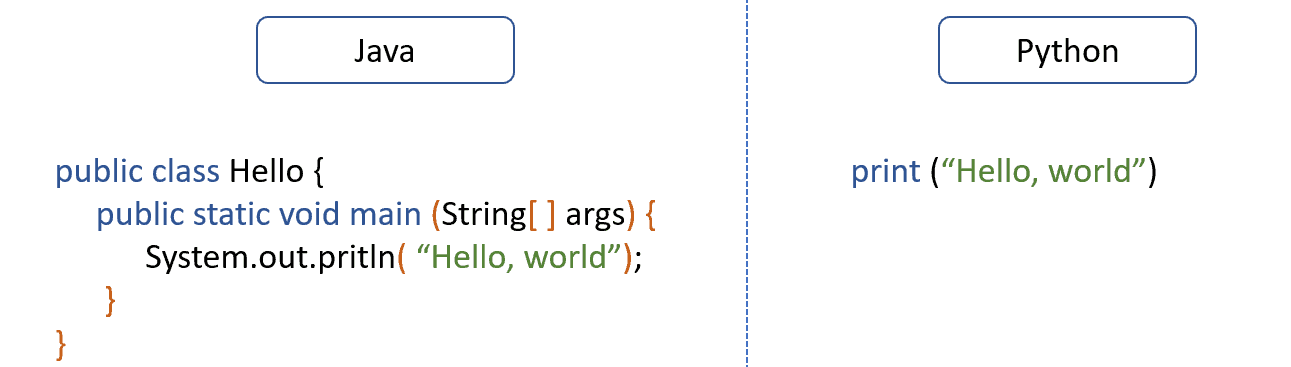
Here, rather than writing three lines, we can execute our task in a single line of code. So, imagine the overall time it saves.
Python Libraries for Data Science
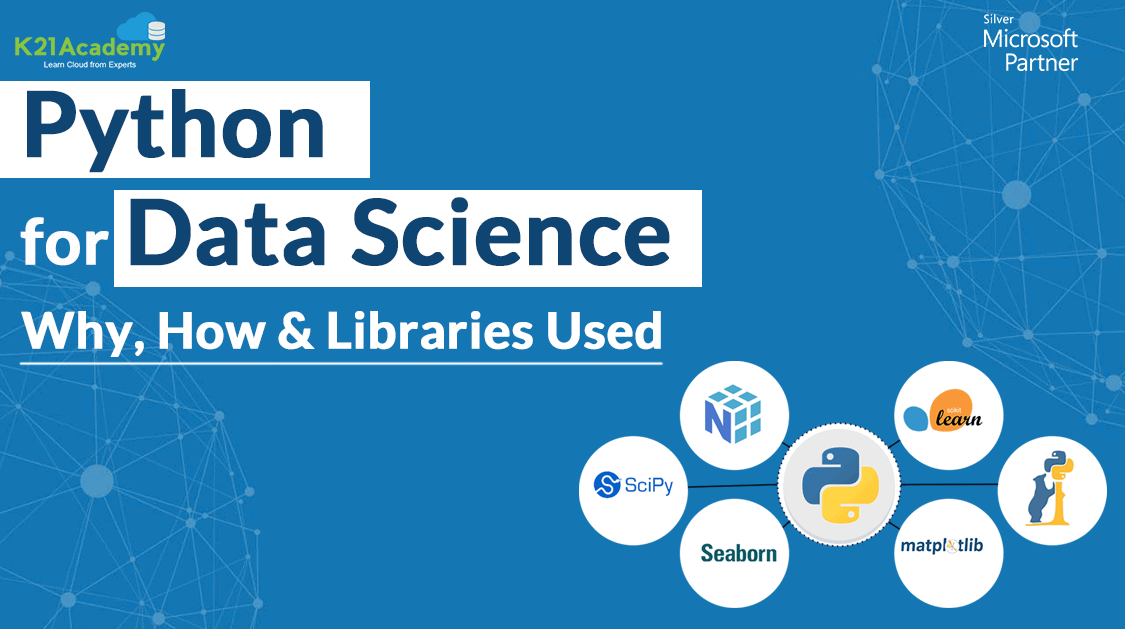
Python is a perfect fit for data science due to its full-fledged libraries rooted in many data science tasks like data cleaning, data analysis and varied data visualisation options.
I think it will be fair to say that “The Libraries make the Python language“: as its 72,000 libraries and still growing number attribute to its success.
NumPy
NumPy = Numerical Python
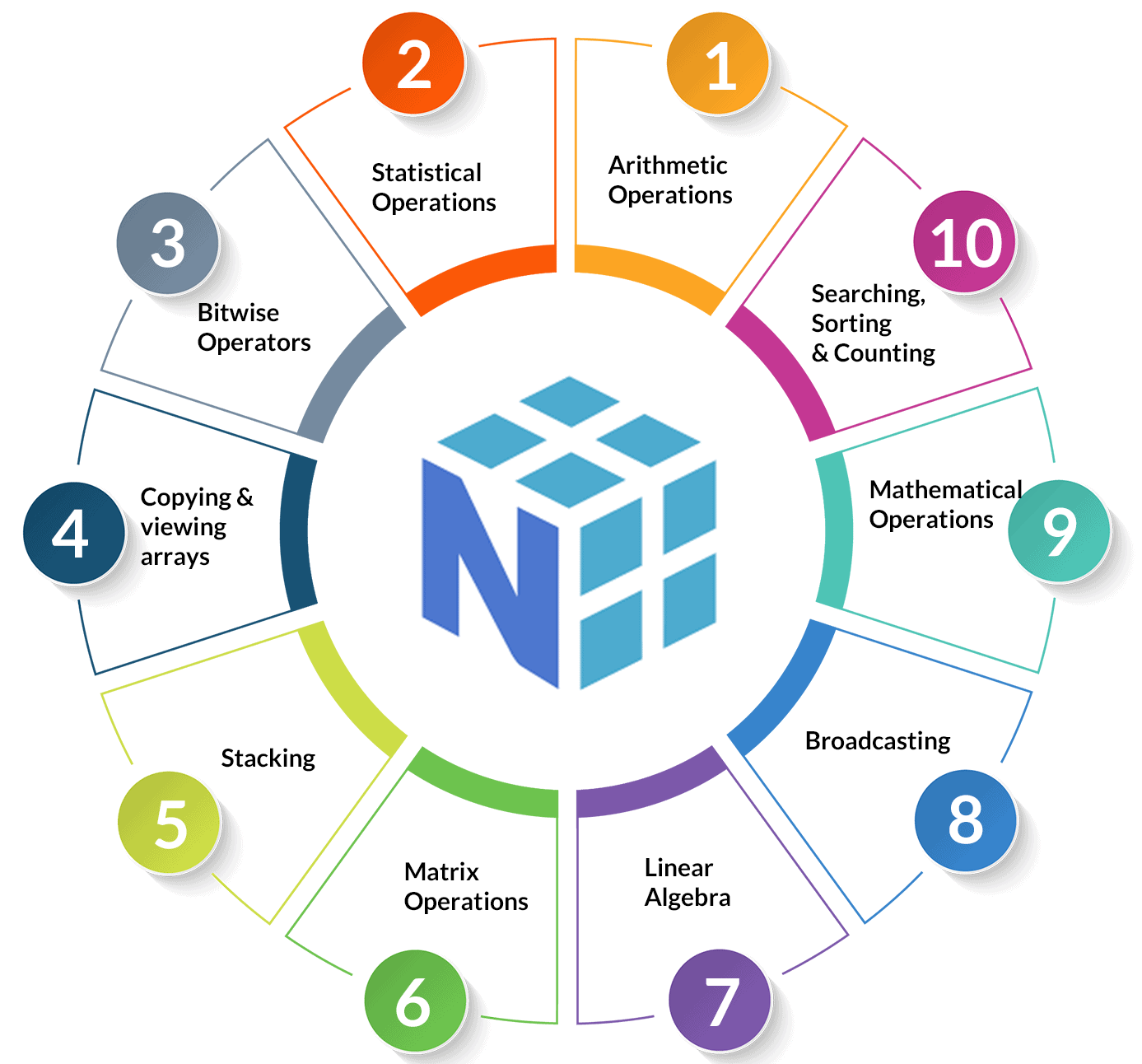
NumPy is a Python library for numerical computing. It provides high-level math functions along with data manipulations on large arrays and matrices. The library helps in enhancing computation speed and performance. The different use-cases of NumPy are shown in the image below.
Pandas

The Pandas library is known for its simplicity. It is preferred for data wrangling and data manipulation as it allows a user to read data in, change it, look for missing values. Not only does it help in manipulating structured data, but it is considered a go-to library to perform data analysis. Panda has two data structures.
Series – Store and Handle one-dimensional data.
d = {'a': 1, 'b': 2, 'c': 3}
>>> ser = pd.Series(data=d, index=['a', 'b', 'c'])
>>> ser
a   1
b   2
c   3
dtype: int64
Data Frame – Store and Handle two-dimensional data.
d = {'col1': [1, 2], 'col2': [3, 4]}
>>> df = pd.DataFrame(data=d)
>>> df
   col1  col2
0     1     3
1     2     4
Matplotlib
Matplotlib are known to simplify data visualisation task. It provides a solid foundation that provides a good sense of data and helps in creating graphical charts and interactive plots. Various plots or graphs that can be created with it are – bar graphs, Scatter plots, Pie charts, histograms, line graphs, area plots and so on.
Seaborn
Another library for data visualisation is built on top of Matplotlib. It helps in creating appealing statistical graphs. Seaborn is dataset-oriented, and declarative API helps in understanding data and different elements of the plot. The plotting function performs semantic mapping and statistical aggregation to build an informative plot.
SciPy
SciPy = Scientific Python
This open-source library is related to scientific and technical computing. SciPy is based on NumPy and provides user-friendly numerical integration, linear algebra, and statistics. SciPy is used for data optimisation and modification, algebra, special functions, etc. It is also preferred for ML tasks because it has all the algorithms you’ll want to use for regression, classification, and unsupervised learning.
Scikit-learn
It can be considered as a one-stop solution for the thriving needs of all the machine learning tasks. To give you insight, it helps you with supervised, unsupervised, SVM, k-means, logistic regression, DBSCAN, gradient boosting. It is built on top of NumPy, SciPy and Matplotlib and hence help in implementing data mining and data analysis task quickly.
Q : How does TensorFlow support machine learning model training for production?
A : TensorFlow supports machine learning model training for production by offering scalable and flexible tools like TensorFlow Serving for deployment, TensorFlow Lite for mobile and edge devices, and TensorFlow Extended (TFX) for end-to-end pipelines. These tools help streamline model development, ensure efficient deployment, and manage production workflows effectively.
Q : How does Requests assist in collecting data for data science?
A : The Requests library in Python simplifies web scraping and API data collection for data science projects. It allows easy handling of HTTP requests, fetching data from websites or APIs in various formats like JSON or XML. This streamlined data retrieval process aids in gathering large datasets for analysis and model building.
Q : How does PyTorch assist in transitioning from research to practice in machine learning?
A : PyTorch bridges the gap between research and practice by offering flexibility, ease of use, and scalability. Its dynamic computational graph allows for rapid prototyping and experimentation, making it ideal for research. At the same time, its optimized performance and strong deployment support enable smooth transitions into real-world applications.
Q : How does Keras help developers in machine learning?
A : Keras simplifies the process of building and training deep learning models by providing an intuitive, high-level API. It supports both beginners and advanced users, offering easy model design, quick prototyping, and seamless integration with popular frameworks like TensorFlow. This makes it an ideal tool for efficient machine learning development.
Q : What features does Scrapy offer for web crawling and data extraction?
A : Scrapy offers powerful features for web crawling and data extraction, such as automatic request handling, support for multiple data formats (JSON, CSV, XML), and built-in selectors for navigating HTML structures. It also provides an asynchronous architecture for efficient crawling, custom middlewares for enhanced functionality, and robust logging for debugging.
Q : Why are PyTest and PyUnit important for testing and debugging in data science applications?
A : PyTest and PyUnit are crucial for testing and debugging data science applications because they provide a structured framework to validate code behavior, ensuring accuracy and reliability. These tools help automate test cases, detect issues early, and maintain code quality, making them essential for scalable and error-free data science workflows.
Q : How is OpenCV used in real-time computer vision applications?
A : OpenCV is widely used in real-time computer vision applications for tasks like object detection, facial recognition, and motion tracking. It enables efficient image processing, feature extraction, and live video analysis by providing a range of algorithms. This makes it ideal for applications in security, robotics, and augmented reality.
Q : What role does Theano play in solving complex mathematical expressions?
A : Theano is a Python library used for efficient mathematical computations, particularly in deep learning and scientific computing. It allows for the definition, optimization, and evaluation of complex mathematical expressions, especially those involving multi-dimensional arrays. By leveraging GPU acceleration, Theano speeds up computation, making it ideal for large-scale data tasks.
Q : What image processing functions does Pillow add to Python?
A : Pillow, a Python Imaging Library (PIL) fork, provides a wide range of image processing functions. It supports opening, manipulating, and saving various image formats. Key features include resizing, cropping, rotating, filtering, adjusting brightness/contrast, converting between formats, and adding text or shapes. Pillow simplifies tasks like image enhancement and transformation.
Q :How does SimpleITK facilitate multi-dimensional image analysis?
A : SimpleITK simplifies multi-dimensional image analysis by providing efficient tools for handling n-dimensional images, including 2D, 3D, and higher-dimensional data. It supports various image processing techniques such as filtering, segmentation, and registration, making it ideal for medical and scientific image analysis in research and real-time applications.
Q : What image processing capabilities does Mahotas provide?
A : Mahotas is a Python library for image processing that offers fast, efficient functions for tasks such as filtering, feature extraction, and morphological operations. It supports operations like edge detection, thresholding, and object recognition, all implemented in C++ for high performance, making it suitable for real-time computer vision applications.
Python Libraries for Data Analysis
Python offers a rich set of libraries for data analysis, making it a go-to language for data scientists. Libraries like Pandas provide powerful data structures, such as DataFrames, for manipulating and analyzing data. NumPy enhances computational efficiency with multi-dimensional arrays and mathematical functions. For statistical analysis, SciPy is invaluable, while Matplotlib and Seaborn offer extensive plotting capabilities for data visualization. Scikit-learn is widely used for machine learning tasks, and Statsmodels supports statistical modeling. These libraries together offer a comprehensive ecosystem for effective data analysis and exploration.
Python Statistical Libraries
Python offers a rich set of statistical libraries that provide powerful tools for data analysis and statistical modeling. Libraries like SciPy and Statsmodels enable users to perform a wide range of statistical tests, hypothesis testing, regression analysis, and probability distributions. Pandas complements these by offering data manipulation and aggregation capabilities. For more advanced techniques, PyMC3 and Scikit-learn are excellent for machine learning and Bayesian statistical modeling. Together, these libraries offer a comprehensive ecosystem for performing sophisticated statistical analysis in Python.
Data Science Tools Python
In data science, Python offers a rich ecosystem of tools for data analysis, visualization, and machine learning. Libraries like Pandas and NumPy provide powerful data manipulation and analysis capabilities, while Matplotlib and Seaborn enable intuitive data visualization. Scikit-learn simplifies machine learning tasks, offering a range of algorithms for classification, regression, and clustering. For deep learning, TensorFlow and PyTorch are popular choices. Additionally, Jupyter Notebooks and Google Colab serve as interactive environments for prototyping and sharing code. These tools, combined with Python’s flexibility, make it a go-to choice for data science projects.
Conclusion
Data Science is a vast field, and python has emerged as a versatile language that helps in various applications and use-cases of data science. What we have seen in this blog is just the tip of the iceberg, Python has more to offer, and the faith of tech giants like Google has secured Python top spot in the Data Science field.
Related References
- Visit our YouTube channel “K21Academy”
- Join Our Generative AI Whatsapp Community
- Introduction to Recurrent Neural Networks (RNN)
- Introduction To Data Science and Machine Learning
- Deep Learning Vs Machine Learning
- Introduction to Artificial Neural Network in Python
- Natural Language Processing with Python
Next Task: Enhance Your Azure AI/ML Skills


![Microsoft Agentic AI Business Solutions Architect [AB-100] | K21 Academy](https://test.k21academy.com/wp-content/uploads/2025/11/Microsoft-Agentic-AI-Business-Solutions-Architect-AB-100-Exam-Overview1.png)