




The LangChain Expression Language (LCEL) is one of the most potent yet frequently overlooked capabilities of working with LangChain. LCEL is the foundation for creating, structuring, and optimizing intricate LLM-powered applications; it is more than just syntactic sugar.
We’ll go into great detail about what LCEL is, why it matters, and how to become proficient with it in this book. LCEL will significantly simplify and optimize your process, regardless of your level of experience, from a novice experimenting with chains to a seasoned developer creating production-ready AI agents.
Table of contents:
- What is LCEL
- Why LCEL matters
- Key Features
- Benefits of LangChain Expression Language
- Limitations of LCEL
- How LCEL Enhances LangChain Development
- Key Concepts in LCEL
- LCEL Syntax
- Future of LCEL
- Conclusion
What is LangChain Expression Language (LCEL)?

A domain-specific language (DSL) within LangChain, LangChain Expression Language (LCEL) offers a standardized method for creating components such as output parsers, retrievers, models, prompts, and more.
- It is declarative: You describe what you want to happen.
- It is composable: You can combine small, reusable components into complex pipelines.
- It is lazy-evaluated: Chains aren’t executed until you call .invoke(), .stream(), or .batch().
- It is runtime flexible: Works seamlessly in synchronous, asynchronous, streaming, and batch modes.
In short, LCEL makes it easy to define, extend, and execute AI workflows without rewriting boilerplate code.

Why LCEL matters?

Traditionally, developers used imperative Python code to link LangChain modules together. This quickly became messy for:
- Complex chains (e.g., retrieval + LLM + parsing + memory).
- Switching execution modes (sync vs async vs streaming).
- Debugging pipelines.
LangChain Expression Language solves these challenges by introducing a unified syntax for expression composition. Benefits include:
- Composable Pipelines – Connect retrievers, models, and parsers like Lego blocks.
- Performance – Optimized execution (parallelism, lazy evaluation).
- Consistency – Same chain works with sync, async, streaming, or batch.
- Maintainability – Declarative design is easier to extend and debug.
Related Readings: Understanding RAG with LangChain
Key Features of LangChain Expression Language
Let’s see the key features of LangChain Expression Language:
- Declarative Syntax Using Pipe Operators: Runnables are joined with the pipe | operator to form chains, which produce a distinct data flow from left to right.
- Parallel Execution: Utilising RunnableParallel, this feature facilitates the simultaneous execution of separate processes, lowering end-to-end latency.
- Ensured Asynchronous enable: All chains enable high-throughput use cases, such as web servers, by operating asynchronously by default.
- Streaming Output: Enhances responsiveness by enabling incremental streaming, which speeds up the time-to-first-token from language models.
- Smooth Deployment with LangServe: Chains may be set up in production settings with ease, thanks to fallbacks, retries, and scaling support.
Related Readings: How to Create an AI Agent
Benefits of using LangChain Expression Language
- Developer Productivity & Simplicity: Significantly less boilerplate code. Faster iteration is made possible by developers describing the chain’s functions rather than its operation.
- Enhanced Performance: Runtime enhancements such as streaming and parallel execution reduce latency and streamline processes for real-time applications.
- Better Debugging and Monitoring: By automatically tracking all intermediate steps and data flows, integration with LangSmith simplifies debugging.
- Flexibility: Adaptable to a variety of uses, such as business automation, conversational AI, retrieval-augmented generation, and more.
Limitations of LCEL
- Linear Structure: Because LCEL chains often proceed step-by-step, it might be challenging to create processes with dynamic branching or intricate decision-making.
- Complex State Management: It can be challenging to manually handle the state of a conversation or workflow throughout several turns, which adds complexity to the code.
- Challenges with Tool Integration: It can be difficult to use and coordinate several external tools within LCEL chains, particularly when tool utilisation needs to fluctuate.
- Problems with Debugging and Scalability: It can be challenging to debug long or nested LCEL chains, and because of its more recent design, stability and performance may differ in intricate production use cases.
How LCEL Enhances LangChain Development
LCEL takes LangChain development to the next level by making complex AI workflows simpler, faster, and more reliable.
- Simplifies pipelines: Build complex workflows with clean, declarative syntax instead of verbose imperative code
- Composable & modular: Connect prompts, models, retrievers, and parsers like Lego blocks.
- Execution flexibility: The same chain remains unchanged when running in batch, streaming, async, or sync modes.
- Reusable & maintainable: Pipelines are simple to extend, debug, and reuse in different applications.
- From prototype to manufacturing: Transition from notebook experiments to reliable, production-ready systems with ease.
Key Concepts in LCEL
Let’s break down the building blocks of LangChain Expression Language:
1) Runnables
A Runnable is an abstract computation unit (like a function but composable). Everything in LCEL is a Runnable. Every Runnable exposes standard methods:
.invoke(input) → single input/output.
.batch(inputs) → multiple inputs.
.stream(input) → token streaming.
.ainvoke(), .abatch() → async versions.
2) Operators
LangChain Expression Language uses operators to chain and compose runnables.
Pipe (|) → Sequential composition: Takes output of one component and feeds it to the next.
chain = prompt | llm | output_parser
Dictionary ({}) → Parallel mapping: Fetches context and original question in parallel.
chain = {
    "question": RunnablePassthrough(),
    "context": retriever
} | prompt | llm
RunnableSequence → Explicit pipeline declaration
from langchain.schema.runnable import RunnableSequence
chain = RunnableSequence(first=prompt, middle=[llm], last=parser)
Branching (RunnableBranch) → Conditional logic
from langchain.schema.runnable import RunnableBranch
branch = RunnableBranch(
    (lambda x: "math" in x.lower(), math_chain),
    (lambda x: True, default_chain)
)
3) Execution Modes
LCEL chains support multiple runtime modes without code changes that make the same pipeline reusable across notebooks, APIs, or production servers.
Synchronous → .invoke(input)
Asynchronous → .ainvoke(input)
Batch → .batch([inputs])
Streaming → .stream(input)
4) Data Transformation
LangChain Expression Language supports structured transformations that ensure smooth flow between retrievers, LLMs, and downstream systems.
RunnablePassthrough() – Forwards input unchanged.
RunnableLambda(fn) – Wraps Python functions.
Output parsers (e.g., StrOutputParser, PydanticOutputParser).
5) Error Handling & Retry
LCEL integrates with LangChain’s retry and fallback system. This adds resilience to LLM-powered applications.
from langchain.schema.runnable import RunnableRetry
chain = RunnableRetry(llm, max_attempts=3)
LCEL Syntax

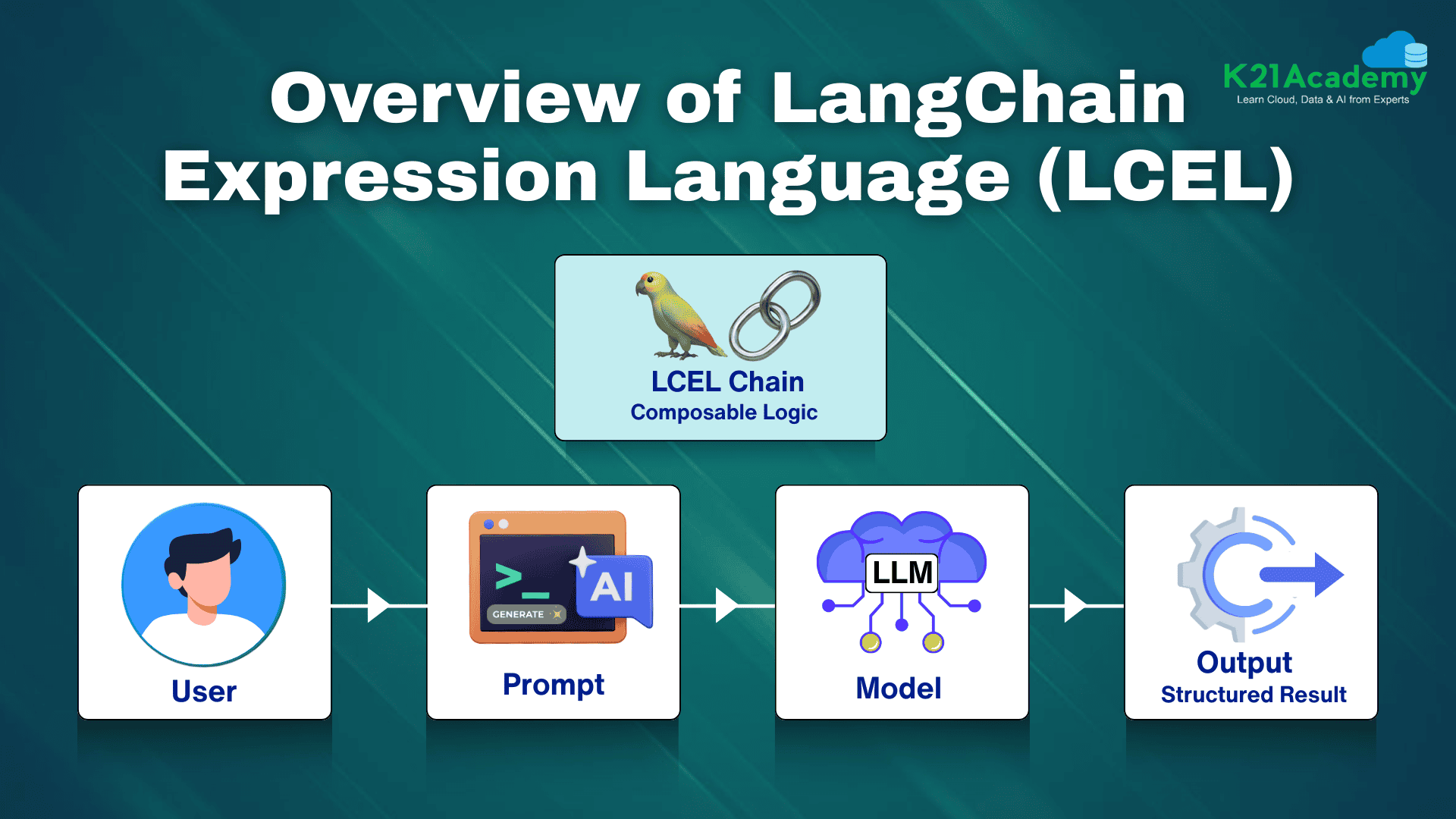
Instead of employing Chains objects to form our chain, we use pipe operators (|) in LangChain Expression Language. The following three elements make up a basic LLM chain; there are more variations that we shall discover later.
- LLM: An abstraction of the Langchain paradigm that is used to produce completions such as OpenAI GPT3.5, Claude, and others.
- Prompt: This is the input that the LLM object uses to provide the LLM questions and define its objectives. In essence, we define a string template with specific placeholders for our variables.
- Output Parser: An output parser specifies how to take the output from a response and present it as the final answer.
- Chain: A chain connects the aforementioned elements. Calls to an LLM or any other step in the data processing process are made repeatedly.
# LCEL CHAIN
chain = prompt | llm | output_parser
Future of LCEL
LCEL is set to become the backbone of scalable AI pipelines—just like SQL is for databases.
- Deeper monitoring, tool, and vector database integrations.
- More intelligent optimisations, such as cost control, caching, and parallelism.
- Improved observability through visualisation, tracing, and logging.
- Agent and multi-LLM workflow standardisation.
- Community extensions featuring parsers and reusable runnables.
- Retries, error management, and compliance are examples of enterprise-ready capabilities.
Conclusion
A ground-breaking method for creating Python applications is presented by LangChain Expression Language. Despite having a distinct vocabulary, LCEL provides a uniform interface with integrated capabilities like dynamic setups, streaming, and asynchronous processing that simplifies industrialisation. By carrying out activities concurrently, automatic parallelisation improves performance and overall efficiency. Additionally, developers may easily create and modify chains thanks to LCEL’s composability, which guarantees that code stays flexible and adaptive to changing requirements. Adopting LCEL is an attractive option for contemporary Python applications since it guarantees both optimised execution and simplified development.
Frequently Asked Questions
How does LangChain Expression Language improve performance?
Automatic task parallelisation, made possible by LCEL, speeds up execution by allowing several operations to perform simultaneously.
What are the drawbacks of LCEL?
Because LCEL is a domain-specific language (DSL) and has input-output dependencies, it is not entirely PEP compatible. If we wish to access intermediate outputs, we must pass them all the way to the end of the chain.
Why should developers consider using LCEL in python applications?
Because of its unified interface, extensive capabilities, and composability, LCEL is a great choice for developers looking to create scalable and effective Python applications.

![Microsoft Agentic AI Business Solutions Architect [AB-100] | K21 Academy](https://test.k21academy.com/wp-content/uploads/2025/11/Microsoft-Agentic-AI-Business-Solutions-Architect-AB-100-Exam-Overview1.png)