



What Is Deep Learning? | Why Deep Learning? | How Deep Learning Works? | What Is Machine Learning? | Why Machine Learning? | When You Go for Machine Learning? | How Does Machine Learning Works? | What’s the Difference Between Deep Learning and Machine Learning? | Choosing Between Deep Learning and Machine Learning. | Real-Time Use Cases of Deep Learning.
Deep learning is the foundation for developing AI robots. it attains recognition accuracy at top levels than ever before. In this blog, we will cover everything about Deep Learning (DL) and Machine Learning (ML) which is a hot buzz nowadays.
What Is Deep Learning?
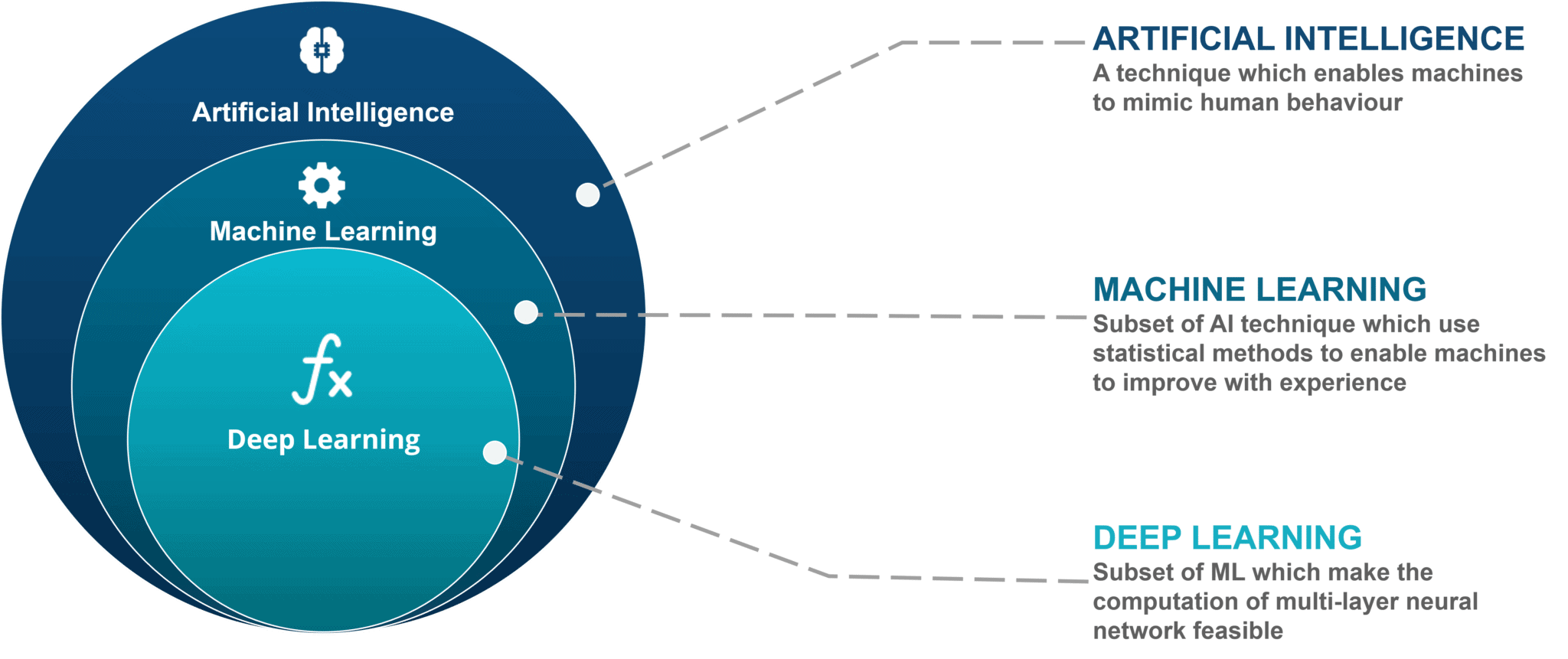
- Deep learning is a subset of machine learning that train computer to do what comes naturally to humans: learn by example.
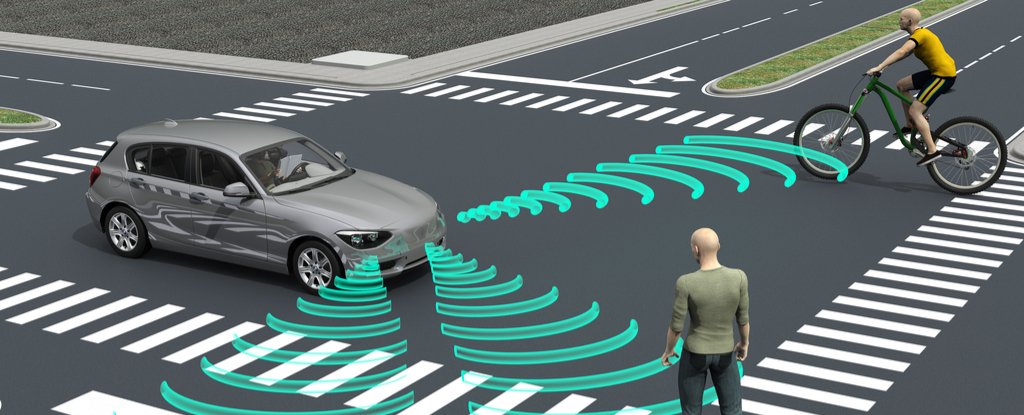
- Behind driverless cars research, and recognize a stop sign, voice control in devices in our home. DL is a key technology.
- In DL, we trained our model to perform classification tasks directly from text, images, or sound.
- Sometimes deep learning models exceeding human-level performance.
- Models are learned from a large set of labelled data and artificial neural network architectures that contain many layers.
Read: Learning Big Data & Hadoop
Why Deep Learning?
- DL earns recognition accuracy at top levels than ever before.
- It is used in safety-critical applications like driverless cars.
- It came in the 1980s, but due to a lack of labelled data and computing power, it was not popular at that time.
- Today, we have large amounts of labelled data. For example, a driverless car requires millions of images and thousands of hours of video to train with high accuracy.
- For computing power, we have high-performance GPUs, cloud computing that is efficient for deep learning.
What is the current state of Deep Learning in terms of accessibility and development?
Deep learning has become more accessible due to open-source frameworks like TensorFlow, PyTorch, and Keras, coupled with cloud-based platforms offering powerful GPUs. Continuous research and tools have democratized AI, making it easier for developers and businesses to implement innovative solutions.
How Deep Learning Works?
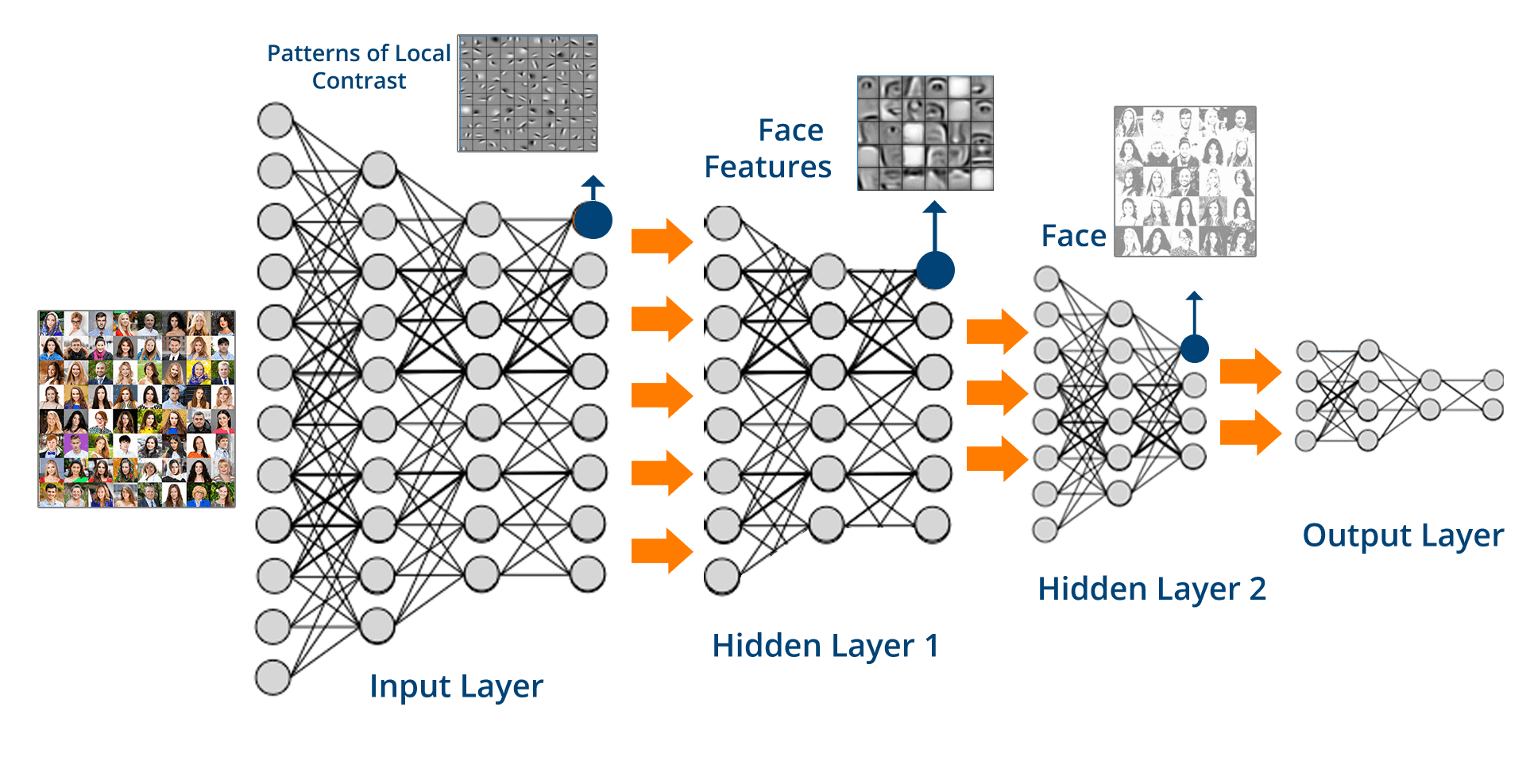
- Deep learning work on neural network architectures.
- The number of hidden layers in the neural network usually refers to “deep”. Hidden layers in deep neural networks can have as many as 150.
- These models are trained by using large sets of labelled data & and neural networks learn features directly from the data.
- Convolutional Neural Networks is one of the most popular types of deep neural networks.
- CNN’s eliminates the manual work of feature extraction; it works by extracting features directly from images.
What is transfer learning and how does it benefit Deep Learning?
Transfer learning is a technique in deep learning where a pre-trained model is reused on a new but similar problem. It helps save time, reduces computational cost, and enhances model performance, especially when labeled data is scarce.
How can one build custom Deep Learning solutions without extensive technical knowledge?
To build custom Deep Learning solutions without extensive technical knowledge, one can use user-friendly platforms like AutoML tools, pre-trained models, and low-code frameworks. These tools simplify model training, fine-tuning, and deployment, enabling users to create effective AI solutions easily.
What Is Machine Learning?
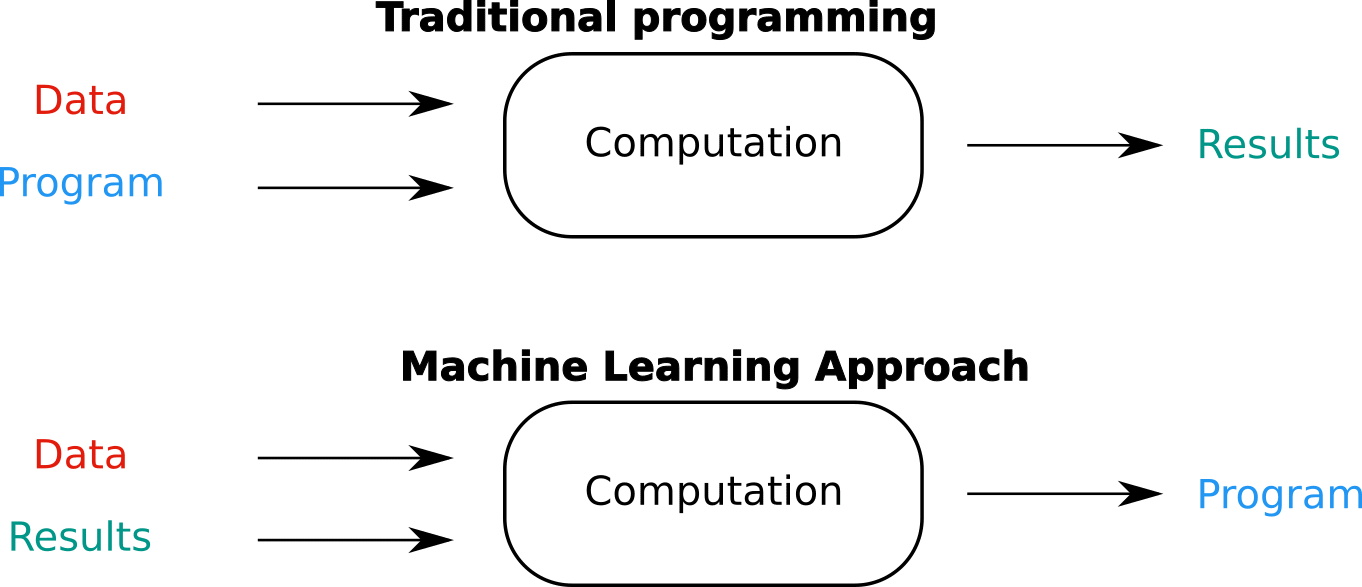
- Machine learning is a data analytics technique that learns from experience.
- Machine learning algorithms directly learn from data without relying on a predetermined equation.
Why Machine Learning?
- With the rise in big data daily from IoT devices, machine learning has played a very important role in solving problems in areas, such as:
- Computer vision
- Computational finance
- Energy production
- Aerospace, and Manufacturing
- Natural language processing

When You Go For Machine Learning?
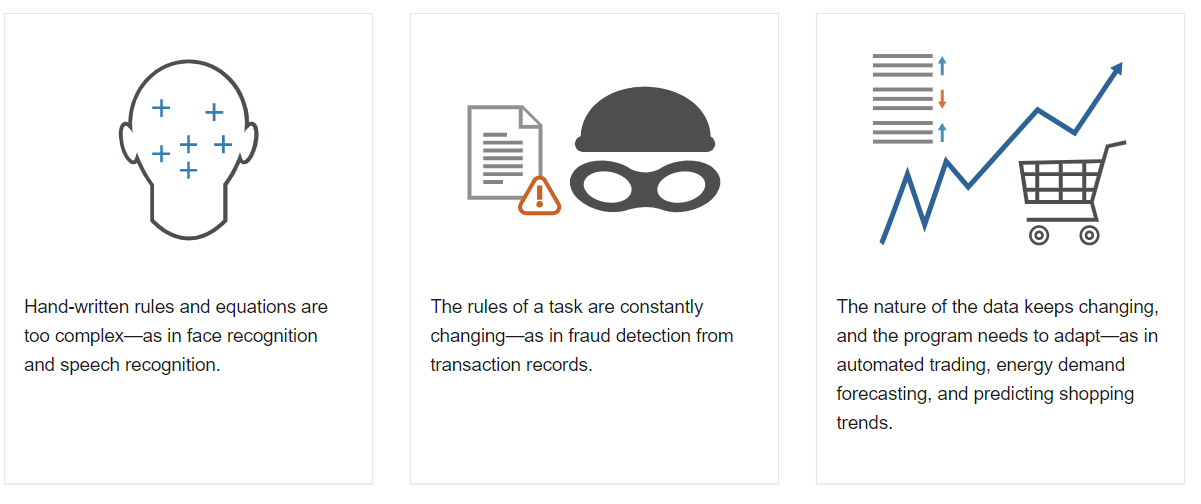
- Go for machine learning when you have a complex task or problem involving a Big data and lots of variables, but you don’t know the formula or equation.
How Does Machine Learning Works?
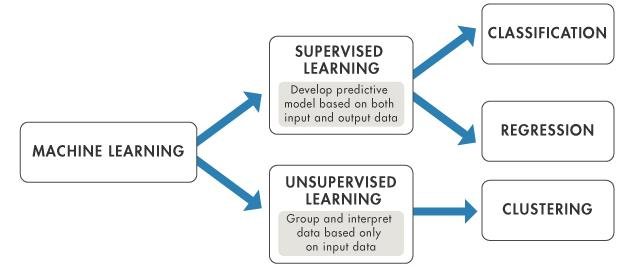
- ML uses two types of techniques: supervised learning, and unsupervised learning.
- supervised learning trains a model on labelled data so that it can predict future outputs.
- unsupervised learning trains a model on labelled data & finds hidden patterns in input data.
How does a traditional Machine Learning algorithm like linear regression work?
Linear regression is a traditional machine learning algorithm that models the relationship between a dependent variable and one or more independent variables by fitting a linear equation to observed data, minimizing the sum of squared differences between actual and predicted values.
How do precision and recall function in Machine Learning?
Precision measures the accuracy of positive predictions (true positives/total predicted positives), while recall quantifies the ability to identify all relevant instances (true positives/total actual positives). Both metrics are crucial for evaluating classification model performance, especially in imbalanced datasets.
What’s the Difference Between Deep Learning and Machine Learning?
- DL is a particular form of machine learning.
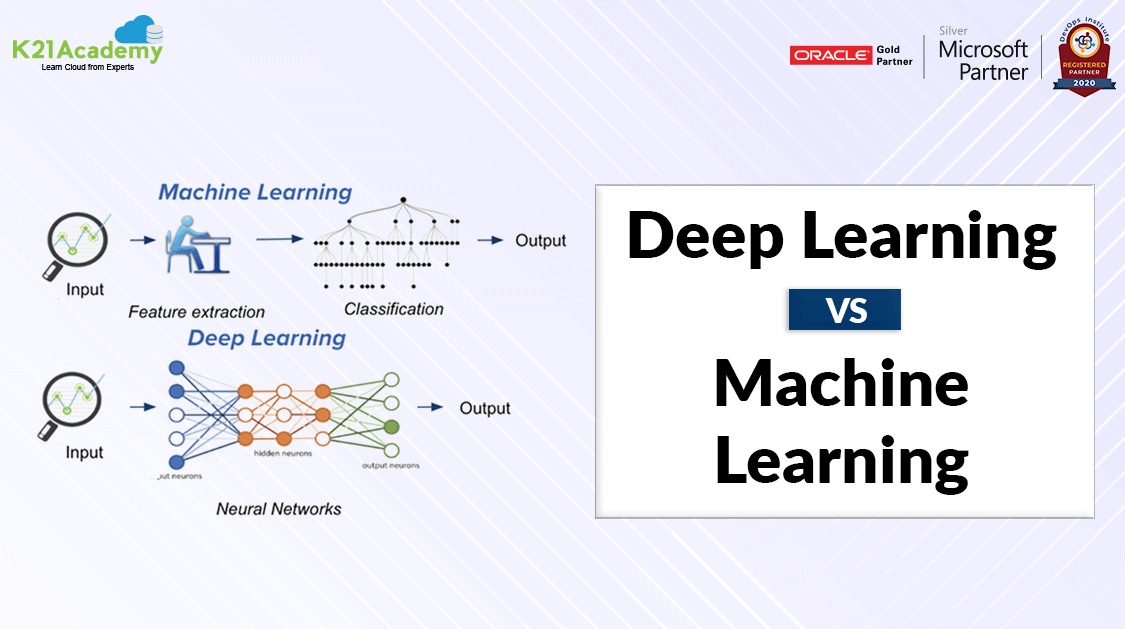
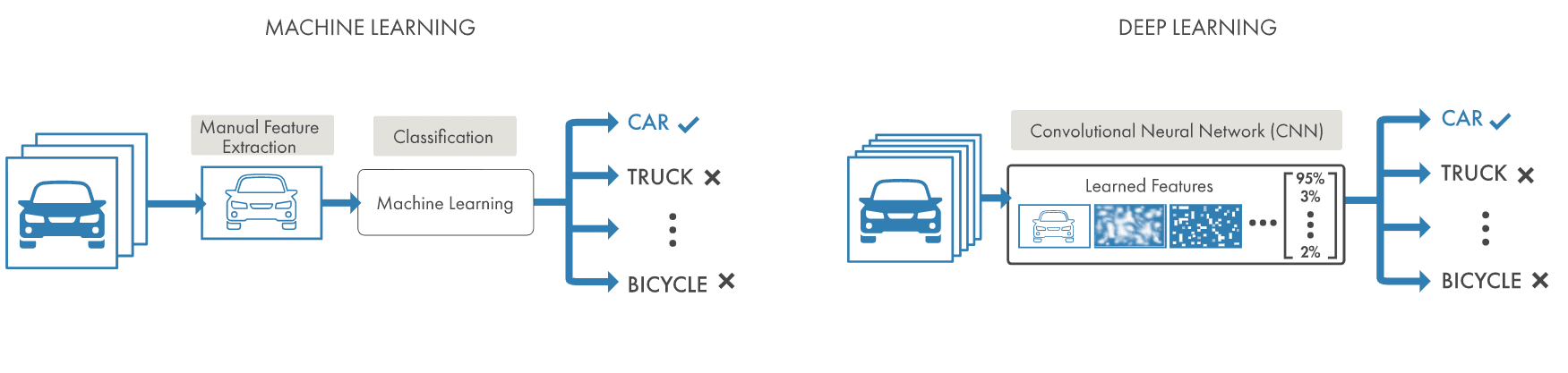
- A machine learning pipeline begins with relevant features manually pulling from images. The features are then used to develop a model that classifies the objects in the image.
- With a DL pipeline, suitable features are automatically extracted from images.
- Deep learning implements “end-to-end learning”. where a neural network is given raw data and a task to do classification, and it learns how to do this automatically.
- DL algorithms scale with data, whereas machine learning plateau at a certain level of performance when we add more data.
Choosing Between Deep Learning and Machine Learning
- When choosing between deep learning and machine learning, consider whether you have lots of labelled data and a high-performance GPU.
- If you don’t have these two things, then go for machine learning instead of DL.
- DL is usually a more complex and high-performance GPU to analyze all images.
Real-Time Use Cases Of Deep Learning
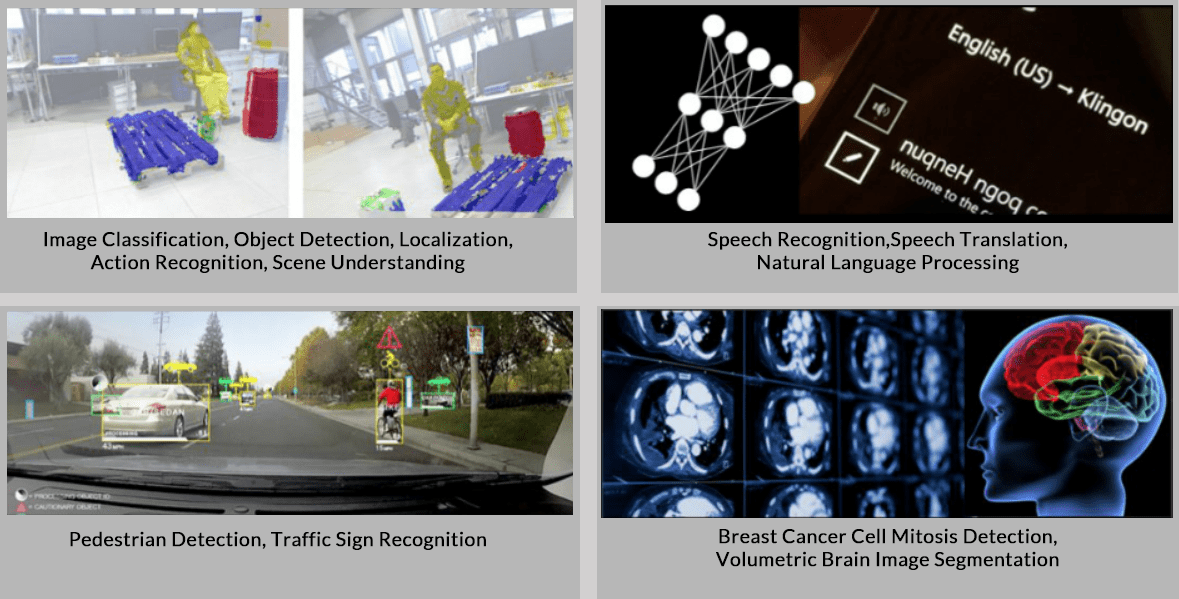
- Autonomous Car: self-driving car researchers are using DL to automatically detect objects without human input such as traffic lights and stop signs.
- Defence and Aerospace sector: DL is used to detect objects from satellites that locate areas of interest, and detect safe or unsafe zones for troops.
- Industrial Automation: DL automatically detecting worker safety around heavy machinery.
- Medical Research: DL automatically detects cancer cells. High-dimensional data set used to train a DL application to exactly identify cancer cells.
- Electronics: Home assistance devices that reply to our voice and know our preferences are powered by DL applications.
Deep Learning Vs Machine Learning quora
Deep Learning vs Machine Learning:
Machine Learning (ML) and Deep Learning (DL) are both subsets of Artificial Intelligence but differ significantly in their approach and applications. ML algorithms use statistical models and require human input for feature extraction and model tuning, making them suitable for simpler tasks like classification and regression. In contrast, Deep Learning, powered by neural networks, automatically extracts features from data and excels in complex tasks like image and speech recognition. While ML works with smaller datasets, DL requires large volumes of data and high computational power for tasks like autonomous driving or medical imaging.
When to use Machine Learning Vs Deep Learning ?
Use Machine Learning when you have structured data and need simple models for tasks like classification, regression, or clustering. It works well for problems with smaller datasets and can provide accurate results with traditional algorithms like logistic regression or decision trees. On the other hand, Deep Learning should be used for more complex tasks involving large datasets, such as image recognition, speech processing, or natural language understanding. Deep learning excels with unstructured data and requires more computational power but can outperform machine learning in tasks requiring high accuracy and automation.
Soft Computing Vs Machine Learning
Soft Computing is a set of techniques like fuzzy logic, genetic algorithms, and neural networks designed to handle uncertainty and approximate solutions for complex problems. It focuses on imprecision and tolerance for approximations, making it ideal for real-world applications with incomplete data.
Machine Learning (ML), a subset of soft computing, uses algorithms to learn patterns from data and make predictions. While soft computing deals with more generalized problem-solving, ML focuses on learning from large datasets and improving accuracy over time. Both are vital for AI, but ML is more data-driven.
Related References
- Visit our YouTube channel “K21Academy”
- Join Our Generative AI Whatsapp Community
- Decision Tree Algorithm Introduction
- Natural Language Processing with Python
- An Introduction to Reinforcement Learning
- Data Science And Machine Learning: Hands-On Labs With Python
Next Task: Enhance Your Azure AI/ML Skills


![Microsoft Agentic AI Business Solutions Architect [AB-100] | K21 Academy](https://test.k21academy.com/wp-content/uploads/2025/11/Microsoft-Agentic-AI-Business-Solutions-Architect-AB-100-Exam-Overview1.png)


