
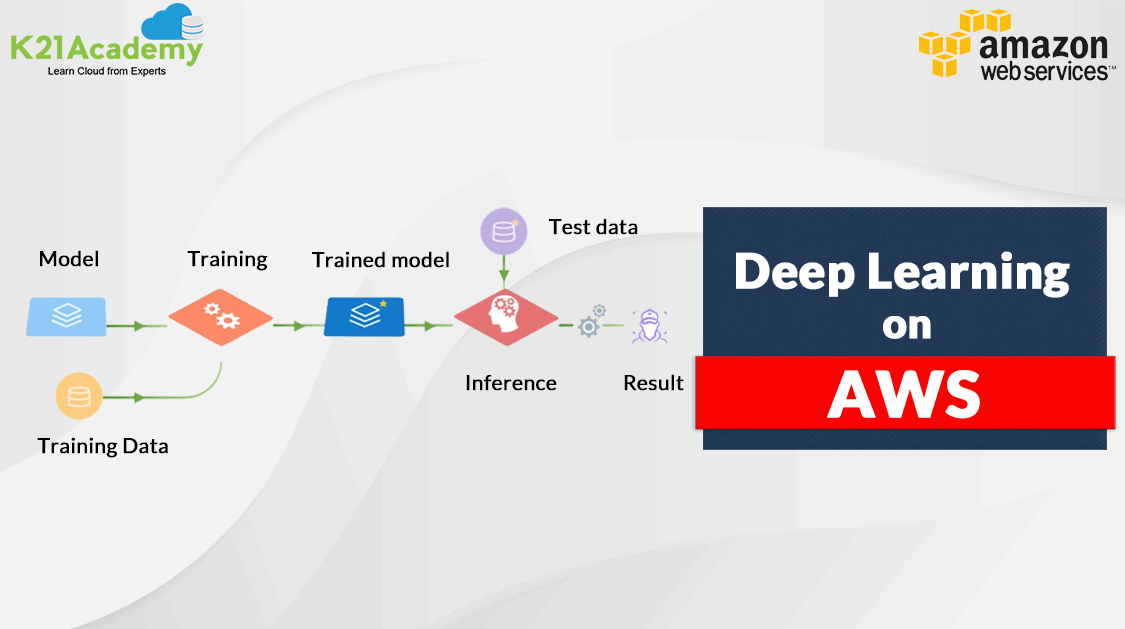



Nowadays Machine Learning and Artificial Intelligence gaining a lot of buzz. But have you noted about AWS deep learning? Deep learning is also a developing field that is turning many heads in the current business scene. AWS has carried another point to deep learning with Amazon Machine Images (AMIs) explicitly implied for AI.
This blog post covers:
- What Is AWS Deep Learning?
- AWS Services for Deploying Deep Learning Models
- Benefits of Deep Learning on the Cloud
- Use Case of AWS Deep Learning
- FAQ’s
What Is AWS Deep Learning?
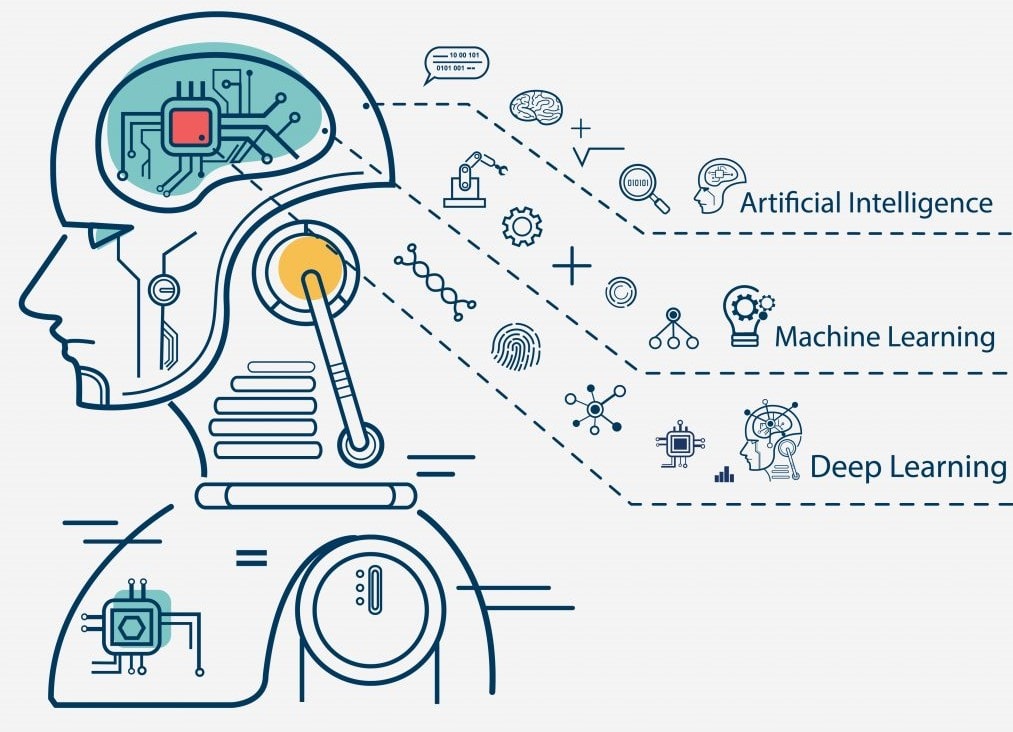
Prior to plunging into the conversation on deep learning with Amazon Web Services, let us a note of deep learning essentials. Machines have a great deal of information available to them, and the age of new information consistently presents a ton of undiscovered possibilities. This is the place where deep learning comes in with the force of both AI and Machine Learning. The easiest method to characterize AWS deep learning is through a reflection on its work.
Deep learning involves training artificial intelligence (AI) to foresee certain outputs based on a set of inputs. The techniques of supervised and unsupervised learning are ideal for training the AI.
AWS Services for Deploying Deep Learning Models
When you’re ready to deploy your deep learning models, AWS offers a variety of robust services tailored to meet your needs:
- AWS Lambda: This serverless compute service allows you to execute code in response to specific events, enabling scalable deployment without managing servers.
- AWS IoT Greengrass: Ideal for edge computing, this service extends AWS functionality to local devices, ensuring seamless deployment of models at the edge.
- Amazon Elastic Container Service (ECS): A fully managed container orchestration service, ECS simplifies running and scaling containerized applications, perfect for deploying deep learning models.
- AWS Elastic Beanstalk: This platform as a service (PaaS) automates deployment, making it easy to launch scalable web applications and services.
AWS AI Services Based on Deep Learning
AWS also offers a suite of AI services that leverage deep learning technology:
- Amazon Polly: This service uses deep learning to convert text into lifelike speech, enhancing user interaction through voice applications.
- Amazon Lex: Powering conversational interfaces, this service uses deep learning to create advanced chatbots and voice assistants.
- Amazon Rekognition: It employs deep learning to analyze images and videos, offering features like facial recognition and object detection.
Using these AWS services, you can efficiently deploy deep learning models and access cutting-edge AI capabilities to revolutionize user experiences.
Also Read: Our Blog Post On “AWS Certified Machine Learning Specialty“.
AWS has delivered a brand-new attitude to deep learning with Amazon Machine Images (AMIs) particularly intended for Machine Learning. The AWS Deep Learning AMI (DLAMI) is your one-stop shop for deep learning in the cloud. This custom-built machine instance is available in most Amazon EC2 regions for a range of instance types, from a small CPU-only instance to the latest high-powered multi-GPU instances. It comes preconfigured with NVIDIA CUDA and NVIDIA cuDNN, as well as the current releases of the most updated deep learning frameworks.
Do Check : Our Blog Post on Modeling With AWS Machine Learning.
Important Benefits Of Deep Learning On The Cloud
Cloud computing for deep learning is able to easily ingest and manage important datasets to train algorithms and is able to scale deep learning models efficiently and at a lower price using GPU processing power. By implementing different distributed networks, AWS deep learning through the cloud enables you to develop, design, and deploy various deep learning applications or software quite easily & faster. Some benefits of this are:
1) High Speed
The algorithms of deep learning are designed in such a way that they can train very quickly. The users can speed up the training of these learning models, using clusters of GPUs and CPUs. With this, the user can carry out the complex matrix operations on compute-intensive projects. After that, such models can be deployed to process the massive amount of data and to get better results.
Do Check: Our Blog Post On Amazon Rekognition.
2) Good Scalability
Deep learning artificial neural networks are ideally good to take the benefits of multiple processors, and distribute workloads seamlessly and precisely across different processor types and quantities. With the vast range of on-demand resources available through the cloud, you can deploy virtually infinite resources to tackle deep learning models of any size.
Also Read: Our Blog Post On Amazon SageMaker.
3) High Flexibility
Some important deep learning frameworks such as Microsoft Cognitive Toolkit, Apache MXNet, Caffe, Theano, Torch, TensorFlow and Keras run on the cloud servers. These frameworks are suited for deep learning use cases, whether it’s for the web, connected devices, or mobile.

Use Case of AWS Deep Learning In Different Sectors
Till now, AWS deep learning has played a very important role in Computer Vision, Speech Recognition, Recommendation Engines, and Natural Language Processing. In these sectors, deep learning generates an immense number of opportunities for research and engineering.
Also Read: Our Blog Post On Data Engineering With AWS Machine Learning.
1) Computer Vision
By training algorithms with thousands of labelled datasets (images), deep learning artificial neural networks can easily identify subjects as well or even better as compared to humans, leading to advanced capabilities like rapid facial recognition. Learn more about computer vision.
2) Speech Recognition
speech recognition is difficult for computers when speech patterns and accents in humans vary. With AWS Deep learning algorithms, you can more easily determine what is said. This technology is used today in Amazon Alexa and many other virtual assistants.
Do Check: Our Blog Post On Amazon Lex.
3) Recommendation Engines
AWS deep learning systems can easily track user activity to develop personalized recommendations. By matching the aggregate activity of numerous users, deep learning systems able to find out totally new items that might interest a user.
Do Read: Our Blog On Amazon Comprehend.
4) Natural Language Processing
With deep learning, computers understand everyday conversations, where context and tone are critical to communicating unspoken meaning. With deep learning algorithms that can identify emotions, automated systems such as customer service bots can interpret and respond to users usefully. Learn more about NLP on AWS.
Conclusion
AWS Deep Learning offers a comprehensive and robust ecosystem to accelerate AI and ML advancements, making it accessible and scalable for organizations of all sizes. By leveraging services like AWS Lambda, Amazon SageMaker, and Deep Learning AMIs, businesses can efficiently build, train, and deploy deep learning models tailored to specific needs. The benefits of high speed, flexibility, and scalability empower developers and data scientists to process massive datasets, experiment with innovative algorithms, and deploy state-of-the-art applications.
AWS deep learning has become a cornerstone in sectors such as computer vision, speech recognition, recommendation systems, and natural language processing, revolutionizing how businesses interact with data and users. Whether you’re a beginner or an expert, AWS provides the tools and frameworks to streamline your journey, making it an invaluable ally in the age of AI and ML.
FAQ’s
How is Amazon Sagemaker used for deep learning?
Amazon Sagemaker supports Jupyter Notebook, where developers can share live codes. Amazon SageMaker comes with libraries, packages, and drivers for deep learning platforms.
Q: How do I learn deep learning on AWS?
You can get started with a totally managed experience of the usage of Amazon SageMaker, the AWS platform to instantly and easily build, train, and deploy ML models at scale. You can also use the AWS Deep Learning AMIs to create custom environments and workflows for ML.
What are the deep learning frameworks for Amazon?
You can rapidly launch Amazon EC2 instances pre-installed with suitable AWS deep learning frameworks and interfaces such as PyTorch, TensorFlow, Apache MXNet, Horovod, Chainer, Gluon, and Keras to train sophisticated, custom ML & AI models, experiment with new algorithms, or to learn new skills and techniques.
Can I drastically speed up my deep learning training?
If you have connected to a GPU on your system, you can drastically speed up the training time of your deep learning training.
Also Check: What is AWS Trusted Advisor?
Related References
- Join Our Generative AI Whatsapp Community
- Introduction To Amazon SageMaker Built-in Algorithms
- Introduction to Generative AI and Its Mechanisms
- Mastering Generative Adversarial Networks (GANs)
- Generative AI (GenAI) vs Traditional AI vs Machine Learning (ML) vs Deep Learning (DL)
- AWS Certified AI Practitioner (AIF-C01) Certification Exam
- AWS Certified Machine Learning Engineer – Associate (MLA-C01) Exam
Next Task For You
Don’t miss our EXCLUSIVE Free Training on Generative AI on AWS Cloud! This session is perfect for those pursuing the AWS Certified AI Practitioner certification. Explore AI, ML, DL, & Generative AI in this interactive session.
Click the image below to secure your spot!


![Microsoft Agentic AI Business Solutions Architect [AB-100] | K21 Academy](https://test.k21academy.com/wp-content/uploads/2025/11/Microsoft-Agentic-AI-Business-Solutions-Architect-AB-100-Exam-Overview1.png)


