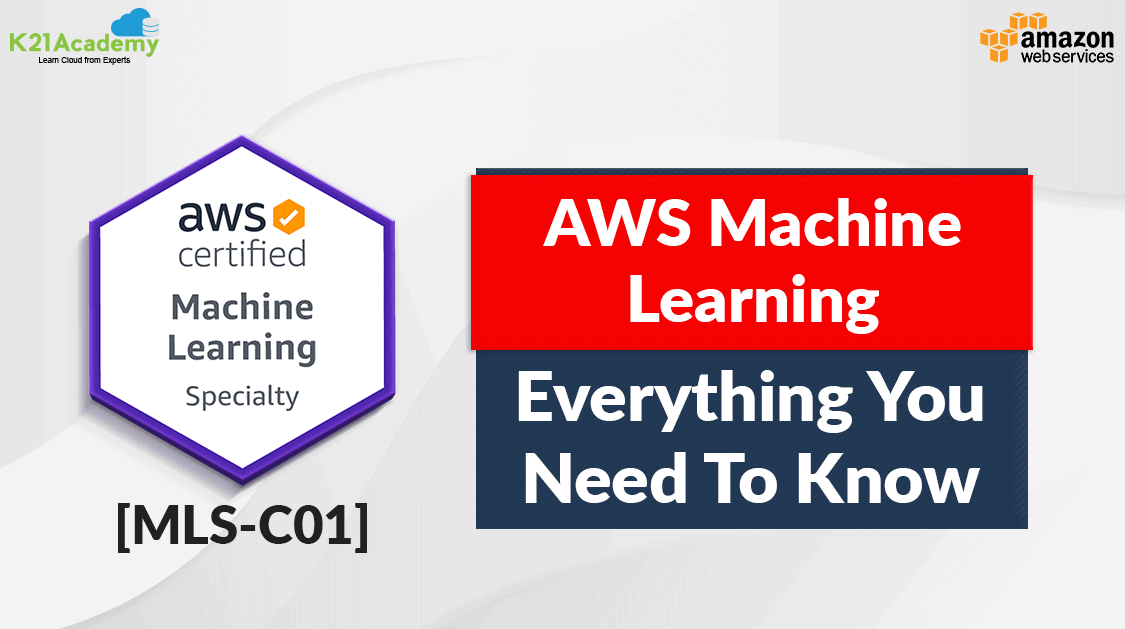




For those who work in improvement or data science, the AWS Certified Machine Learning specialty certification is available. It verifies a candidate’s capacity to develop, carry out, deploy, and hold machine learning (ML) solutions for specified business issues.
Data science and machine learning are fields with numerous job opportunities. Competition is increasing as the variety of available jobs expands. As a result, whether you need to find work, change careers, or advance in your career, you want something that will set you apart from the throng. This is where the certification comes in handy. It verifies the ability to create and deploy machine learning (ML) solutions on AWS. It also measures understanding of essential ideas.
“According to the report by Paysa, the Amazon Machine Learning Scientist’s average salary is $214,484.”
In this blog we will discuss:
- Who is AWS certified Machine Learning Specialist?
- Why you should learn AWS ML?
- AWS ML certification Benefits
- AWS Machine Learning – Specialty Exam Goals
- Prerequisites for AWS ML
- Exam Details
- Exam Topics
- AWS ML Hands-on Guides
- Who This Certification is for?
- Exam Retake Policy
- FAQ’s
Who Is AWS Certified Machine Learning Specialist?
AWS-certified Machine Learning Specialists assist businesses in developing, putting into practice, deploying, and managing ML solutions for operational issues. Establish the appropriate ML strategy, choose the best AWS administrations, and safeguard ML solutions.

Note : Read Our Blog Post on Modeling With AWS Machine Learning.
Why You Should Learn AWS ML
Reasons to Learn AWS ML
In addition to verifying your technical abilities, having an AWS certification can help you promote your accomplishments and grow your AWS experience.
Following are a few benefits of holding an AWS certification :
- Credibility: Having a certification will improve both your credibility and your knowledge of the services. Credentials will provide you access to more options.
- Obtaining the title of “AWS Certified”: This would open up several career options for professionals and recent graduates in AWS-related initiatives.
- Enhances abilities: Utilizing an AWS you can develop your skill set and lower the risks involved in putting an AWS project into action.
- Help you get a job: If you’re a professional or a fresher the tag “AWS Certified” will fetch you a lot of job opportunities in AWS-related projects.
- Higher Pay: AWS is the highest earning certification in the US, yet certification does not ensure a higher salary.
- Builds your business for you: Employers want AWS-certified individuals because they help with business development. It is one of the prerequisites for higher-tier AWS Partner Network memberships.
- Large advantages: You can obtain market support, AWS use credits, training subsidies, and other benefits by joining the AWS Partner Network.
Check Also: Free AWS Training and Certifications
AWS Machine Learning Certification Benefits
Benefits of an AWS Machine Learning Certification
The following are some advantages of having an AWS-approved machine learning certification:
- Confirms your ability to build, train, and deploy the machine learning model utilizing the AWS Cloud.
- Gives you recognition on a global scale for your knowledge, skills, and expertise.
- One of the highest-paying data-Tech certificates worldwide.
- Adds a qualification to your resume, helping you to stand out from the competition.
- Enhances your ability to obtain more opportunities to advance as an AWS engineer.
AWS Machine Learning – Specialty Exam Goals
AWS Certified Machine Learning Specialty exam goals are:
1. Demonstrate your ability to create, build, implement, and maintain ML solutions for business problems.
2. Select and validate the precise ML technique for the specified business issue.
3. Select the relevant AWS administrations to put ML solutions into action.
4. Design and implement adaptable, cost-effective, reliable, and secure ML solutions.
Note: Our Blog Post on Deep Learning On AWS, For More Information.
Prerequisites for AWS ML
1. 1-2 years of experience designing, implementing, or executing machine learning/deep learning workloads on the AWS Cloud
2. The capability to convey the intuition underlying fundamental ML techniques
3. Proven proficiency with fundamental hyperparameter optimization
4. Proficient in machine learning and deep learning frameworks
5. The capability to adhere to excellent practices in model-training
6. Being able to adhere to deployment and operating best practices
Exam Details
- Certification Name: AWS Certified Machine Learning Specialty
- Exam Duration: 180 minutes to complete the exam
- Exam Cost: 300 USD (Practice exam: 40 USD)
- Exam Format: There are two types of questions on the exam:
- Multiple choice: Has one correct response and three incorrect responses
(distractors) - Multiple response: Has two or more correct responses out of five or more
response options
- Multiple choice: Has one correct response and three incorrect responses
- Exam Language: Available in English, Korean, Japanese, and Chinese
- Number of Questions: 65
- 50 questions that affect your score.
- 15 unscored questions that do not affect your score.
- Passing Score: a minimum passing score of 750 out of 1000
- Validity: 3 years
You can schedule your AWS Certified Machine Learning Specialty exam by going to the official site.
Exam Topics
The AWS Certified Machine Learning Specialty exam focuses on the following 4 domains:
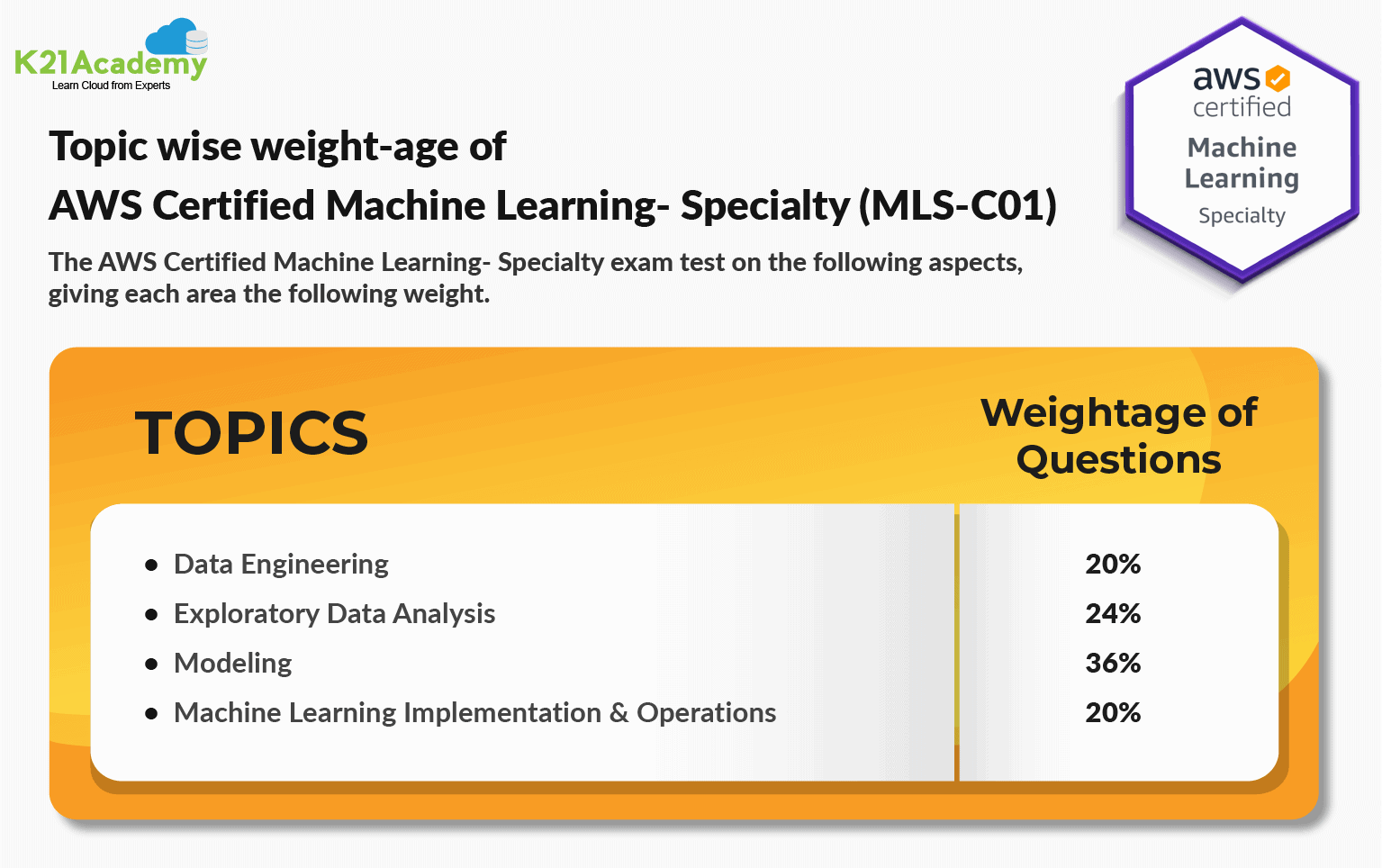
Also Check Our Blog On Amazon Comprehend.
1) Data Engineering (20% of Examination)
This segment focuses on creating data repositories, data ingestion, and data transformation solutions for ML using the AWS big data stack:
- Create Data Repositories for Machine Learning:
- Identify the content, location, and primary data sources, such as user data.
- Choose storage mediums: databases, Amazon S3, Amazon EFS, Amazon EBS.
- Implement Data Ingestion Solutions:
- Identify data job styles and types: batch processing, real-time streaming.
- Build data ingestion pipelines using tools like Amazon Kinesis, Amazon Data Firehose, Amazon EMR, AWS Glue, and Amazon Managed Service for Apache Flink for both batch and streaming workloads.
- Schedule data jobs.
- Implement Data Transformation Solutions:
- Transform data on the move using ETL processes with AWS Glue, Amazon EMR, or AWS Batch.
- Manage ML-specific data using MapReduce technologies like Apache Hadoop, Apache Spark, and Apache Hive.
Read Our Blog Post On Amazon SageMaker.
2) Exploratory Data Analysis (24% of Examination)
This segment is about cleaning data and feature engineering, ensuring data is ready for modeling:
- Prepare Data for Modeling:
- Address missing or corrupt data and eliminate stop words.
- Format, normalize, augment, and scale the data.
- Ensure sufficient labeled data and use tools like Amazon Mechanical Turk for data labeling if necessary.
- Perform Feature Engineering:
- Extract features from datasets including text, speech, images, and public sources.
- Evaluate feature engineering techniques: binning, tokenization, handling outliers, creating synthetic features, one-hot encoding, reducing data dimensionality.
- Visualize Data for Machine Learning:
- Create graphs: scatter plots, time series, histograms, box plots.
- Interpret statistics: correlation, summary statistics, p-values.
- Perform cluster analysis using techniques like hierarchical clustering and elbow plots.
3) Modeling (36% of Examination)
This segment focuses on the various aspects of Machine Learning (ML) Modeling. It outlines the steps required to frame business problems as ML problems, select and train appropriate ML models, optimize hyperparameters, and evaluate the performance of ML models. Here’s a breakdown of the focus areas:
- Frame Business Problems as ML Problems:
- Determine when to apply machine learning.
- Differentiate between supervised and unsupervised learning.
- Choose ML models: classification, regression, forecasting, clustering, recommendation systems, foundational models.
- Select Appropriate Models for ML Problems:
- Choose from XGBoost, logistic regression, k-means, linear regression, decision trees, random forests, RNN, CNN, ensemble methods, transfer learning, large language models.
- Explain the reasoning behind model choices.
- Train ML Models:
- Split data into training and validation sets using cross-validation.
- Optimize training using techniques like gradient descent and adjust loss functions for convergence.
- Choose appropriate compute resources: GPU/CPU, distributed/non-distributed platforms (e.g., Spark or non-Spark).
- Perform batch or real-time retraining.
- Optimize Hyperparameters:
- Apply regularization techniques like dropout and L1/L2.
- Perform cross-validation.
- Initialize models appropriately.
- Understand neural networks: layers, nodes, learning rate, activation functions.
- Configure tree-based models: number of trees, levels.
- Adjust linear models: learning rates.
- Evaluate ML Models:
- Manage bias and variance to avoid overfitting/underfitting.
- Evaluate metrics: AUC-ROC, accuracy, precision, recall, RMSE, F1 score.
- Interpret confusion matrices.
- Conduct offline and online model evaluation (A/B testing).
- Compare models using metrics like training time, quality, engineering costs.
- Perform cross-validation.
Do Read : Our Blog Post On Amazon Rekognition.
4) Machine Learning Implementation and Operations (20% of Examination)
This segment of the exam focuses on machine learning solutions for:
- Build ML Solutions for Robust Performance:
- Utilize AWS CloudTrail and Amazon CloudWatch for logging and monitoring.
- Implement error monitoring solutions.
- Deploy across multiple regions and availability zones.
- Create AMIs and golden images.
- Deploy Docker containers.
- Set up auto scaling groups.
- Rightsize resources: instances, Provisioned IOPS, volumes.
- Perform load balancing.
- Follow AWS best practices.
- Implement Appropriate ML Services and Features:
- Use AWS ML services: Amazon Polly, Amazon Lex, Amazon Transcribe, Amazon Q.
- Understand AWS service quotas.
- Determine when to use custom models versus SageMaker built-in algorithms.
- Manage costs using Spot Instances for deep learning model training with AWS Batch.
- Apply AWS Security Practices:
- Implement IAM policies.
- Set S3 bucket policies.
- Configure security groups.
- Utilize VPCs.
- Apply data encryption and anonymization.
- Deploy and Operationalize ML Solutions:
- Expose and interact with endpoints.
- Understand and manage ML models.
- Conduct A/B testing.
- Retrain pipelines as needed.
- Debug and troubleshoot models to detect performance drops and continuously monitor performance.
Do Check : Our Blog Post On Amazon Lex.
AWS ML Hands-on Guides
For AWS ML we have 19 Step-by-step Activity Guides for you to practice and have a clear knowledge of concepts both theoretically and practically: Click here to Learn more
Who This Certification Is For?
AWS Certified Machine Learning Specialty exam is for:
- Candidates with a data science interest.
- Business Decisive Individuals
- Developers
- Platform Data Engineers
- One who wants to develop a career in machine learning
Note: Do Check Our Blog Post On Data Engineering With AWS Machine Learning.
Exam Retake Policy
- The candidate desires to attend 14 days earlier than they’re eligible to retake the exam.
- The candidate can take any number of examinations tries till he passes.
- For each exam attempt, the candidate needs to pay the whole registration rate. but the beta exam takers can take the exam once most effective.
Frequently Asked Questions
How can I enroll in the AWS Machine Learning certification program?
You can arrange your exam by visiting the AWS Cloud website. To schedule the exam, you'll need an Amazon account, so create one and complete the necessary paperwork.
How may an AWS Certification exam be rescheduled?
Up to 24 hours prior to your planned appointment, you may postpone or cancel your exam without incurring additional costs.
What training is advised before taking the AWS ML Certification exam?
The AWS ML exam has no prerequisites, to my knowledge. You can take the Amazon AWS certification exam right away. Following are some suggestions for test preparation: 1. Practical experience in designing, constructing, or managing ML/deep workloads for learning on the AWS Cloud. 2. Experience with deep learning and machine learning frameworks. 3. The aptitude and basic sense to pinpoint the goal of the ML algorithms. 4. The ability to attempt simple hyperparameter optimization. 5. The ability to combine deployment and operational best practices.
I hope this blog helps you clear your doubts regarding the AWS-certified Machine Learning Specialist Exam, what are the topics covered within the exam, certification benefits, and more.
Related References
- AWS Certificate Manager: Overview, Features and How it Works?
- AWS Certified Solutions Architect Associate SAA-C03 Exam
- AWS Database Services – Amazon RDS, Aurora, DynamoDB, ElastiCache
- Multi-Account Management Using AWS Organizations
- AWS Certified Solutions Architect: Roles & Responsibilities
- Amazon Kinesis Overview, Features And Benefits
- AWS Route 53 Introduction
Next Task For You
Don’t miss our EXCLUSIVE Free Training on Generative AI on AWS Cloud! This session is perfect for those pursuing the AWS Certified AI Practitioner certification. Explore AI, ML, DL, & Generative AI in this interactive session.
Click the image below to secure your spot!


![Microsoft Agentic AI Business Solutions Architect [AB-100] | K21 Academy](https://test.k21academy.com/wp-content/uploads/2025/11/Microsoft-Agentic-AI-Business-Solutions-Architect-AB-100-Exam-Overview1.png)