



Amazon Lex is a carrier for making conversational interfaces with the use of voice and text. Powered with the aid of the identical conversational engine as Alexa. In this blog post, we are going to cover everything about Amazon Lex.
This post covers:
- What is Amazon Lex?
- How Amazon Lex Works
- Key Features of Amazon Lex
- Benefits of Using a Conversational Interface
- Use Cases of Amazon Lex
- Amazon Lex Pricing
- FAQs
- Challenges of Voice-Based Assistants
What is Amazon Lex?
- Amazon Lex is a service that makes conversational interfaces for any application using text and voice.
- It provides high-level deep learning capabilities of automatic speech recognition for transforming speech to text.
- It also enabled natural language understanding to recollect the text’s intent, enabling us to create applications with highly attractive user experiences and lifelike conversational communication.
- With Amazon Lex, you can rapidly and smoothly build natural language conversational bots (chatbots).
 Related Readings: Amazon Comprehend
What Are the Benefits of Using a Conversational Interface?
Conversational interfaces offer a range of advantages that enhance customer interaction and streamline business operations. Let’s explore these benefits in more detail.

24/7 Availability
One major perk is round-the-clock availability. No matter the time zone or hour, conversational interfaces can provide immediate assistance. This constant availability ensures that your business never misses an opportunity to engage with potential customers or address their inquiries.
Time and Effort Optimization
By automating repetitive tasks, conversational interfaces save considerable time for your team. They handle routine queries and processes efficiently, allowing human resources to focus on more complex and strategic activities. This automation not only improves productivity but also reduces operational costs.
Related Readings: Hugging Face: Revolutionizing NLP and Beyond
Enhanced Interactivity
Unlike traditional apps that require downloads or installations, conversational interfaces are immediately accessible. They actively engage users by initiating contact and seamlessly guiding them through interactions. This proactive approach not only captures attention but also keeps the communication dynamic and engaging.
Instantaneous Responses
Speed is of the essence in today’s fast-paced digital world. Conversational interfaces deliver prompt responses to user questions, enhancing the overall experience. Quick solutions reduce customer frustration and increase satisfaction, fostering a positive perception of your brand.
By leveraging these benefits, businesses can significantly improve their customer service offerings while also driving efficiency and cost savings.
Understanding Conversational Interfaces
A conversational interface is a user-friendly platform that allows individuals to communicate with technology using natural, everyday language.
Bridging the Language Gap
Traditionally, humans and machines have interacted through graphical user interfaces (GUIs) like buttons or icons, requiring users to understand specific commands or symbols. However, conversational interfaces break down these barriers by enabling communication in plain, human language.
Intuitive and Accessible Interaction
As technology advances, so do our methods of communication with it. Conversational interfaces leverage improvements in language recognition and processing to create more intuitive user experiences. Instead of navigating complex menus or understanding syntax-heavy commands, users can simply instruct the device with words, whether spoken or typed.
The Future of Interactions
These interfaces are swiftly capturing attention by making digital interactions more straightforward and efficient. By allowing voice or text communication using everyday language, conversational interfaces hold the potential to eventually replace traditional GUIs and command-line interfaces.
In essence, conversational interfaces are reshaping how we interact with technology, pushing the boundaries of accessibility and efficiency in an ever-evolving digital landscape.
Related Readings: Microsoft Azure Chatbot Using Cognitive and Bot services
How Amazon Lex Works?
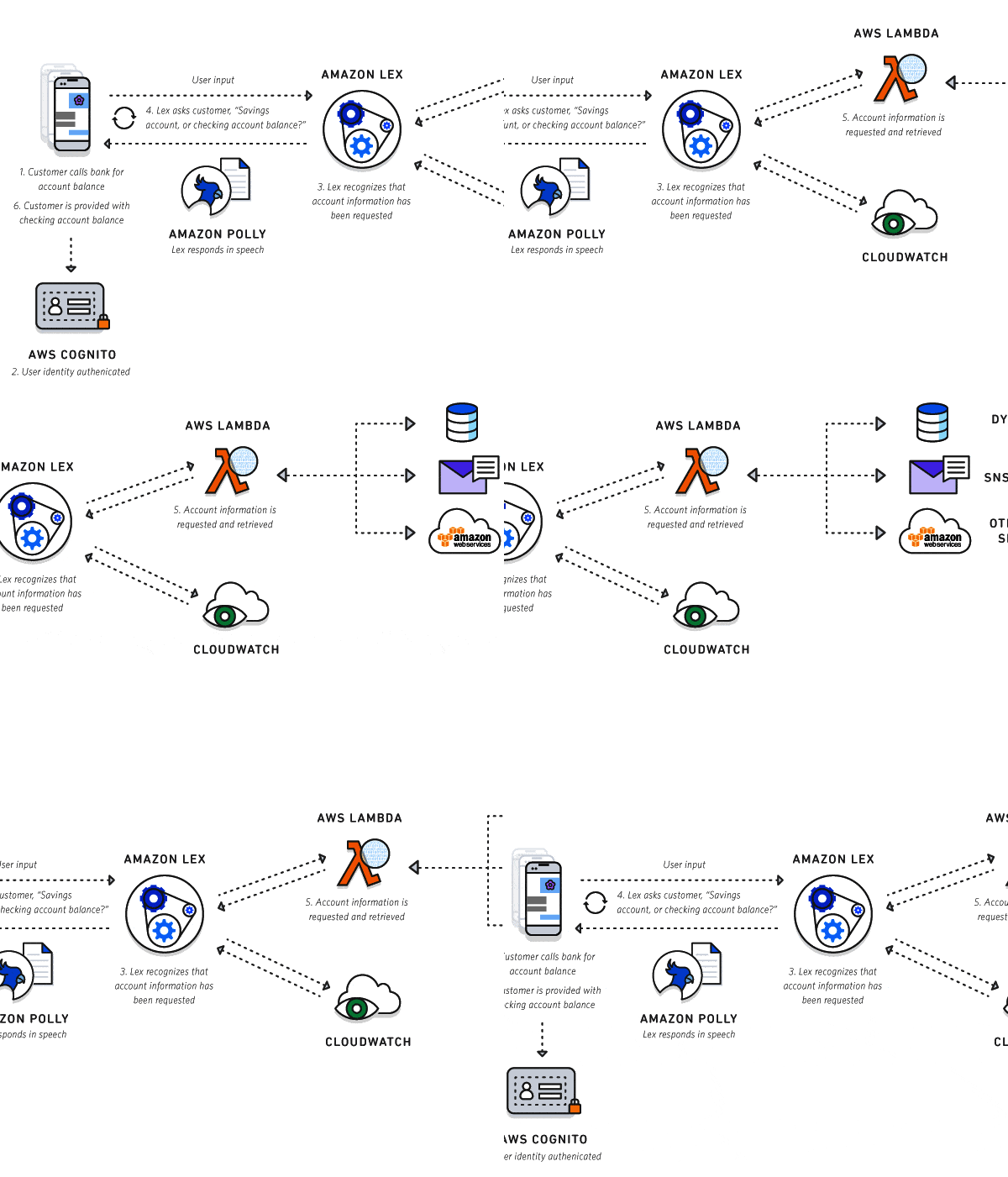
Amazon Lex works on the same technology as Alexa. It combined with AWS Lambda which we are able to use without difficulty trigger features for the execution of our back-end business logic for information retrieval and updates. Once built, our bot can be used directly to chat platforms, IoT devices, and mobile clients. It provides a secure, scalable, easy-to-use, end-to-end solution to build, monitor, and publish our bots.
Ease of Use
Amazon Lex offers a user-friendly console that simplifies the creation of your own bot or conversational interface. With just a few example phrases, Amazon Lex constructs a comprehensive natural language model. This allows users to interact seamlessly through voice and text, enabling them to ask questions, get answers, and complete sophisticated tasks with ease.
By combining advanced technology with intuitive design, Amazon Lex ensures that even complex backend processes can be managed effortlessly, providing a streamlined experience from development to deployment.
How Do Text-Based Assistants Work?
Text-based assistants are increasingly becoming essential in our digital interactions. These sophisticated tools operate by processing the text you input and then generating responses based on their programming and data sources.
- User Input: You begin by typing a question or command into the interface. This input is crucial, as the quality and clarity of your text directly influence the assistant’s ability to provide a relevant response.
- Natural Language Processing: At the core of text-based assistants is Natural Language Processing (NLP), a branch of artificial intelligence that enables machines to understand and interpret human language. NLP breaks down your input, analyzes the syntax and meaning, and determines the intent behind your request.
- Data Retrieval and Response Generation: Once the input is understood, the assistant accesses its database or searches the web to find the most accurate information. Advanced systems may use machine learning algorithms to improve their responses over time based on previous interactions.
- Output Delivery: Finally, the assistant delivers a response. This can be a straightforward answer, a link to more information, or even prompting you for further clarification to narrow down the query.
Considerations
- Performance: The efficiency of a text-based assistant can vary depending on its design and the quality of its programming.
- Input Quality: Clear and concise questions tend to yield the most accurate responses.
- Adaptability: Many systems adapt and improve as they process more interactions, enhancing their ability to understand diverse language patterns over time.
By leveraging these components, text-based assistants provide a streamlined and efficient way to obtain information and services through simple text interactions.
Related Readings: Deep Learning On AWS
Key Features Of Amazon Lex
Amazon Lex is a powerful tool for creating conversational interfaces, offering a range of features and benefits that streamline development and enhance user experience.
- Automatic Speech Recognition and Natural Language Understanding: Amazon Lex offers fully automatic speech recognition and natural language understanding technologies to generate a Speech-Language Understanding system. This capability allows for sophisticated user interactions with minimal setup.
- Multi-turn Conversations: Its bots provide the capacity for multi-turn conversations, enabling more dynamic and engaging interactions. Users can have seamless dialogues, making the experience more natural and intuitive.
- Context Management: It helps with context control natively, so you can manage the context immediately without the want for custom code. This feature simplifies the process of handling complex conversation flows and enhances the bot’s ability to understand user intent.
- Prompt Types:
- Confirmation Prompts: Ensure users have the ability to confirm actions, enhancing interaction accuracy.
- Error-handling Prompts: Guide users smoothly through any misunderstandings or errors, improving user experience.
- Effortless Multi-platform Deployment: It allows you to simply publish your bot to chat services directly from the Amazon Lex console, eliminating multi-platform development efforts. This one-click deployment feature ensures your bot can reach users across various platforms such as mobile web apps, Facebook Messenger, Slack, and Twilio SMS without additional overhead.
- Cost-effective: With no upfront costs or minimum charges, Amazon Lex operates on a pay-as-you-go pricing model. This economical approach makes it accessible for businesses of all sizes. The availability of a free tier allows developers to experiment and innovate without initial financial commitment.
- AWS Lambda Integration: It natively enables integration with AWS Lambda for fact retrieval, updates, and commercial enterprise logic execution. This seamless integration allows developers to leverage AWS’s robust infrastructure for enhanced bot functionality.

Related Readings: Amazon SageMaker.
Amazon Lex’s comprehensive feature set and integration capabilities make it an ideal choice for developers looking to create efficient and scalable conversational interfaces. By leveraging its automated systems and seamless deployment options, businesses can enhance customer engagement while minimizing development time and costs.
What Are the Types of Conversational Interfaces?
Conversational interfaces are digital platforms that facilitate interactive communication between humans and machines. Here’s a breakdown of the main types:
- Simple Bots: These are straightforward interfaces designed for basic interactions. They typically handle simple commands and offer limited input options. Ideal for straightforward tasks, their simplicity allows for easy navigation and usage.
- Text-Based Assistants: Commonly encountered when typing to a chatbot, these interfaces rely on textual inputs from users. The quality of the response you receive often hinges on the clarity and detail of your input. These assistants excel in environments where users prefer typing their queries and can provide detailed information efficiently.
- Voice-Activated Assistants: Popularized by platforms like Google Assistant and Amazon Echo, these interfaces allow users to interact via spoken commands. They excel in tasks such as reordering known items or setting reminders, where hands-free interaction is beneficial. However, they might not be optimal for tasks requiring visual assessment, such as exploring new products.
By understanding these different types, you can choose the most suitable conversational interface for your specific needs, depending on the context and complexity of the tasks at hand.
How Conversational Interfaces Revolutionize Digital Interactions
Conversational interfaces are transforming the way we engage with digital services, making interactions more intuitive and seamless. Unlike traditional graphical user interfaces (GUIs), which require users to familiarize themselves with specific icons, menus, and commands, conversational interfaces leverage natural language processing to simplify the experience.
Key Benefits of Conversational AI AWS:
- Ease of Use:
- Users communicate in everyday language, eliminating the need to learn specific commands or navigate complex menus. This approach reduces the learning curve significantly.
- Increased Accessibility:
- By using voice or text-based inputs, these interfaces cater to a wider audience, including those with disabilities, by offering multiple ways to interact without relying solely on visual cues.
- Enhanced Efficiency:
- Interacting in one’s own language speeds up processes. Users can ask for what they need directly and receive immediate responses, streamlining tasks without the need for multiple clicks or steps.
How They Work:
Instead of relying on a series of clicks or typing complex strings, users now have the ability to simply speak or text their requests. Technologies like Google’s Dialogflow, Amazon’s Alexa, and Apple’s Siri are at the forefront of integrating these interfaces into everyday technology. By understanding and processing human language, they translate commands into actions, making digital interactions feel more personal and engaging.
In conclusion, conversational interfaces break down the barriers between humans and machines by allowing for more natural, efficient, and accessible communication. As technology continues to advance, these interfaces will further enhance our digital interactions, making them more human-centric.
Related Readings: Amazon Rekognition.
Use Cases Of Amazon Lex
1) Call Center Voice Assistants and Chatbots
With Amazon Lex chatbot in a call center, callers can do tasks such as requesting a balance on an account, password change, or arranging an appointment, without the need to speak to an agent.
These chatbots work on automatic speech recognition and natural language understanding to examine a caller’s intent, maintain context, and fluidly control the conversation.
Related Readings: AWS Certified Machine Learning Specialty
2) QnA Bots and Informational Bots
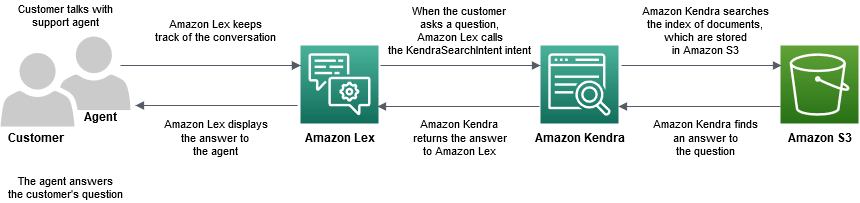
With Amazon Lex creation of chatbots for the everyday user, requests are very simple such as accessing the game scores, latest news updates, or weather updates. After you create your Lex bot, you can use them on chat services, mobile devices, and IoT devices, with support for rich message formatting.
3) Application Bots
We can easily integrate a voice or text chat interface to create bots on smartphone devices that can help customers with many daily tasks, such as accessing their bank account, ordering food, booking tickets, or calling a cab. It easily connects with Amazon Cognito so you can control user management, authentication, and sync across all devices.

Related Readings: AWS Trusted Advisor
4) Enterprise Productivity chatbots
We can use Lex to develop enterprise-productive chatbots that establish common work activities and improve Enterprise efficiencies. For example, in marketing performance from HubSpot, employees can check sales data from Salesforce, and customer service status from Zendesk, directly from their chatbots within minutes.

Understanding Amazon Lex Bots and Their Limitations
What Are Basic Bots?
Basic bots are rudimentary software programs designed to automate simple tasks. These bots typically operate within straightforward interfaces, enabling them to perform simple commands based on the user’s input. The primary function of basic bots is to handle repetitive, rule-based tasks with minimal complexity.
Limitations of Basic Bots
- Limited Inputs:
- Basic bots can only process simple commands and lack the capability to understand complex requests. This limitation restricts their use to tasks that do not require advanced decision-making or nuanced interaction.
- Basic Interface Design:
- The interfaces used in basic bots are straightforward, which can be both an advantage and a drawback. While the simplicity ensures user-friendliness, it limits the bot’s ability to perform complex operations or integrate with more sophisticated systems.
- Lack of Advanced Features:
- Basic bots typically do not include advanced features such as natural language processing (NLP) or machine learning capabilities. As a result, they cannot adapt or learn from interactions, limiting their ability to improve performance over time.
- Restricted Task Capabilities:
- These bots excel at handling tasks like answering FAQs, scheduling, or basic data entry. However, they struggle with more dynamic processes that require human-like understanding or emotional intelligence.
In summary, while basic bots provide utility in specific scenarios, their functionality is constrained by their simplistic design and limited input handling. For businesses requiring more nuanced automation solutions, advanced bots equipped with artificial intelligence might be necessary.
Amazon Lex Pricing
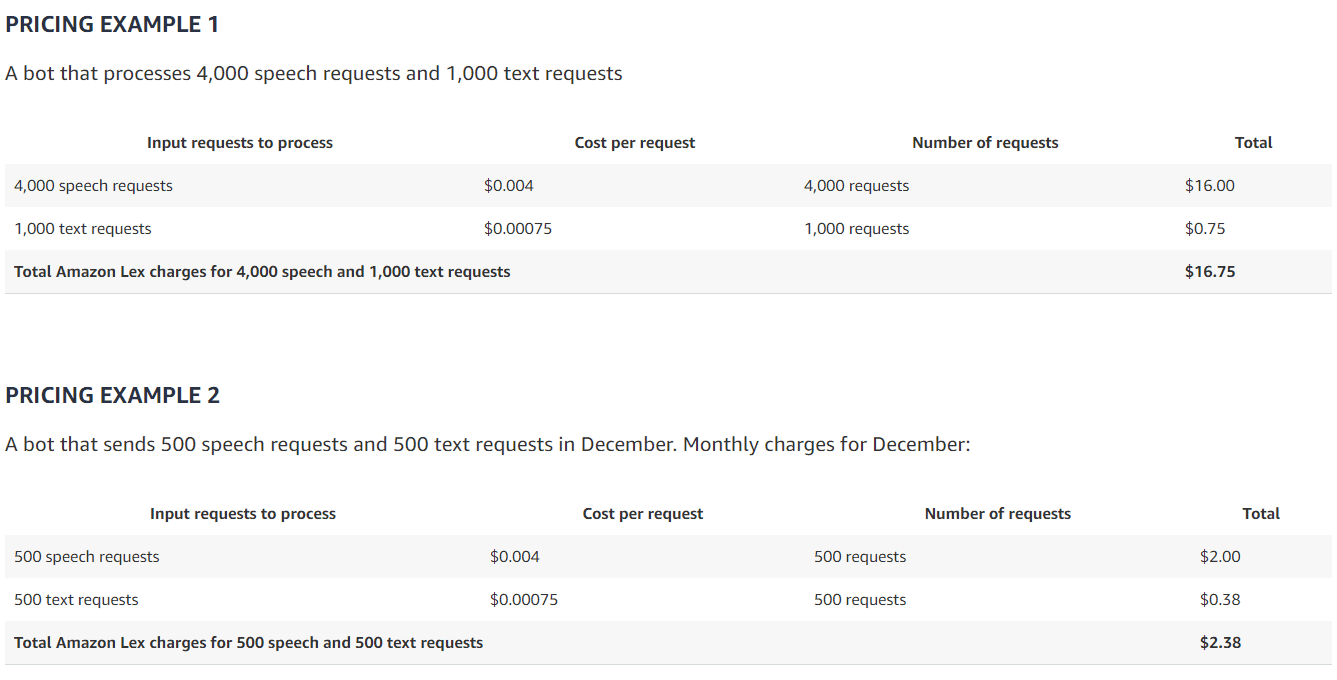
With Amazon Lex, you pay most effectively for what you use. It is charged you based on the number of voice or text requests processed by your bot, at $0.00075 per text request and $0.004 per voice request.
Cost-Effective Pricing
Amazon Lex offers a pay-as-you-go pricing model with no upfront costs or minimum charges. This means you only pay for the requests your conversational interfaces handle, making it an economical choice for businesses of all sizes. By leveraging this flexible pricing, you can efficiently manage costs while scaling your operations.
Free Tier Benefits
You can attempt Amazon Lex without spending a dime. From the date you get started with it, you can proceed up to 10,000 text requests and 5,000 speech requests per month totally free for the first year. This generous free tier allows you to explore and develop conversational interfaces risk-free, ensuring you can assess the tool’s capabilities without financial pressure.
By combining low request costs with a robust free tier, Amazon Lex stands out as a cost-effective solution for building conversational interfaces that can adapt to your evolving needs.
What are the Challenges of Voice-Based Assistants?
Voice-based assistants have revolutionized how we interact with technology, yet they present unique challenges, particularly in shopping scenarios. While these assistants streamline tasks like reordering commonly purchased items, they struggle in situations where visual information is crucial.
- Limited Sensory Interaction: Voice assistants rely solely on auditory communication. This means they can’t leverage visual aids like images or videos, which are often needed to examine new products or browse menus effectively.
- Complex Product Evaluation: For products that require detailed information or comparison, voice-only interfaces can be inefficient. Users may find it challenging to assess features or differences without visual context.
- User Experience Limitations: Navigating a wide selection or making nuanced choices is often cumbersome when reliant solely on voice commands. This limitation can lead to frustration and decreased user satisfaction.
- Adoption for Specialized Tasks: While perfect for simple tasks, voice assistants are less suited for complex, decision-heavy processes. This can limit their adoption in areas where comprehensive evaluation and deliberation are necessary.
Addressing these challenges involves integrating voice with other sensory tools or enhancing the auditory capabilities to provide richer interactions. As technology evolves, these solutions will become critical in expanding the capabilities and utility of voice assistants.
FAQs
Answer: To build a bot, you will first decide the tasks performed by the bot. These Tasks are the intents that require to be fulfilled by the bot. For every intent, you'll add sample utterances and slots. Slots are input data need to fulfill the intent. Utterances are phrases that invoke the intent. Lastly, you'll provide the business common sense important to execute the action. An Amazon Lex bot can be created each through Console and REST APIs.
Answer: Yes, It is a fully managed service so you don’t have to maintenance of code or manage the scaling of resources. Your communication schema and language models are automatically backed up. Amazon also provides full versioning capability for easy rollback. Its architecture does not need storage or backups of end-user data.
Answer: It provides SDKs for iOS and Android. You can create bots for your mobile use cases with these SDKs. User authentication can be enabled via Amazon Cognito. I hope this blog helps you in clearing your doubts regarding Amazon Lex.
Answer: Lex is a service for creating conversational interfaces using voice and text. Amazon Polly converts inputs text to speech. Q: How do I build a bot in Amazon Lex?
Q: Is Amazon Lex a managed service?
Q. How can I create Amazon Lex bots for smartphones?
Q. When do I use Amazon Lex vs. Amazon Polly?
Next Task For You
Don’t miss our EXCLUSIVE Free Training on Generative AI on AWS Cloud! This session is perfect for those pursuing the AWS Certified AI Practitioner certification. Explore AI, ML, DL, & Generative AI in this interactive session.
Click the image below to secure your spot!

![Microsoft Agentic AI Business Solutions Architect [AB-100] | K21 Academy](https://test.k21academy.com/wp-content/uploads/2025/11/Microsoft-Agentic-AI-Business-Solutions-Architect-AB-100-Exam-Overview1.png)