


The evolution of autonomous intelligent systems is being accelerated by open-source AI agent frameworks, transforming AI from simple chatbots to advanced problem-solvers. These frameworks are not only free but also collaborative and extendable, empowering developers, businesses, and even non-technical individuals to build agentic systems that can plan, act, and learn autonomously.
In this blog, we’ll explore the top open-source AI agent tools that enable you to create AI agents for various applications—from task automation to complex decision-making systems. You’ll learn about the essential elements of AI agent frameworks, the advantages of using free platforms, and how low-code/no-code solutions are making AI development more accessible than ever.
Table of Contents:
- What are AI Agent Frameworks?
- Key Components of an Agent Framework
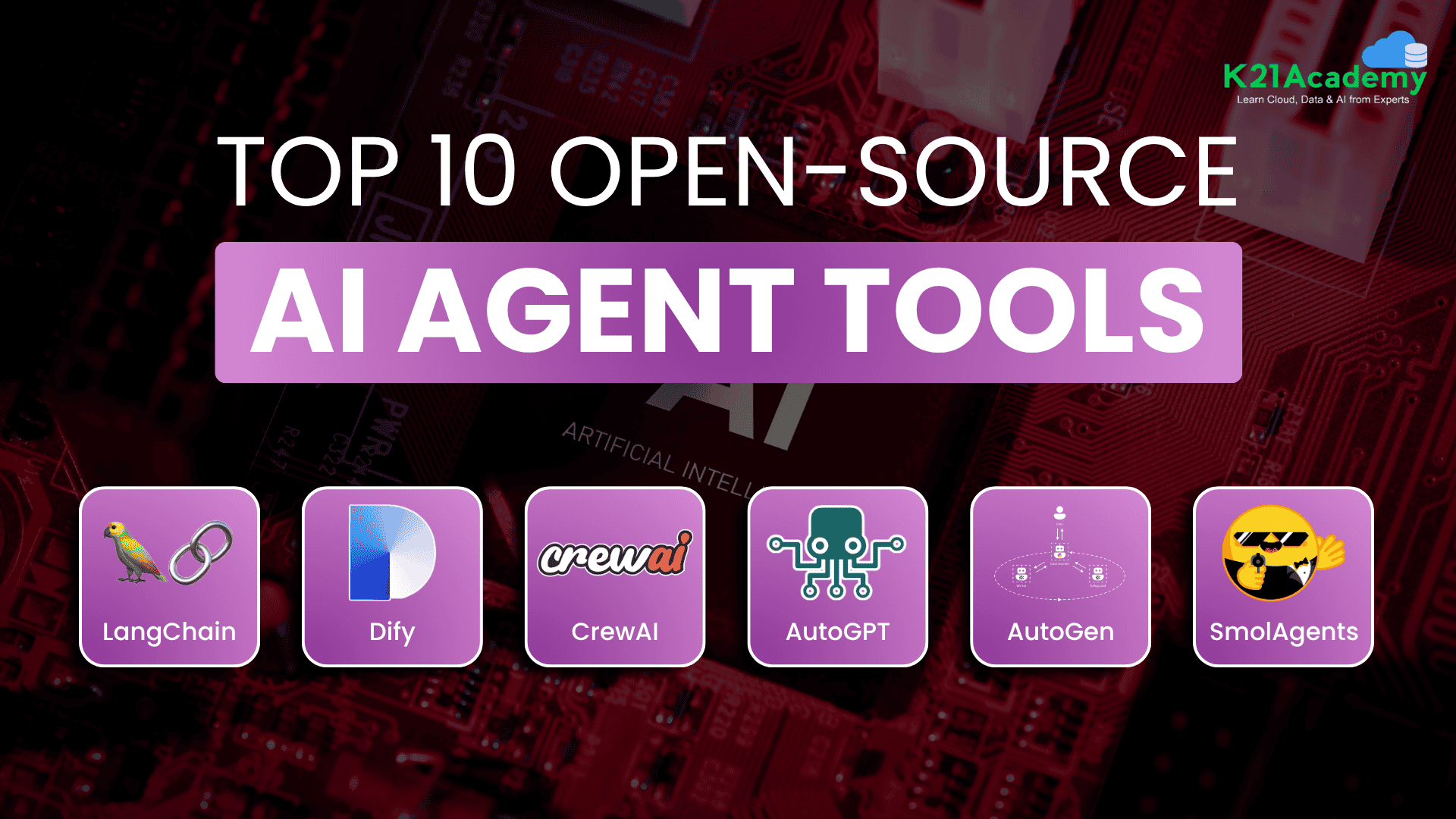
- Top 10 Open-Source AI Agent Tools
- Conclusion

What are AI Agent Frameworks?

Source: AI-Agent Tools & Frameworks
AI agent frameworks are software toolkits that package LLMs, planning logic, memory, tool integrations (APIs, data stores, browser control), orchestration, and evaluation. They simplify building agents capable of autonomous or collaborative multi-step tasks.
An AI agent framework provides the foundation for creating autonomous agents by managing key components like memory, tool integrations, and multi-agent workflows. These frameworks enable developers to create agents that behave naturally, allowing them to perform tasks autonomously rather than simply responding to commands from humans
Related Readings: What is Agentic AI?
Key Components of an AI Agent Framework
Key components of AI agent frameworks typically include:
1) Language Model Integration
To comprehend context, produce answers, and make decisions, agents rely on LLMs. For LLMs, an abstraction layer lessens vendor lock-in and facilitates testing across providers.
Large Language Models (LLMs), which are the brains behind the majority of AI agents, are capable of reasoning, producing text or code, deciphering instructions, and making judgments. The framework ought to facilitate:
- a number of LLM suppliers, including OpenAI, Anthropic, Google, Mistral, and Cohere.
- Plug-and-play design for model switching or fine-tuning.
- Multi-model routing, rate-limiting, retry logic, and API key/token management.
Related Reading: What is LLMOps (large language model operations)?
2) Tool Interface
LLMs have little knowledge and memory. Agents can do real-world tasks, including research, automation, computations, and data retrieval, by connecting to tools.
Agents extend beyond text by using external tools to act in the world. These can include:
-
APIs: for calling services (e.g., weather, booking, finance).
-
Web browsers: for scraping or navigating websites (using tools like Playwright or Puppeteer).
-
Databases: querying SQL/NoSQL or vector databases (e.g., Pinecone, ChromaDB).
-
File systems: read/write PDFs, spreadsheets, or code files.
-
Custom tools: user-defined Python functions or actions.
3) Planner/Reasoner
Agents that lack a reasoning strategy are either reactive or one-step. Self-reflection, goal prioritization, and long-term task accomplishment are all made possible by planning.
This component governs how an agent thinks through a task. Strategies include
-
ReAct (Reason + Act): agents think step-by-step and then act.
-
Plan-and-Execute: the agent creates a full plan, then executes each step.
-
AutoGPT-style recursive loops: continuously evaluate task progress.
-
Multi-agent collaboration: agents assign subtasks to peers with specialized roles.
4) Memory (Short-term & long-term)
By avoiding repetitive or conflicting acts, remembering pertinent background, and learning from interactions, memory enables agents to behave more like humans.
Agents need memory to track past interactions, retain goals, and access prior knowledge.
-
Short-term memory: recent chat history, tool outputs, task flow.
-
Long-term memory: stored in vector databases or structured documents.
-
Episodic memory: interaction logs from previous sessions.
-
Semantic memory: facts, concepts, and summaries learned.
5) Debugging & Monitoring Tools
Debugging autonomous agents is hard. Without visibility into decision paths and tool execution, troubleshooting becomes trial and error.
To build and maintain robust agents, you need
-
Trace logs: what decisions were made, what tools were used.
-
Session replays: a visual history of agent runs.
-
Performance metrics: latency, success rates, and token usage.
-
Error handling: graceful fallbacks and retries.
Related Reading: What is Prompt Engineering?
Top 10 Open-Source AI Agent Tools
Now, let’s dive into some of the most prominent AI agent tools & frameworks available today. Some of them are low-code/no-code:
1) LangChain

Source: LangChain
One of the most well-known and adaptable AI agent tools is LangChain, which was developed to combine LLMs with other tools (like databases, search engines, and APIs) in organised processes called “chains”. Both TypeScript and Python come with it. It is used for building multi-step chatbots, retrieval-augmented generation, and autonomous assistants.
Key features:
- Long-term and short-term memory components.
- Vector stores (Chroma, Pinecone, Weaviate) are supported.
- Use of tools: file systems, Python code execution, and APIs.
- LangSmith for debugging and observability.
2) CrewAI

Source: CrewAI
With clearly defined roles and common objectives, CrewAI, an open-source framework for multi-agent systems, allows AI agents to work together on tasks. It is intended for situations where agents must collaborate intelligently. This AI Agent tools is generally used in multi-role assistants (researcher + editor + QA) and teams of AI collaborators for writing or dev tasks.
Key features:
- Role-based agent design.
- Compatible with LangChain tools and memory.
- Ideal for complex RAG systems and workflow pipelines.
3) Microsoft Semantic Kernel

Source: Microsoft Semantic Kernel
A versatile orchestration framework called Microsoft Semantic Kernel assists developers in integrating AI capabilities into pre-existing applications. It is ideal for creating reliable AI agents that can function in business settings because of its emphasis on modularity, memory, and goal planning. It is generally used for embedding agents in internal apps (CRM, helpdesk, BI dashboards).
Key features:
- Planner, skill, memory, and connector layers.
- Enterprise-ready integration with Microsoft Graph, Azure.
- Can run locally or in cloud environments.
4) AutoGPT

Source: AutoGPT
AutoGPT, the Python-based framework that started the autonomous agent movement, allows agents to recursively plan, carry out, and improve their strategy in order to achieve a user-specified objective. AutoGPT is an autonomous agent framework that turns GPT-4 into a self-planning, goal-driven assistant.
Key features:
- using browser plugins to access the internet.
- modules for long- and short-term memory.
- reading and writing files and running code.
5) AutoGen

Source: AutoGen
Microsoft Research developed the event-driven, multi-agent framework AutoGen to facilitate role-based cooperation and dynamic dialogues between AI agents. This AI agent tool is used for enterprises building assistants with specialised roles (e.g., data analyst + report writer).
Key features:
- AutoGen Studio: no-code GUI for agent orchestration.
- Python-based APIs for customisation.
- Supports human-in-the-loop workflows.
6) Dify
 Source: Dify
Dify is a visual low-code platform that allows users to create, manage, and deploy AI agents using a drag-and-drop canvas, flow editor, and UI for testing. It is most being used for the rapid development of product-based chatbots or customer service agents with minimal dev effort.
Key features:
- Visual pipelines for logic control and agent orchestration.
- Supports RAG, OpenAI Function Calling, and ReAct.
- Deployable as chatbots or APIs.
7) SmolAgents (Hugging Face)

Source: SmolAgents
SmolAgents is a simple Python framework designed to run agents that generate and execute code and have a robust Hugging Face integration. It is used for codex-style agents for developers who want fine-grained control with minimal overhead.
Key features:
- Lightweight architecture.
- Quick integration with HF Spaces.
- Primarily aimed at developers.
8) AutoAgent

Source: AutoAgent
In early 2025, AutoAgent, a state-of-the-art zero-code agentic framework, was introduced. By stating objectives in natural language, it makes it possible for anybody to create and manage intelligent agents.
Key features:
- prompt-based construction of a no-code agent.
- awareness of surroundings and memory.
- feedback loop for self-learning.
- use of tools with output that is organised.
9) Rasa

Source: Rasa
Despite being mostly developer-oriented, Rasa is a popular framework for NLU-based chatbots that also features a GUI flow builder for low-code intent, entity, and story logic building.
Key features:
- Drag-and-drop designer for conversations.
- background training of an NLP model.
- deployment over many channels (Slack, WhatsApp, etc.).
- Backend integration and custom actions.
10) BotPress

Source: botpress
Using a robust visual flow editor, Botpress is a low-code conversational AI platform for creating chatbots and virtual assistants. It facilitates real-time deployment across several channels, including web, WhatsApp, and Slack, provides sophisticated dialogue logic, and interfaces with LLMs (such as GPT-4).
Botpress is a perfect bridge for organisations moving towards agentic workflows since it blends conventional NLP (intents, slots, rules) with contemporary LLM capabilities.
Key features:
- Integration of native LLM (OpenAI, Anthropic).
- Entity and intent recognition in an NLU/NLP engine.
- management of context and memory.
- deployment across several channels (messaging apps, Twilio, chat widgets, etc.).
- For testing and real-time hosting, use Botpress Cloud.
Conclusion
The market for open-source AI agent tools is growing rapidly, offering solutions for everyone—from developer-centric SDKs like LangChain and Semantic Kernel to no-code platforms like Dify and AutoAgent. Whether you’re building research-grade simulations, automating internal processes, or creating chatbots for customer interaction, there’s an AI tool tailored to meet your needs.
These tools vary widely, offering everything from memory-rich systems and visual orchestration to role-based reasoning. Each platform brings its own set of unique benefits, enabling you to build smarter, more efficient AI agents without reinventing the wheel.
By choosing the right tool for your project, you can leverage the power of autonomous AI agents to improve processes, enhance user experiences, and unlock new opportunities.
Frequently Asked Questions
A basis for creating and implementing artificial intelligence systems is provided by AI frameworks, which are sets of libraries and tools.
Software applications known as artificial intelligence (AI) agents are capable of information analysis, decision-making, and task execution without continual human supervision. AI agents, as opposed to chatbots, which follow preset routes, make decisions on their own using the information they collect and can learn to adjust to new circumstances.
Prices differ significantly by platform. While commercial platforms range from $20/month (Devin AI Core) to $500/month (Devin AI Team), open-source alternatives like Auto-GPT are free (plus API fees). Instead of charging separately, a lot of enterprise solutions connect with current subscription plans. What are AI frameworks?
What are AI agents and how do they differ from chatbots?
How much do AI agents cost to implement?

![Microsoft Agentic AI Business Solutions Architect [AB-100] | K21 Academy](https://test.k21academy.com/wp-content/uploads/2025/11/Microsoft-Agentic-AI-Business-Solutions-Architect-AB-100-Exam-Overview1.png)