

In 2025, Agentic AI is set to revolutionize the way we interact with machines. From automating business processes to enabling intelligent decision-making, the potential of it is immense. But what if you want to jump into this exciting field and don’t have any coding experience?
Don’t worry — the Agentic AI Roadmap is here to guide you every step of the way. This roadmap is tailored for non-coders who are eager to explore the world of AI without needing to learn complex programming languages. Whether you’re a business professional, an aspiring data analyst, or someone simply curious about AI, this roadmap is designed for you.
In this blog, we’ll explore how you can become an expert in this exciting field by following a structured approach that covers the fundamentals, tools, use cases, and practical steps to bring your AI agents to life. Ready to start your journey? Let’s dive in!
- What is Agentic AI?
- Agentic AI Roadmap: Step-by-Step
- M1: Introduction to Generative AI & LLM Fundamentals
- M2: LangChain Fundamentals
- M3: Prompt Engineering Fundamentals Using LangChain
- M4: Building RAG Systems Using LangChain
- M5: Agentic AI Essentials
- M6: Building Agents with No Code/Low Code
- M7: Agentic AI Architecture and Design Patterns
- M8: Building AI Agents Using LangChain and LangGraph
- M9: Building Agentic RAG
- M10: Multi-Agent Systems Using LangGraph and CrewAI
- M11: AI Agent Observability and AgentOps
- M12: MCP and A2A Protocol for Orchestrating and Democratizing AI Agents
- Real-World Projects
- Top Tools in Agentic AI
- Why This Roadmap Is Perfect for You
- Career Opportunities After Completion
- Why This Roadmap Works
- Conclusion
- Frequently Asked Questions

How to Become an Agentic AI expert in 2025 – K21Academy
What is Agentic AI?
The world of Agentic AI is an exciting one, and it’s rapidly growing. In simple terms, it refers to AI systems that can make decisions, perform tasks, and interact with both humans and other systems to achieve specific goals. Unlike traditional AI, which typically requires human input or set instructions, it is capable of performing autonomously. This means it can adapt, learn, and continuously improve as it works toward its predefined objectives.
But how can you, without any technical knowledge, become an expert in it? This is where the Agentic AI Roadmap comes in. This roadmap provides a clear path for non-coders to understand, build, and deploy AI systems using no-code and low-code tools. And the best part? You don’t need to know how to code to get started!
By the end of this blog, you’ll have a comprehensive understanding of the tools you’ll need to get started and the roadmap you can follow to become an expert in 2025.
Agentic AI Roadmap: Step-by-Step
For anyone interested, the Agentic AI Roadmap offers a step-by-step guide to mastering this technology without the need for coding. Whether you’re completely new to AI or have some experience, this roadmap will help you build practical skills.
 Agentic AI Roadmap Step-by-Step; Source – K21Academy
Module 1: Introduction to Generative AI & LLM Fundamentals
In this introductory module, you’ll explore the world of Generative AI and Large Language Models (LLMs). Understand the basics and key concepts behind these technologies, which are driving the future of AI-powered applications.
-
Key Learning Outcomes:
- Generative AI Universe: Explore the key applications and real-world use cases of Generative AI.
- LLM Fundamentals: Understand the working principles and architecture behind LLMs.
- Python Integration: Learn how to integrate LLMs into Python applications.
- Zero-Shot QA: Run zero-shot Question-Answering using Hugging Face models.
-
Hands-On Labs:
- Lab 1: Experiment with popular Generative AI tools like ChatGPT, Claude, Gemini, and Otter.
- Lab 2: Access and work with open-source LLMs and Diffusion Models.
- Lab 3: Execute zero-shot QA using Hugging Face models.
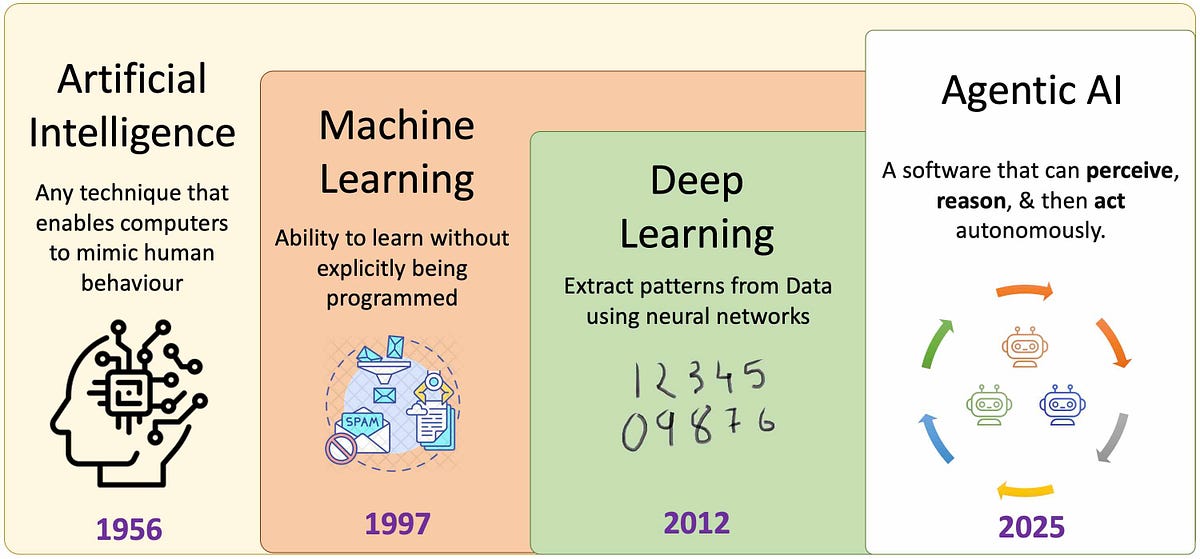
Understanding of FM Models; Source – Medium by Araf Karsh Hamid
Module 2: LangChain Fundamentals
This module delves into LangChain, an essential framework for building AI-powered applications. Learn how to chain multiple LLMs together to create robust and scalable AI systems.
-
Key Learning Outcomes:
- LangChain Components: Explore the core components of LangChain.
- Chat Models & Prompts: Learn how to create effective chat models and prompt templates.
- LCEL Language: Get acquainted with LangChain Expression Language (LCEL) for advanced integration.
- LLM Chains: Learn how to build complex LLM workflows for problem-solving.
-
Hands-On Labs:
- Lab 1: Set up your LangChain environment and initialize models.
- Lab 2: Work with LCEL for seamless LLM handling.
Module 3: Prompt Engineering Fundamentals Using LangChain
In this module, learn the art of prompt engineering to guide language models towards optimal results. Gain expertise in advanced techniques that enhance the decision-making and reasoning capabilities of your AI systems.
-
Key Learning Outcomes:
- Prompt Patterns: Understand different patterns like Persona, Cognitive Verifier, and Audience to optimize AI interactions.
- Advanced Prompting: Learn Chain of Thought, ReAct, and Zero-Shot Prompting for complex tasks.
- LLM as a Judge: Implement LLMs as evaluators for AI-generated content.
-
Hands-On Labs:
- Lab 1: Design persona-based prompts to shape AI responses.
- Lab 2: Apply advanced prompting techniques like Chain of Thought and ReAct.
Related Reading: Top 10 Powerful Prompt Engineering Tools
Module 4: Building RAG Systems Using LangChain
This module covers Retrieval-Augmented Generation (RAG), which integrates external data sources into LLMs for more accurate, context-aware responses.
-
Key Learning Outcomes:
- Data Ingestion: Learn how to load and structure data for RAG systems.
- Text Splitting & Embeddings: Break down text and create meaningful semantic embeddings.
- Vector Databases: Integrate with vector databases for efficient information retrieval.
- Retrieval Strategies: Implement strategies to enhance your RAG system’s performance.
-
Hands-On Labs:
- Lab 1: Build a simple RAG using LangChain.
- Lab 2: Build and deploy a custom RAG pipeline using LangChain.

Retrieval-Augmented Generation Architectural Model; Source – K21Academy
Module 5: Agentic AI Essentials
In this module, explore the world of Agentic AI, which includes agents that can operate autonomously and interact with humans. Learn how to build self-improving AI systems with ethical AI principles.
-
Key Learning Outcomes:
- Agentic AI Introduction: Understand the key concepts behind Agentic AI and its applications.
- AI Agents vs. Agentic AI: Explore the differences between traditional AI and Agentic AI.
- Autonomous & Human-in-the-Loop: Learn how agents can collaborate with humans and work autonomously.
- Ethical AI: Implement ethical considerations when designing Agentic AI systems.
Module 6: Building Agents with No Code/Low Code
Learn how to build AI agents without writing complex code by leveraging no-code and low-code platforms. This module introduces platforms like N8N, Zapier, and Make AI.
-
Key Learning Outcomes:
- No-Code AI Development: Build AI agents using no-code platforms like N8N and Zapier.
- Integrating with Existing Systems: Connect your AI agents to existing workflows.
- Security & Compliance: Understand best practices for ensuring the security and compliance of no-code AI solutions.
-
Hands-On Labs:
- Lab 1: Set up N8N and build a basic AI agent.
- Lab 2: Build AI agents using Zapier and Make AI.
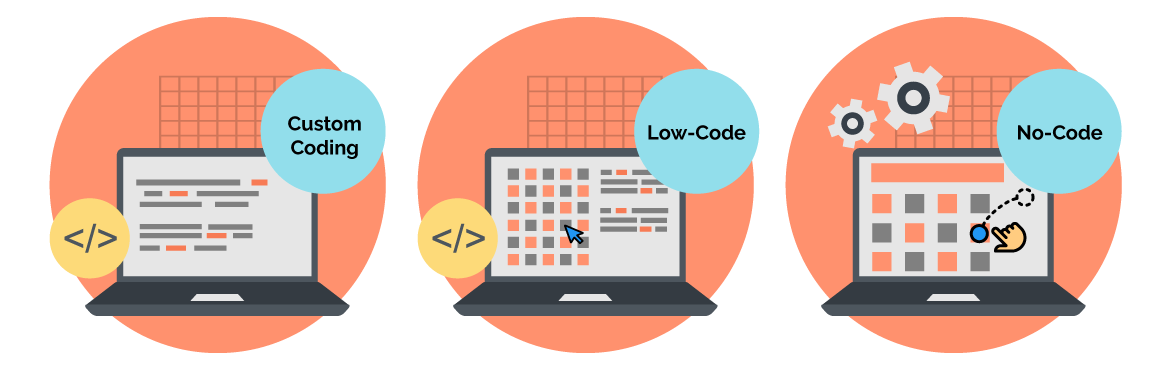
Traditional coding vs low-code vs no-code; source – Quixy
Module 7: Agentic AI Architecture and Design Patterns
Explore the architecture behind Agentic AI systems and learn how to design scalable, robust AI agents that can function autonomously or in collaboration with humans.
-
Key Learning Outcomes:
- Agentic Architecture Types: Understand different Agentic AI architectures.
- Design Considerations: Learn how to design scalable and maintainable AI systems.
- ReAct & Multi-Agent Patterns: Implement multi-agent workflows for collaborative problem-solving.
Module 8: Building AI Agents Using LangChain and LangGraph
In this advanced module, learn how to build AI agents using LangChain and LangGraph, managing both state and memory for optimal performance.
-
Key Learning Outcomes:
- LangGraph Basics: Learn about the core components and capabilities of LangGraph.
- Memory & State Management: Manage memory in your AI agents to improve reasoning and decision-making.
- Long-Term Memory: Build long-term memory systems for AI agents.
-
Hands-On Labs:
- Lab 1: Build AI agents using LangChain.
- Lab 2: Implement AI agents with LangGraph for end-to-end tasks.
Related Reading: Understanding RAG with LangChain
Module 9: Building Agentic RAG
Learn how to build adaptive RAG systems that evolve and improve over time, based on previous outputs, using LangChain and Agentic AI principles.
-
Key Learning Outcomes:
- Adaptive RAG: Build systems that self-correct and improve based on data.
- Agentic RAG: Integrate Agentic RAG into your workflows for dynamic improvements.
-
Hands-On Labs:
-
Lab 1: Implement adaptive Agentic RAG workflows.
-
Module 10: Multi-Agent Systems Using LangGraph and CrewAI
Learn how to build and manage multi-agent systems that can work together seamlessly, leveraging LangGraph and CrewAI.
-
Key Learning Outcomes:
- Multi-Agent Workflows: Learn how agents can collaborate and complete tasks more efficiently.
- CrewAI: Integrate CrewAI for managing multi-agent systems.
-
Hands-On Labs:
- Lab 1: Build multi-agent workflows using LangGraph.
- Lab 2: Set up and configure CrewAI for multi-agent AI systems.

Multi-agent system with crew AI; source – LinkedIn post by Dipanjan S
Module 11: AI Agent Observability and AgentOps
This module focuses on monitoring, troubleshooting, and optimizing the performance of your AI agents using LangFuse and Langsmith.
-
Key Learning Outcomes:
- LangFuse Dashboard: Set up AI agent monitoring systems.
- Langsmith for Observability: Use Langsmith for troubleshooting and improving AI agent performance.
-
Hands-On Labs:
- Lab 1: Set up LangFuse for agent performance monitoring.
- Lab 2: Implement Langsmith for troubleshooting and enhancing AI agents.
Module 12: MCP and A2A Protocol for Orchestrating and Democratizing AI Agents
Learn about the protocols that enable the orchestration and democratization of AI agents, making them accessible and scalable for all.
-
Key Learning Outcomes:
- MCP and A2A Protocols: Understand how these protocols streamline AI agent orchestration.
- Orchestrating AI Agents: Deploy and manage AI agents more efficiently across systems.
-
Hands-On Labs:
-
Lab 1: Build an agent using the MCP server.
-

Comparison of different Agentic AI Protocols; Source – K21Academy
Related Readings: What is A2A Protocol
Real-World Projects
Throughout the course, you’ll work on several real-world projects, applying your knowledge and skills to solve business challenges. These projects include:
Project 1: Autonomous HR Agent for Employee Onboarding
Objective: Automate the entire employee onboarding process using AI agents, allowing HR teams to focus on strategic decision-making. This AI system will streamline tasks like document collection, training scheduling, and progress monitoring, ensuring a smooth and personalized onboarding experience.
Key Features:
- Automated Document Collection and Verification: The AI agent collects necessary documents (e.g., identification, contracts) and verifies their accuracy.
- Scheduling Orientation and Training: Automatically schedules orientation sessions, training programs, and other essential onboarding activities.
- Progress Tracking and Personalized Support: Monitors the new employee’s progress, sends reminders, and provides personalized support based on their onboarding journey.
- Integration with Internal HR Systems: Seamlessly integrates with existing HR systems to manage employee records and ensure a smooth workflow.
Technologies:
- LangGraph for workflow orchestration
- LangChain for LLM integration
- SQL Databases for record management

Autonomous HR Agent for Employee Onboarding; Source – LinkedIn, Allen Adams
Project 2: AI-Powered Financial Advisor Agent
Objective: Create a cutting-edge AI-powered financial advisor that delivers personalized investment recommendations. The agent will analyze market data, financial records, and trends to offer actionable investment strategies and help users manage their financial portfolios.
Key Features:
- Financial Data Analysis: The AI analyzes user financial data, market trends, and investment opportunities to provide relevant recommendations.
- Tailored Investment Strategies: Based on the analysis, the agent suggests personalized strategies that align with the user’s risk tolerance and financial goals.
- Market Condition Monitoring: The AI monitors ongoing market changes and sends real-time alerts to users, advising on potential investment opportunities or risks.
- Compliance with Financial Regulations: Ensures that the recommendations comply with financial regulations and ethical standards.
Technologies:
- LangGraph for decision-making workflows
- LangChain for financial data API integrations
- LangSmith for performance evaluation
Project 3: AI Agent for Legal Document Analysis
Objective: Build an AI agent to assist legal professionals in analyzing and summarizing legal documents like contracts and agreements. This tool will extract crucial clauses, identify risks, and provide recommendations for legal actions.
Key Features:
- Extract Key Clauses and Terms: The agent identifies and extracts essential clauses from contracts, such as payment terms, penalties, and confidentiality agreements.
- Risk and Legal Issue Identification: The AI assesses potential risks, legal issues, and non-compliance areas within the documents.
- Generate Summaries and Recommendations: Automatically summarizes the document, offering actionable insights or recommendations for legal professionals.
- Integrate with Document Management Systems: The agent integrates with existing legal document management systems for easy storage and retrieval of analyzed documents.
Technologies:
- LangGraph for document workflow management
- LangChain for LLM integration
- SQL Databases for storing results

AI Agents for Legal Documents; Source – LeewayHertz
Project 4: AI Agent for Healthcare Diagnostics Assistance
Objective: Develop an AI agent that assists healthcare professionals in diagnosing medical conditions based on patient data, such as symptoms, medical history, and test results. This tool will help reduce diagnostic errors and offer timely treatment recommendations.
Key Features:
- Symptom and Medical History Analysis: The agent analyzes symptoms and medical history to suggest possible diagnoses.
- Test and Procedure Recommendations: Based on the analysis, the AI suggests relevant tests or procedures for further examination.
- Access to Medical Research and Treatment Guidelines: The AI keeps healthcare professionals updated with the latest medical research, guidelines, and best practices.
- Compliance with Healthcare Standards: Ensures that the agent’s recommendations adhere to healthcare standards and regulations.
Technologies:
- LangGraph for diagnostic workflows
- LangChain for medical database integration
- LangSmith for performance evaluation
Project 5: AI Agent for E-commerce Customer Support
Objective: Create an AI agent to enhance customer support for e-commerce platforms. This system will handle customer inquiries, manage orders, and provide personalized product recommendations, improving the overall customer experience.
Key Features:
- Product and Order Inquiries: The agent answers customer questions about product availability, specifications, and order status.
- Personalized Product Recommendations: Based on customer preferences, the AI suggests products and promotions tailored to individual needs.
- Order Tracking and Updates: Automatically tracks orders and provides real-time updates on shipping and delivery status.
- CRM System Integration: Integrates with Customer Relationship Management (CRM) systems to manage customer data and interactions seamlessly.
Technologies:
- LangGraph for customer interaction workflows
- LangChain for e-commerce API integrations
- LangSmith for performance evaluation
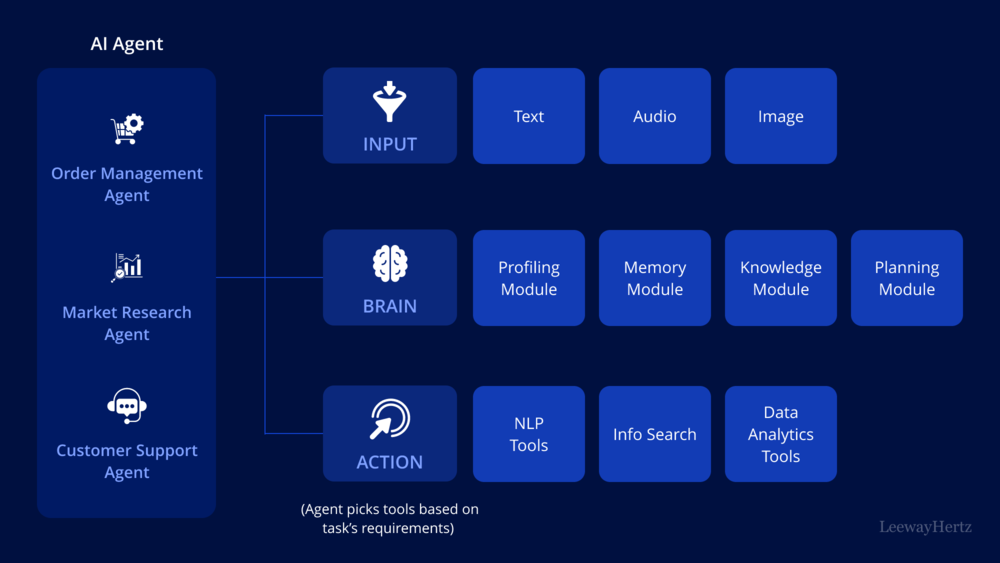
AI agent for retail and ecommerce; Source – LeewayHertz
These hands-on projects provide practical experience, ensuring you’re well-prepared to implement Agentic AI in real-world scenarios.
Top Tools in Agentic AI
Mastering Agentic AI requires using the right tools. Here are some of the top tools you will explore during the Roadmap:
- Cognosys: A no-code platform perfect for building customer support bots and automating workflows.
- Relevance AI: A tool for creating AI models and automating tasks using real-world data.
- Make.AI: A drag-and-drop interface for creating complex AI workflows without needing to code.
- n8n: A low-code tool for creating AI agents and workflows that integrate multiple services.
- CrewAI: A platform for building advanced AI workflows, ideal for non-coders transitioning to low-code solutions.
- Langflow: A visual tool for designing and managing AI flows, ideal for beginners looking to explore low-code AI development.
These tools make it easier for you to develop, test, and deploy Agentic AI systems, empowering you to create practical solutions with minimal technical knowledge.
Related Readings: Top 10 No-Code AI Tools in 2025
Why This Roadmap Is Perfect for You
This Roadmap is specifically designed to empower non-coders to master Agentic AI without needing to write code. It provides practical, hands-on experience with powerful tools that will help you create functional AI agents for real-world applications.
No-Code and Low-Code Solutions
This roadmap is all about accessibility. It allows you to dive into Agentic AI using no-code and low-code platforms. These tools allow you to build AI agents, automate processes, and develop intelligent systems without the need for programming skills. Whether you’re a business professional or an aspiring data analyst, this roadmap makes it possible to explore the world of AI with ease.

Agentic AI using No-Code & Low-Code Solutions; Source – K21Academy
Career Opportunities After Completion
Once you complete the Agentic AI Roadmap, you’ll be well-prepared to step into various high-demand roles:
- No-Code AI Developer
- AI Solutions Architect (No-Code)
- AI Integration Specialist
- Automation Engineer
- AI Product Manager
These roles are highly sought after, and with your new skills, you will be ready to pursue career opportunities in the rapidly growing field of AI.
Why This Roadmap Works
- Tailored for non-tech learners: Specifically designed for beginners with no prior coding experience.
- Hands-on labs and real-world applications: Gain practical experience in building AI agents through real-world use cases.
- Job-ready skills: By the end of the program, you’ll be equipped for roles such as AI Product Manager, No-Code Developer, or AI Integration Specialist.
- Industry-standard tools: Learn to use the same tools that leading companies rely on in their production environments.
- Structured learning path: Follow a clear, step-by-step roadmap that ensures steady progress and avoids confusion from random, disjointed content.
Conclusion
This Roadmap is your ultimate guide to mastering Agentic AI in 2025. Whether you’re a non-coder, business professional, or aspiring data analyst, this roadmap will equip you with the skills and knowledge you need to succeed in AI. With hands-on labs, real-world use cases, and the best tools available, you’ll be ready to enter the world of this fascinating technology and take your career to new heights.
Frequently Asked Questions
What is the difference between Agentic AI and traditional AI?
Traditional AI relies heavily on human intervention and predefined instructions to perform tasks, while Agentic AI can operate autonomously. Agentic AI systems adapt to new situations, make decisions on their own, and perform tasks based on pre-set goals, making them more flexible and capable of managing complex, real-world scenarios.
How long does it take to become an expert in Agentic AI?
The time it takes to become an expert in Agentic AI depends on your prior experience and dedication to learning. Generally, it can take several months to a year, depending on how consistently you practice and the depth of learning you pursue. With structured learning and hands-on projects, many learners can start building expertise in about 4-6 months.
Which industries benefit the most from Agentic AI?
Agentic AI has significant applications across multiple industries, including tech, healthcare, finance, retail, and manufacturing. It is particularly useful for automating workflows, improving customer service, and driving efficiencies in decision-making. Industries relying on data-intensive processes or requiring complex decision-making, like healthcare (for diagnostics) and finance (for fraud detection), stand to benefit the most.
How will this program help me become skilled at building AI agents?
This program will teach you how to design and build AI agents using easy-to-use, no-code tools. You’ll gain hands-on experience in automating workflows, creating intelligent systems, and solving real-world problems with AI, preparing you for roles such as AI Tools Developer or AI Integration Specialist.
I’m an IT professional. How will this program help me transition into AI and automation roles?
This course is ideal for IT professionals looking to pivot into AI and automation. You’ll learn to design AI-driven systems, automate workflows, and manage multi-agent systems using no-code and low-code tools, which will prepare you for roles like AI Architect or AI Solutions Specialist.


![Microsoft Agentic AI Business Solutions Architect [AB-100] | K21 Academy](https://test.k21academy.com/wp-content/uploads/2025/11/Microsoft-Agentic-AI-Business-Solutions-Architect-AB-100-Exam-Overview1.png)