


Source: K21Academy
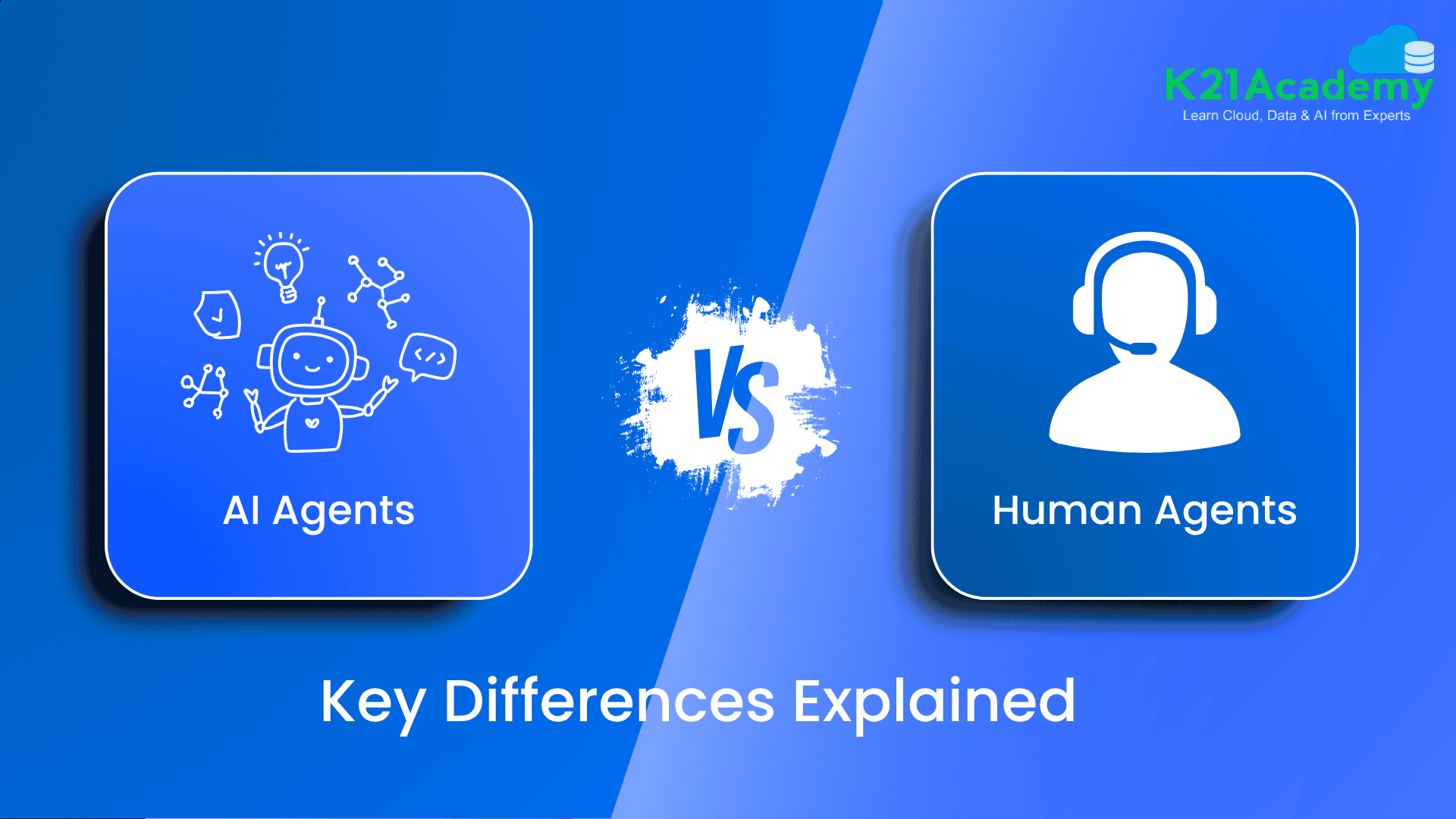
AI agents are rapidly transforming various industries by helping businesses automate tasks, manage data efficiently, and improve customer service. While AI technology continues to evolve, there are notable differences between AI agents and human agents, especially when it comes to emotional intelligence, adaptability, and decision-making skills.
In this blog, we will explore the key differences between AI agents and human agents, comparing their strengths, limitations, and roles in business. We’ll also discuss how businesses can leverage both AI and human agents to optimize workflows, enhance productivity, and create smarter operations.
In this blog, we have covered:
What are AI Agents?

Source: K21Academy
Artificial intelligence agents, or AI agents for short, are computer programs created to mimic human behavior, complete jobs, or carry out intricate procedures with little to no assistance from humans.
These agents can comprehend and reply to user inquiries, examine consumer behavior, and even make recommendations based on previous exchanges thanks to machine learning and natural language processing (NLP). AI voice assistants, automated email responders, and chatbots for virtual customer support are a few examples.
Advantages of AI Agents
-
Efficiency: AI agents excel at handling repetitive tasks and processing large volumes of data much faster than humans. For example, in customer service, they can simultaneously manage thousands of inquiries, providing quick responses to customers at all times.
-
Cost-effectiveness: By automating routine tasks, organizations can significantly reduce labor costs while maintaining or even improving service quality. This is particularly beneficial in sectors facing labor shortages or where 24/7 availability is required, such as in e-commerce and tech support.
-
Scalability: AI agents can scale effortlessly with business growth, operating round-the-clock without breaks. This makes them ideal for rapidly growing companies that need to manage increasing workloads without hiring additional staff.
-
Accuracy: AI systems excel at processing large datasets, offering precise insights and making data-driven predictions with minimal human error. In fields like healthcare, where accuracy can have life-or-death consequences, AI agents are invaluable in ensuring data precision.
Limitations of AI Agents
-
Absence of Emotional Intelligence: Unlike humans, AI agents lack the ability to fully understand or respond to emotions. This makes them less suitable for roles requiring empathy, such as counseling or handling sensitive customer service situations, where human understanding is critical.
-
Dependency on Data Quality: AI agents’ performance heavily relies on the quality of the data used for training. If the data is biased, incomplete, or unrepresentative, the agent’s responses or actions may be inaccurate, potentially leading to harmful or misleading outcomes.
For example, in healthcare, biased data could result in incorrect diagnoses. Similarly, in recruitment, biased hiring algorithms may favor certain demographics over others, leading to unfair hiring practices and limiting diversity. -
Restricted Flexibility: AI agents can only perform tasks they have been specifically trained for. Unlike human agents, who can adapt to new challenges or problems, AI agents struggle with tasks or situations outside their predefined programming, making them less versatile in dynamic environments.
Related Readings: What is LLMOps (large language model operations)?
What are Human Agents?

Source: K21Academy
Human agents are individuals who work across various industries, performing tasks, making decisions, and communicating with others. They bring emotional intelligence, creativity, and the ability to adapt to new or unexpected situations, setting them apart from AI systems.
Human agents excel in fields that require complex problem-solving, empathy, and human interaction. Industries such as healthcare, sales, and management benefit from the unique qualities of human agents. These industries rely on human agents for roles that demand a high level of emotional intelligence and decision-making, which AI cannot replicate effectively.
Advantages of Human Agents
-
Emotional Intelligence: Unlike AI, humans can provide empathy, patience, and understanding. They can sense customer emotions—such as joy or frustration—and adjust their approach accordingly. For example, a customer service representative can gauge the tone of a call and respond with the appropriate level of empathy, which AI agents often lack.
-
Creativity and Problem-Solving: Humans are capable of thinking creatively and coming up with innovative solutions to complex problems. For instance, when faced with a unique customer issue, a human agent can think outside the box, whereas AI can only follow patterns based on its training data.
-
Adaptability and Flexibility: Human agents excel in making quick decisions and adjusting to specific situations. They can find solutions in real-time, offering personalized responses when facing new, unforeseen issues—something AI agents may struggle with due to their rigid programming.
Limitations of Human Agents
-
Cost and Scalability: Relying on human agents can be costly and difficult to scale, especially for companies handling a large volume of inquiries. For example, during peak times, businesses may struggle to quickly expand their workforce to meet demand, unlike AI agents that can handle unlimited queries simultaneously.
-
Fatigue and Inconsistency: Human agents are susceptible to burnout, mood fluctuations, and health issues, which can impact the consistency and quality of their service. For instance, a tired customer service representative may not provide the same level of attention as one who is well-rested, leading to variations in service quality.
-
Error-prone: Distractions, emotional stress, and fatigue can all contribute to human error. In high-pressure environments, such as emergency response or healthcare, these mistakes can significantly affect the quality of decisions and work, making human agents more prone to errors compared to AI systems.
AI Agents vs Human Agents: Key Differences
| Criteria | AI Agents | Human Agents |
|---|---|---|
| Speed & Efficiency | AI agents excel in speed, handling repetitive tasks efficiently. | Human agents are slower and can handle limited tasks at once. |
| Emotional Intelligence | AI agents lack emotional understanding and empathy. | Human agents possess emotional intelligence and empathy. |
| Creativity & Problem-solving | AI agents are limited to predefined solutions and patterns. | Humans can think creatively and solve complex problems. |
| Adaptability | AI agents are rigid and perform best within predefined parameters. | Humans can adapt to unexpected or ambiguous situations. |
| Cost | AI agents are cost-effective for repetitive tasks, reducing overhead. | Human agents have higher costs due to salaries, benefits, and training. |
| Error Rate | AI agents are less prone to mistakes, especially with data. | Humans can make errors due to fatigue, stress, or distractions. |
| Use Cases | Customer service automation, data analysis, fraud detection, and inventory management are common uses for AI agents. | Customer service, consulting, and creative roles benefit from human interaction and problem-solving. |
Blending AI Agents and Human Agents

Source: K21Academy
In order to capitalize on the advantages of both AI and human agents, many businesses are increasingly using a hybrid approach. This paradigm combines the speed and efficiency of AI agents with the emotional intelligence and adaptability of human agents. Here are some notable instances of this hybrid strategy:
- AI-Driven Triage: AI agents manage first contacts, screening, and forwarding more delicate or complicated problems to human agents.
- AI Agent Human Supervision: Many companies use human supervisors to keep an eye on AI agent interactions to guarantee the precision and dependability of AI responses.
- Intelligent Handover: AI agents may easily move a consumer to a human agent for more specialized help when they are unable to answer a question.
This hybrid approach allows businesses to handle up to 80% of repetitive requests using AI, freeing up human agents to address more complex issues. Customers benefit from fast, AI-powered responses with the option to escalate to a human agent when needed.
Additionally, through continuous feedback loops, human agents help AI systems learn and improve, which leads to:
- Faster resolution times
- Improved customer satisfaction
- Reduced operational costs
By blending the capabilities of AI and human agents, companies can optimize their customer service, enhance efficiency, and improve overall customer experiences.
When to Use Human Agents vs AI
The best way to compare AI and human agents is to understand when to use each. For frequent, high-volume queries that demand consistency and speed, use AI agents. When dealing with complex, emotionally charged matters that call for judgment and empathy, use human agents.

Source: K21Academy
When cost-effectiveness, speed, and consistency are crucial, AI agents excel. Ideal use scenarios include the following:
- High-Volume FAQS: AI agents are able to provide prompt answers to thousands of repetitive questions, such as those about return policies or order tracking. This shortens wait times for customers and expedites service.
- After-Hours Support: AI offers round-the-clock assistance, which is ideal for companies with clients across the world. Customers always receive prompt assistance when they need it, regardless of the time zone.
- Lead Qualification: AI agents interact with leads in real time, gather important data, and forward fresh leads to sales representatives. This facilitates effective sales funnel streamlining.
- Routine chores: AI performs routine chores with speed and accuracy, such as scheduling appointments and changing passwords. Human agents can now work on more complicated problems.
On the other hand, complicated problems, emotional support, and decision-making require human agents. Consumers who have experienced emotional distress or a billing problem frequently want to “speak to a real person,” and for good reason.
Nowadays, a lot of businesses employ a hybrid strategy in which human workers cover more complex situations while AI manages the front lines.
The Future: The Evolution of AI Agents

Source: K21Academy
AI agents are rapidly evolving, becoming increasingly capable of handling complex tasks and managing intricate client requirements. With advancements in machine learning and natural language processing (NLP), future AI systems may be able to handle even more sophisticated interactions, including a better understanding of emotions and nuances in human behavior. This will allow AI to provide more personalized and context-aware support across various industries.
Conclusion
In conclusion, both human and AI agents offer unique advantages. While human agents excel in areas requiring empathy, adaptability, and complex problem-solving, AI agents are invaluable for automation, speed, and scalability. By combining the strengths of both, businesses can utilize AI to improve productivity while using human agents to provide personalized, meaningful experiences.
This collaboration between AI and human agents is set to transform industries, driving innovation and creating new opportunities in the workforce. The future of customer service and business operations will undoubtedly rely on this hybrid model, which balances the best of both worlds.
Frequently Asked Questions
Chat GPT: Is it an AI agent?
A real AI agent is not what ChatGPT is. It is a sizable language model that has been educated to carry on discussions and help with duties. However, it lacks important agent characteristics. Without continual human input, AI bots can operate autonomously to accomplish objectives.
What is the difference between a GPT and an agent?
A GPT is an AI language model used for generating text, while an AI agent is an autonomous entity that can perceive its environment, make decisions, and perform tasks, often involving multiple components like sensors and actions.
What is the role of human agents in AI-driven businesses?
In AI-driven companies, human agents supplement AI by offering creativity, emotional intelligence, and decision-making for activities that AI is unable to perform. They maintain a balanced approach by managing customer connections, supervising AI systems, and making sure AI supports corporate objectives.
What is an example of an AI agent?
An example of an AI agent is Siri, which interacts with users, understands commands, and performs tasks like setting reminders or answering questions.


![Microsoft Agentic AI Business Solutions Architect [AB-100] | K21 Academy](https://test.k21academy.com/wp-content/uploads/2025/11/Microsoft-Agentic-AI-Business-Solutions-Architect-AB-100-Exam-Overview1.png)