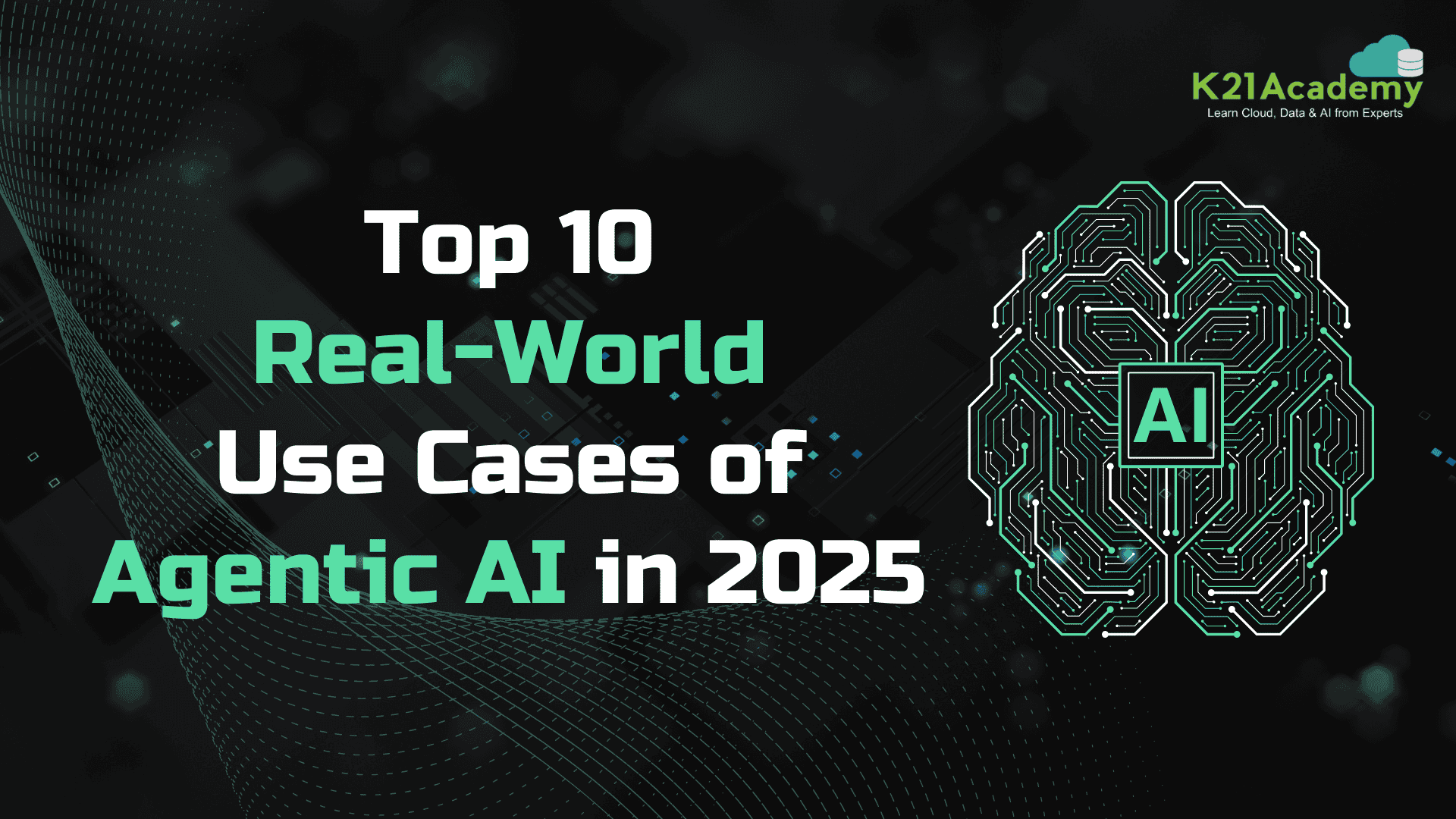


In this blog, we will explore the Top 10 Real-World Applications of Agentic AI in 2025, showcasing how this transformative technology is set to revolutionize industries. From autonomous vehicles and AI-powered healthcare diagnostics to personalized marketing, Agentic AI is paving the way for more efficient, intelligent, and autonomous systems.
Each application discussed here illustrates how Agentic AI can enhance decision-making, optimize operations, and unlock new possibilities across diverse sectors, driving both innovation and efficiency.
Agentic AI refers to AI systems capable of autonomously making decisions, learning from experiences, and interacting with the environment, all without human intervention. By 2025, these AI systems are expected to be deeply integrated across industries, reducing operational costs and reshaping the way businesses and individuals operate.
In this blog, we will delve into the Top 10 Real-World Applications of Agentic AI in 2025 that will reshape industries and redefine the future of technology.

Source: K21Academy
Related Readings: What is Agentic AI | K21Academy
Top 10 Real-World Applications of Agentic AI in 2025
1. Autonomous Vehicles and Transportation Systems
Agentic AI will play a pivotal role in advancing self-driving cars, trucks, and delivery vehicles. These systems can analyze road conditions, traffic patterns, and even make decisions in real-time, improving road safety and efficiency in transportation. By 2025, the use of AI-powered autonomous fleets will be more common in logistics, public transport, and private vehicles.
Example:
-
Waymo (Self-Driving Cars): Waymo, a subsidiary of Alphabet (Google’s parent company), operates a fleet of fully autonomous vehicles. These cars use Agentic AI to navigate city streets, detect obstacles, and adapt to changing road conditions without human intervention.
-
Tesla Autopilot: Tesla’s Autopilot system, which is continuously evolving with AI, provides semi-autonomous driving capabilities. Tesla is aiming to fully integrate Agentic AI for fully autonomous driving by 2025.
2. AI-Driven Healthcare Diagnostics
In healthcare, Agentic AI will enhance diagnostic systems by autonomously interpreting medical data, such as X-rays, MRIs, and genetic sequences. With AI agents capable of learning from vast medical datasets, they will assist doctors in identifying diseases earlier, making more accurate diagnoses, and even suggesting treatment plans based on patient data.
Example:
-
PathAI: PathAI leverages deep learning models to analyze medical images such as pathology slides. It helps doctors diagnose diseases like cancer more accurately by detecting patterns in images that may be invisible to the human eye.
-
IBM Watson Health: IBM’s Watson Health is an AI platform that analyzes health data to assist doctors with personalized treatment options. It can also predict patient outcomes based on historical data, improving decision-making in healthcare.
3. Smart Manufacturing and Robotics
In smart manufacturing, AI-powered robots equipped with decision-making capabilities will autonomously control assembly lines, monitor machinery, and optimize production. These systems will improve operational efficiency, reduce downtime, and even predict maintenance needs, leading to higher productivity and cost savings for businesses.
Example:
-
Fanuc Robotics: Fanuc’s robots, integrated with AI, autonomously handle tasks on manufacturing assembly lines. They optimize production processes, monitor equipment health, and predict when machines need maintenance, thereby reducing downtime.
-
Siemens MindSphere: Siemens’ MindSphere connects industrial machines and devices to a cloud-based platform that uses AI to optimize manufacturing workflows and predict maintenance needs.
4. AI-Powered Virtual Assistants for Businesses
Businesses will increasingly rely on Agentic AI in the form of intelligent virtual assistants. These assistants will autonomously handle customer service, process orders, manage calendars, and perform repetitive administrative tasks. With constant learning and adaptation, AI agents will provide highly personalized and efficient customer experiences.
Example:
-
Zendesk Answer Bot: Zendesk’s Answer Bot uses AI to automatically handle customer service queries. By analyzing previous interactions and understanding context it provides personalized and accurate responses to customers without human intervention.
-
Salesforce Einstein: Salesforce’s AI-powered virtual assistant, Einstein, autonomously handles customer interactions, automates administrative tasks, and provides intelligent insights to sales and service teams, improving efficiency.
Related Readings: AI Agents vs Human Agents: Key Differences & Benefits in Modern Business
5. Personalized Marketing and Customer Experience
Agentic AI will revolutionize marketing by creating highly personalized experiences for customers. AI systems will analyze customer behavior, preferences, and even predict future purchasing trends. This will allow businesses to deliver targeted advertising, personalized content, and tailored product recommendations, enhancing customer engagement.
Example:
-
Netflix Personalization Engine: Netflix uses Agentic AI to analyze user behavior, preferences, and viewing history. It autonomously curates personalized recommendations that keep users engaged with the platform.
-
Amazon’s Product Recommendations: Amazon’s AI algorithms analyze customer purchase history and browsing behavior to suggest products in real-time, enhancing the shopping experience with tailored recommendations.
6. Autonomous Financial Advisors
By 2025, Agentic AI will reshape the financial services industry. AI-driven financial advisors will analyze a client’s financial situation and goals, provide real-time investment recommendations, and autonomously execute trades. These advisors will be able to offer financial guidance that was once only available to high-net-worth individuals, democratizing wealth management.
Example:
-
Betterment: Betterment is an AI-driven financial advisory service that provides autonomous investment recommendations. It analyzes client portfolios, market data, and personal financial goals to create automated, optimized investment strategies.
-
Wealthfront: Wealthfront uses AI to offer personalized investment advice and automate portfolio management. Its AI agents monitor financial markets and make real-time adjustments to investments based on evolving market conditions.
7. AI-Enhanced Cybersecurity
Agentic AI will be used in cybersecurity to autonomously detect and respond to threats. By continuously learning from network traffic, AI systems can identify patterns and anomalies that indicate a potential breach. They will be able to react in real-time, blocking threats before they cause significant damage, and predicting new forms of cyberattacks.
Example:
-
Darktrace: Darktrace’s AI-powered cybersecurity platform autonomously detects and responds to cyber threats in real-time. It uses machine learning to analyze network traffic and identify patterns indicative of potential security breaches.
-
CrowdStrike Falcon: CrowdStrike uses AI to prevent, detect, and respond to cyber threats. Its platform autonomously analyzes endpoint activity and can instantly block malicious activity before it spreads through the network.
Related Readings: What is Generative AI & How It Works?
8. Smart Agriculture and Precision Farming
In agriculture, Agentic AI will autonomously manage crops, monitor soil health, and optimize irrigation systems. By integrating AI with Internet of Things (IoT) devices, these systems will provide real-time insights into crop conditions, enabling farmers to make data-driven decisions that increase crop yields and reduce environmental impact.
Example:
-
John Deere AI: John Deere has integrated AI into its farming equipment to autonomously monitor crop health, optimize irrigation, and even plant seeds with precision. The AI analyzes environmental factors to make real-time farming decisions that increase yield and minimize waste.
-
Ceres Imaging: Ceres Imaging uses AI to provide farmers with aerial data and insights about their crops. Analyzing soil and plant health data helps farmers optimize irrigation, prevent diseases, and improve crop productivity.
9. AI in Legal Services
The legal field will also see significant AI integration. AI agents will autonomously analyze vast amounts of legal documents, flagging important information, identifying precedents, and even drafting contracts. By 2025, law firms and businesses will leverage Agentic AI for faster, more accurate legal research and document processing, significantly reducing operational costs.
Examples:
-
ROSS Intelligence: ROSS Intelligence uses AI to autonomously analyze legal documents and case law to help lawyers with legal research. It drastically reduces the time needed for research and improves the accuracy of legal insights.
-
Luminance: Luminance’s AI technology autonomously reviews contracts, identifying key terms, discrepancies, and legal risks. It’s used by law firms to accelerate document review processes and ensure compliance.
10. AI in Creative Industries
In the creative industries, Agentic AI will autonomously generate art, music, videos, and even write stories. These systems will be capable of learning artistic styles and preferences, producing unique content based on input parameters. By 2025, Agentic AI will be used for entertainment, advertising, and content creation, empowering creators with new tools to enhance their craft.
Example:
-
OpenAI’s DALL·E: OpenAI’s DALL·E can autonomously generate images based on textual descriptions. It has the potential to revolutionize creative industries by helping artists, designers, and marketers produce visuals tailored to their needs without manual effort.
-
Aiva Technologies: Aiva is an AI composer that autonomously creates original music. It uses machine learning to learn different musical styles and can compose unique tracks, which can be used for advertising, video games, or film production.
Related Readings: Top 10 Open-Source AI Agent Tools | K21 Academy
Why Agentic AI is Set to Transform Industries in 2025
As we move into 2025, the adoption of Agentic AI is set to accelerate across industries, driving unprecedented levels of efficiency, personalization, and automation. From self-driving vehicles to AI-powered healthcare systems, Agentic AI is pushing the boundaries of innovation, solving complex challenges, and creating new opportunities for both businesses and consumers.
The primary advantage of Agentic AI lies in its ability to make autonomous decisions, allowing businesses to streamline operations, minimize human error, and focus on high-value activities. As industries increasingly seek innovative solutions, Agentic AI offers the competitive edge needed to stay ahead in a rapidly evolving market.
How K21 Academy Prepares You for Agentic AI Careers
At K21 Academy, we provide cutting-edge training in AI, including specialized courses on Agentic AI. Our programs are designed to equip you with the essential skills to succeed in this fast-evolving field. Whether you’re transitioning into AI or looking to deepen your expertise, our hands-on labs, expert-led sessions, and certification support will empower you to unlock exciting new career opportunities.
CTA: Stay ahead of the curve by enrolling in K21 Academy’s Agentic AI courses. Take the first step towards mastering Agentic AI and transforming your career today!
Conclusion
The potential of Agentic AI is vast, and as we move further into 2025, its applications will continue to reshape industries. From healthcare to agriculture, Agentic AI is more than just a buzzword—it’s transforming how we live, work, and interact with technology. If you’re looking to stay ahead of the curve and explore how AI can enhance your career, K21 Academy offers a range of courses designed to meet the needs of professionals in the dynamic and evolving AI landscape.
FAQs
Q1. What is agentic AI?
Agentic AI refers to intelligent systems that act autonomously, pursue goals, and make decisions in dynamic environments—often performing tasks without continuous human oversight.
Q2. How is agentic AI different from traditional AI?
Traditional AI solves predefined tasks, whereas agentic AI agents operate across workflows, adapt in real-time, and self-improve through learning.
Q3. What industries benefit from agentic AI the most?
High-impact industries include healthcare, logistics, finance, retail, and public sector—where intelligent automation leads to major ROI.
Q4. Can small businesses use agentic AI agents?
Yes. With modular AI solutions and platforms, small businesses can also deploy agents for tasks like customer support, inventory alerts, and fraud detection.


![Microsoft Agentic AI Business Solutions Architect [AB-100] | K21 Academy](https://test.k21academy.com/wp-content/uploads/2025/11/Microsoft-Agentic-AI-Business-Solutions-Architect-AB-100-Exam-Overview1.png)