


Last year, Oracle released Exadata X8M for on-prem, and now Oracle has announced the availability of Exadata Cloud Service X8M in Oracle’s next-generation cloud, i.e. Oracle Cloud Infrastructure (OCI).
It is now available in 26 global cloud regions and Dedicated Region Cloud@Customer.
If you are a beginner and wants to know more about Exadata Cloud Service check our previous post on Exadata Overview & Architecture
This blog post covers:
- What Is Exadata X8M?
- Remote Direct Memory Access (RDMA)
- RDMA over Converged Ethernet (RoCE)
- Persistent MEMory (PMEM)
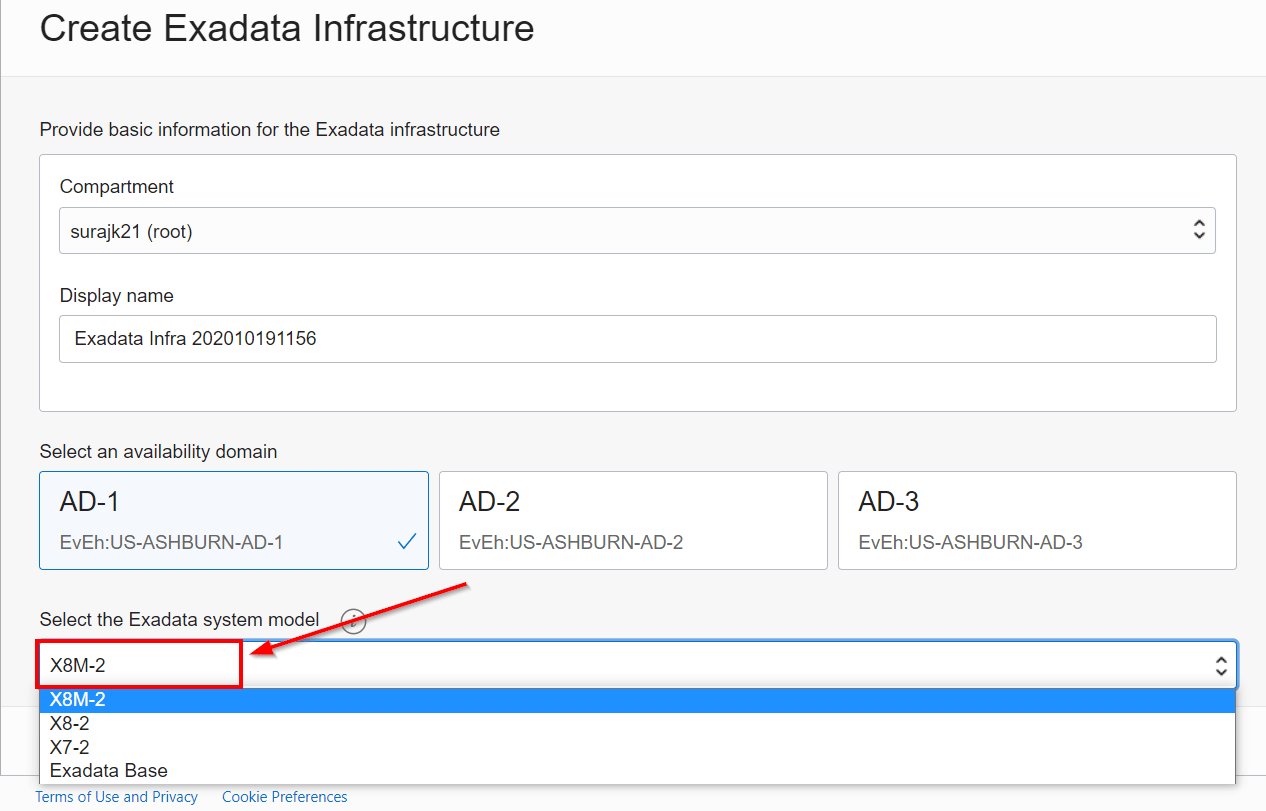
- How To Create Exadata X8M on Cloud Console
What Is Exadata X8M?
Exadata X8M is the latest generation Exadata Database Machine that provides in-memory performance for both OLTP and Analytics with capacity, sharing, and cost benefits of shared storage.
Exadata X8M introduces three new breakthrough technologies:
- Native Persistent Memory
- New RDMA over Converged Ethernet (RoCE) Network Fabric
- Ultra-Fast RDMA to Persistent Memory Access
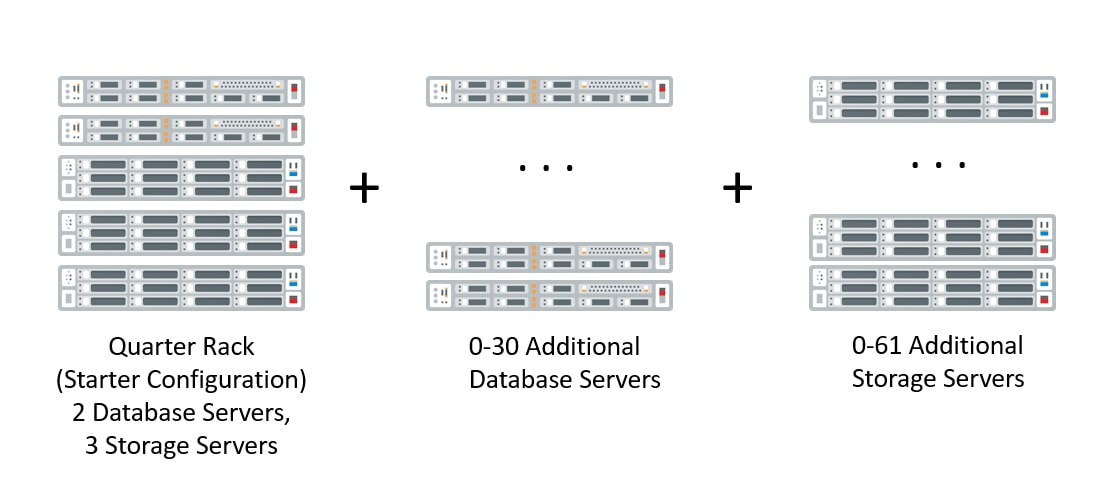
The starting Exadata Cloud Service X8M configuration consists of a Quarter Rack, two database servers, and three storage servers, which can be elastically expanded by adding an additional database and/or storage servers independently. There are no fixed ratio racks anymore.
Exadata X8M provides dramatically better performance for All Database Workloads by using:
1) Ideal Database Hardware: scale-out, database optimized services for fastest performance and lowest cost
2) Smart System Software: specialized algorithms that improve OLTP, Analytics, Consolidation
3) Automated Management: fully automated and optimized configuration, performance, updates
Remote Direct Memory Access (RDMA)
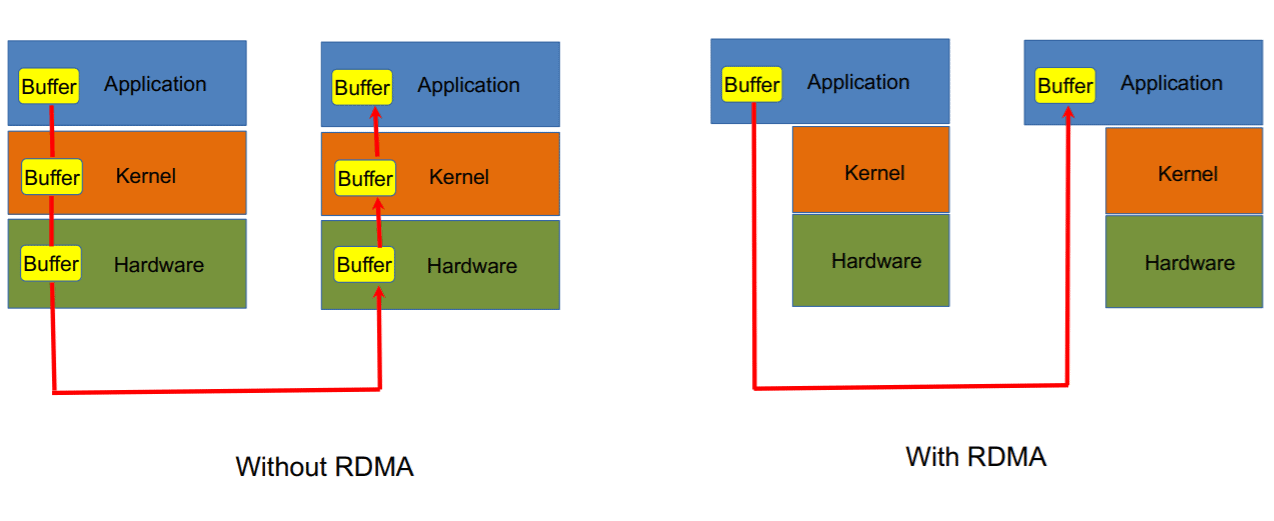
Remote Direct Memory Access (RDMA) is the ability for one computer to access data from a remote computer without OS or CPU involvement, bypassing the entire network and I/O stack, that is network and I/O software, interrupts, context switches. RDMA was introduced to Exadata with InfiniBand and is a foundational part of Exadata’s high-performance architecture.
RDMA enables direct transfer of data from application buffers on local node to application buffer on the remote node without CPU involvement. The benefits of RDMA are:
- High throughput
- Low CPU utilization
- Low latency
Read More: Oracle Enterprise Manager(OEM) 13c for beginners, what is OEM, high-level steps to deploy OEM on Oracle cloud infrastructure (OCI), OEM architecture components, OEM HA/DR overview.
RDMA over Converged Ethernet (RoCE)
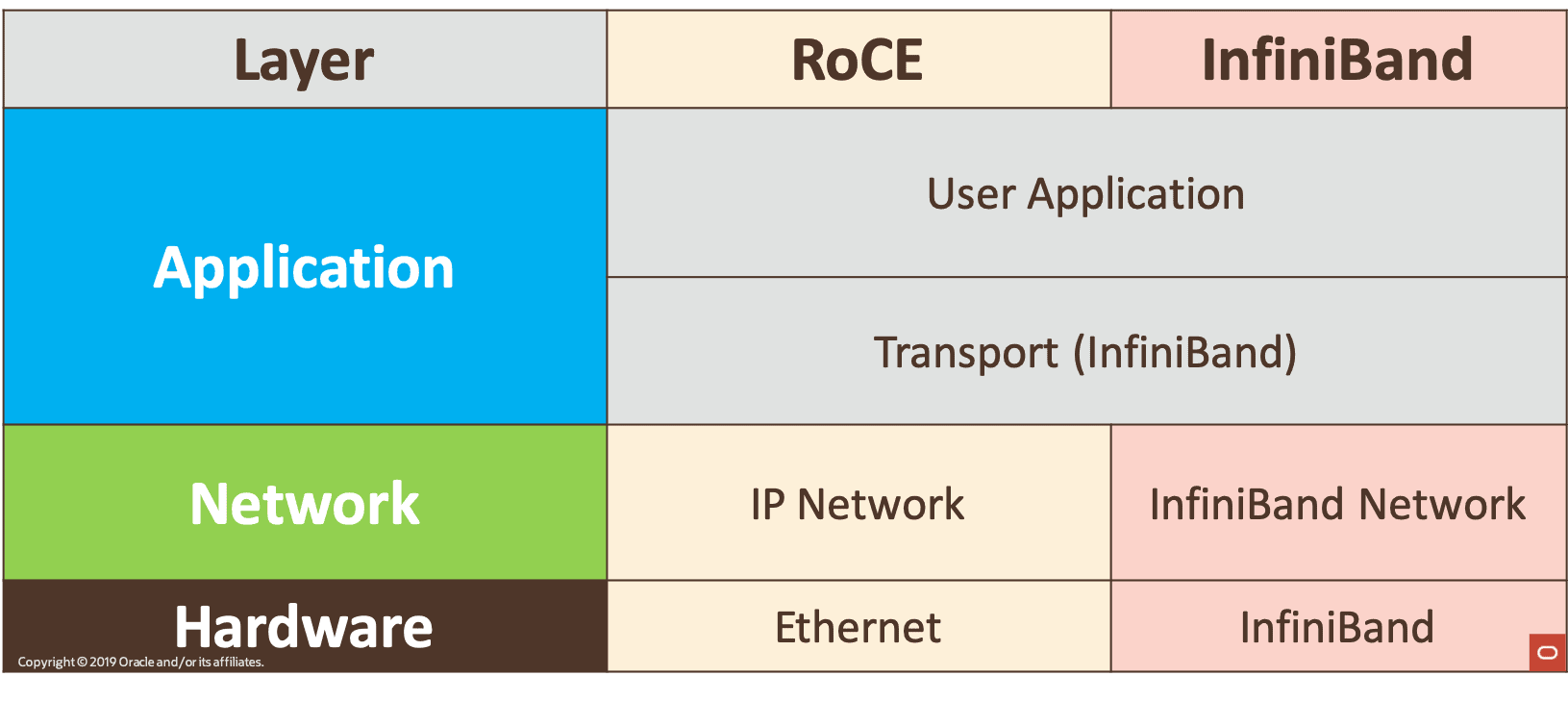
When Exadata was first introduced InfiniBand was the only viable RDMA capable network available for Exadata, but now Ethernet has caught up. RDMA over Converged Ethernet (RoCE) is a protocol that runs InfiniBand RDMA software on top of Ethernet that connects all servers and storage.
If you want to know more about InfiniBand for Exadata, check our blog on [Video] Oracle Exadata Cloud Service(ExaCS) Architecture
The 100 Gb/sec RDMA over Converged Ethernet (RoCE) Network Fabric connects all the components inside an Exadata Database Machine delivering much lower latency and higher bandwidth than ever possible with generic communication protocols for faster response time for OLTP operations and higher throughput for analytic workloads.
Want to know more about Networking in Exadata Cloud Service, check our blog on Oracle Exadata Cloud Service (ExaCS) Networking
Persistent MEMory (PMEM)
Persistent Memory is a new silicon technology and its capacity, performance, and price fits somewhere between DRAM and flash. For the Exadata X8M release, 1.5 TB of persistent memory is added to High Capacity and Extreme Flash Storage Servers. Persistent memory enables reads at memory speed, and ensures writes survive any power failures that may occur.
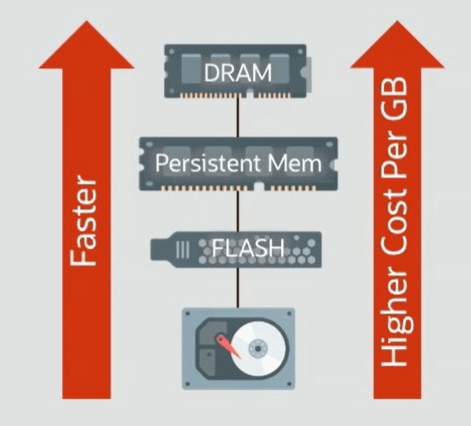
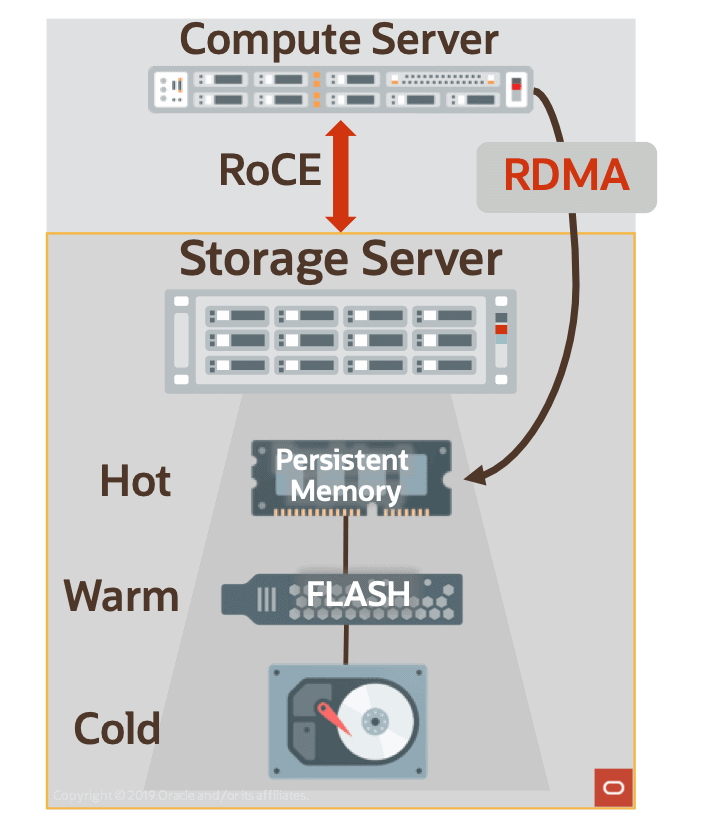
In combination with the new RoCE 100Gb/s Network Fabric, smart Exadata System Software is able to fully leverage the benefits of persistent memory on remote storage servers via specialized data and commit accelerators.
Persistent Memory Data Accelerator
Exadata X8M Storage Servers transparently adds Persistent Memory in front of flash memory delivering 2.5x higher read I/Os per second than before. This enables Oracle Database to use RDMA instead of I/O to read remote persistent memory bypassing the entire software stack providing the typical latency as low as 19 microseconds which is 10x faster than before.
Persistent Memory Commit Accelerator
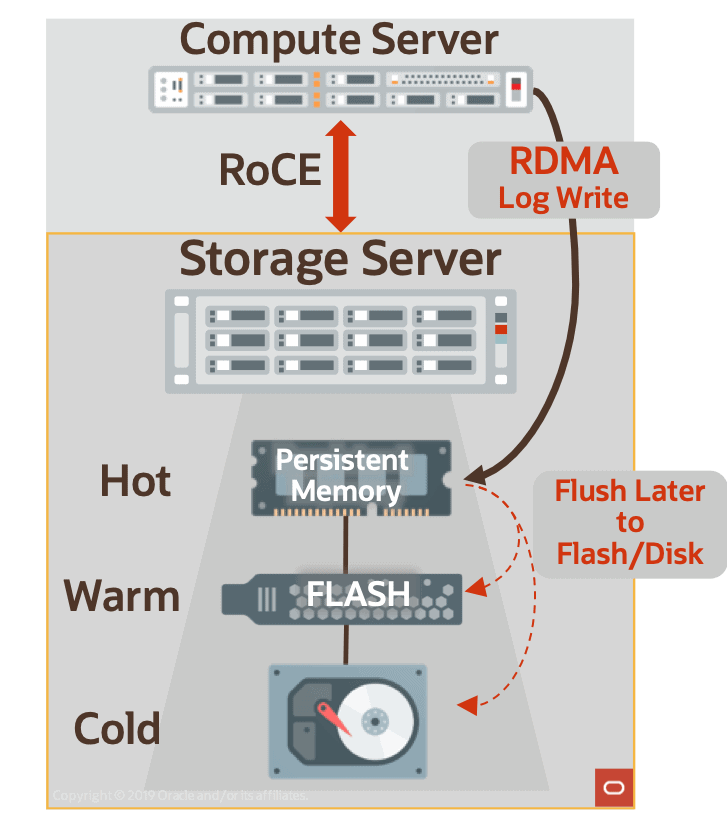
Redo Log write latency is critical for OLTP Database performance, a faster log write means faster transaction commit time. Inversely, any slowdown of log writes can cause the database to stall.
With the automatic commit accelerator, Exadata PMEM Log automatically enables the database to issue a one-way RDMA log write to persistent memory. RDMA and persistent memory allow the log write to occur without acknowledgment, and places the write across multiple servers for resilience. This
leads to an 8x performance increase in log writes.
PMEM in Shared Exadata Storage Advantages
Persistent Memory in Shared Exadata Storage Servers provide many advantages, some are listed below:
- Much better utilization of PMEM capacity: Only the hottest data, that is the most recently used data, is moved into PMEM
- Much more adaptive: Aggregate performance of PMEM is available to all database server
- Much better security: No direct access to PMEM from DB hosts, only databases across network can access
- Much better redundancy: Automatic mirroring of PMEM across storage servers protects from PMEM failures
- Much simpler: All PMEM benefits come with no extra management
How To Create Exadata X8M on Cloud Console
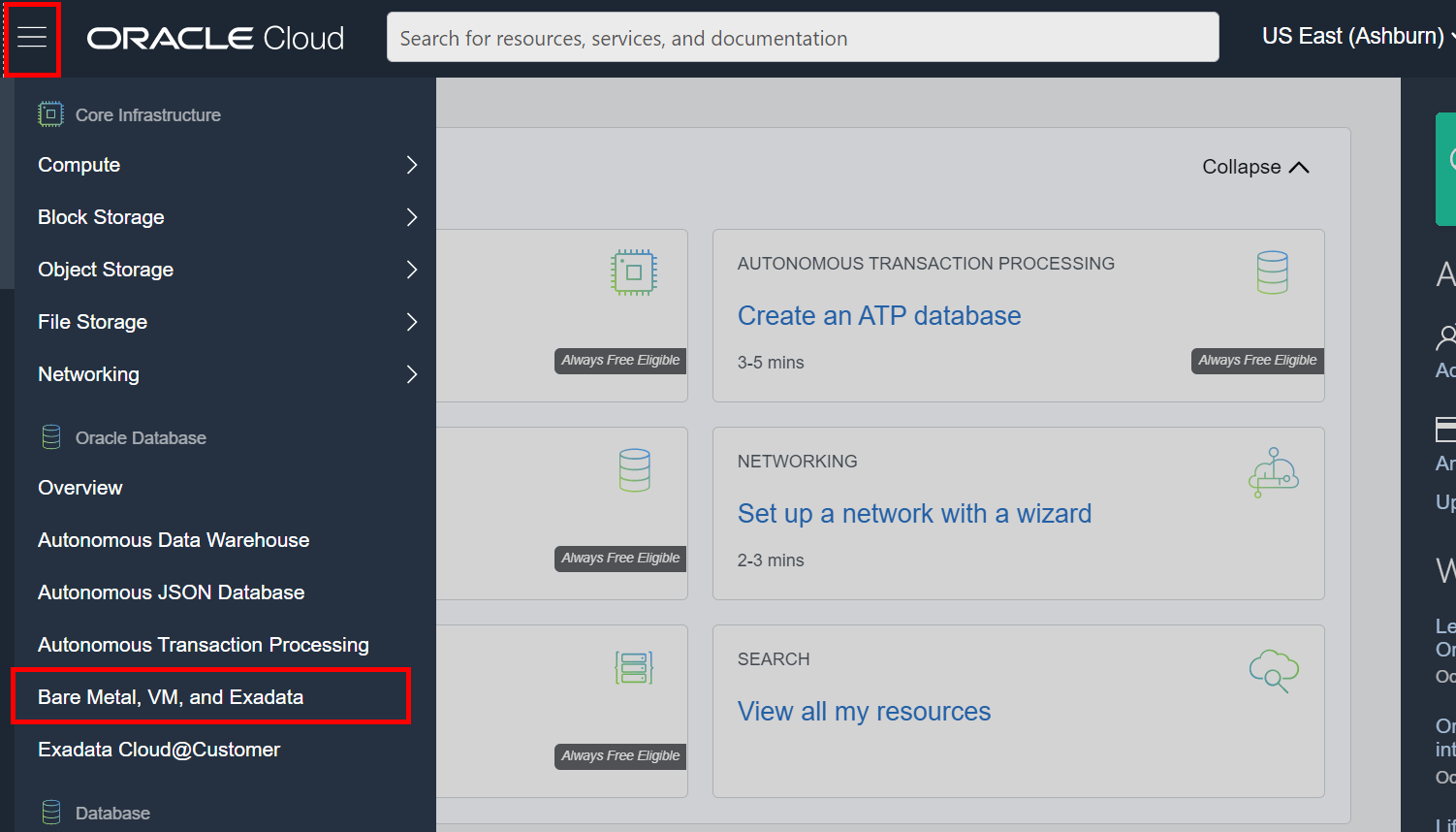
1. log in to your cloud account. Open the navigation menu. Under Oracle Database, click Bare Metal, VM, and Exadata
2. On Create DB system page, select Exadata as Shape type. On Create Exadata Infrastructure page, select X8M-2 as Exadata system model
Related/References
- Oracle Introduces Exadata Cloud Service X8M
- [First video] Oracle Exadata Cloud Service (ExaCS): Overview for Beginners
- [Second video] Oracle Exadata Cloud Service(ExaCS) Architecture
- [Third video] Exadata Deployment Options: Cloud Service (ExaCS) vs Cloud at Customer (ExaCC) vs Exadata Machine
- [Fourth video] Oracle Exadata Cloud Service(ExaCS) Offerings
- [Fifth video] Oracle Exadata Cloud Service(ExaCS) Storage Options
- [Sixth video] Oracle Exadata Cloud Service (ExaCS) Networking
- NOSQL Cloud Database Service in Oracle Cloud
- MySQL Database as a Service in Oracle Cloud
- Introduction to Oracle Database 21c New Update Now Available On Oracle Cloud
Next Task For You
If you want to upgrade your career from an Oracle DBA to Oracle Cloud DBA, and wants to clear Oracle Cloud Database Service Specialist[1Z0-1093-21] & Oracle Cloud Autonomous Database Certification[1Z0-931-21] with 18 Hands-On labs, then register for a FREE class, and don’t miss an opportunity to gain a plethora of insights on becoming a certified Oracle Cloud DBA.


![Microsoft Agentic AI Business Solutions Architect [AB-100] | K21 Academy](https://test.k21academy.com/wp-content/uploads/2025/11/Microsoft-Agentic-AI-Business-Solutions-Architect-AB-100-Exam-Overview1.png)