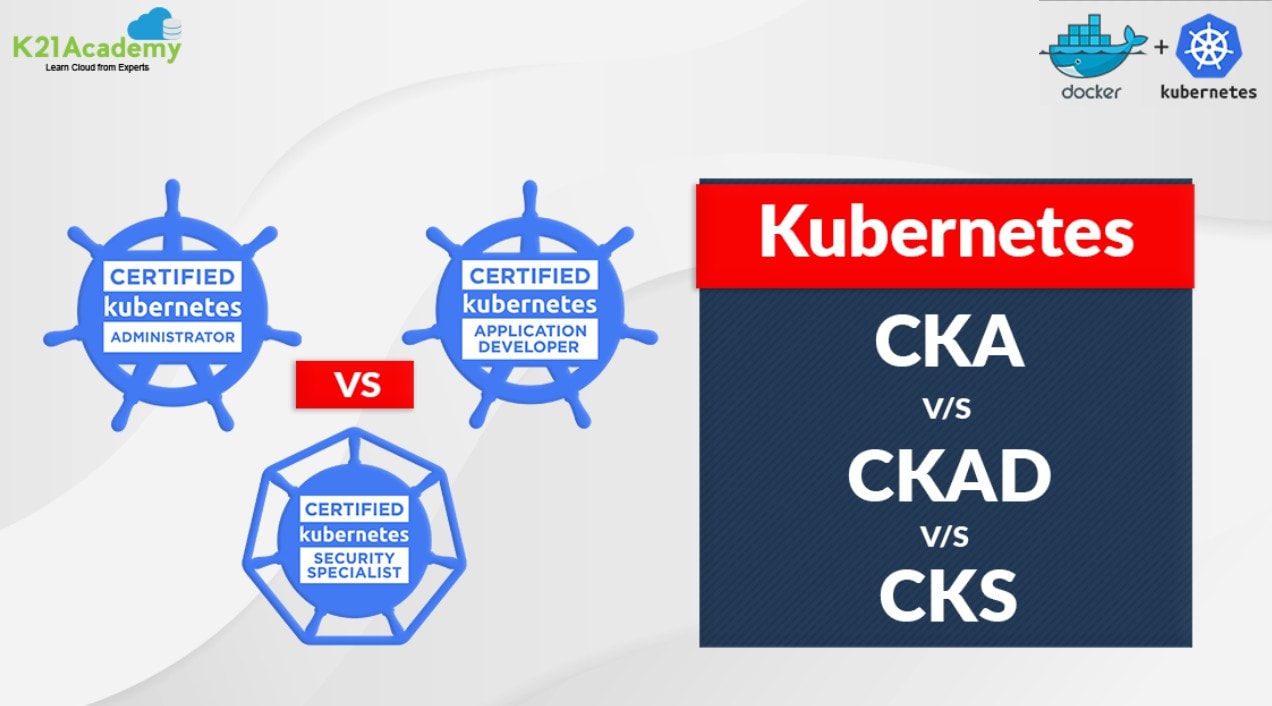



If you do brisk research on the internet, you will quickly notice a lot of posts from people on cracking the Kubernetes certifications like CKA, CKAD, and CKS exams. Why are these exams hyped so much? Let us do a comparison of CKA vs CKAD vs CKS. Well, Some people might feel that they need a whole lot of resources and even so much time to prepare for this exam, On the contrary, you can successfully clear all exams within a month as long as you have adequate study materials.
This blog covers why are these exams hyped so much and what is the reason behind it and what are the common topics and also the contrasting features between CKA, CKAD, and CKS. If you are still wondering what are these, CKA is a Certified Kubernetes Administrator and CKAD is a Certified Kubernetes Application Developer and CKS is a Certified Kubernetes Security Specialist
What Is CKA?
As mentioned earlier, CKA is the ‘Certified Kubernetes Administrator’ exam which focuses on testing the knowledge and skills of a candidate in the field of all aspects of Kubernetes cluster concepts. The CKA exam focuses on managing and operating the Kubernetes cluster, including the troubleshooting part. So, on a higher note, we can say that it involves everything from creating, managing, and troubleshooting a cluster.
Now, after September 2020 CNCF has reduced the course curriculum and has decreased the duration to 2 hours.
To know more, visit CKA: Everything You Need to Know and also check Role-Based Access Control
What Is CKAD?
CKAD is the ‘Certified Kubernetes Application Developer’ exam which tests the skills of a candidate in the application development in the field of Kubernetes. Thus, the focus of CKAD is on managing and deploying applications to the Kubernetes cluster. It emphasizes only the topics required for application development, deployment, and management. This is a new certification that is being provided by the CNCF.
To know more, visit CKAD: Everything you need to know
What Is CKS?
CKS is the ‘Certified Kubernetes Security Specialist’ program that will consist of a performance-based certification exam and assures that a CKS has the skills, knowledge, and competence on a broad range of best practices for securing container-based applications and Kubernetes platforms during build, deployment, and runtime. To take the CKS exam, you must hold a current CKA certification to demonstrate you possess sufficient Kubernetes expertise.
To know more, visit
CKS: Everything You Must Know
CKA vs CKAD vs CKS
Learn with us: Check out our Kubernetes and docker training & Understand the Basic Concept Of Kubernetes.
The common things:
The certifications surely do complement each other, and which one you can/should aim for will depend on your role and especially how you use Kubernetes.
- The Kubernetes Core Concepts which is present in all these exams is a must, as this is the foundation of everything else that is there to come.
- Both CKA & CKAD have the same topics in the aspects of Services & Networking as both are needed for a developer as well as an administrator.
- As Storage is concerned, CKA & CKAD exams Storage Persistence topics which are also quite important.
- The most important aspect of Kubernetes certification is Cluster creation & Configuration, hence all these exams relay on this topic the most.
- Both CKA and CKS have Cluster monitoring in common.
- One can even open an additional tab with documentation located on Kubernetes io and GitHub during these exams.
- The topics of pod designing are similar in CKA & CKAD exams.
Check out: All you need to know about Docker Storage
Things that differ:
Here are some of the main differences between the CKA vs CKAD vs CKS exams:
| Certification | CKA (Certified Kubernetes Administrator) | CKAD (Certified Kubernetes Application Developer) | CKS (Certified Kubernetes Security Specialist) |
|---|---|---|---|
| Target Audience | System Administrators, DevOps Engineers, Kubernetes Operators | Application Developers, Software Engineers, Kubernetes Developers | Security professionals, System Administrators with a focus on Kubernetes Security |
| Exam Focus | Cluster architecture, installation, configuration, and management. | Application deployment, observability, Application Configuration and security | Kubernetes security best practices, securing Kubernetes components, securing containerized applications. |
| Exam Format | Performance-based exam using command-line tools. | Performance-based exam using command-line tools. | Performance-based exam using command-line tools. |
| Number of Questions | Approximately 17-18 | Approximately 19-20 | Approximately 15-20 |
| Exam Duration | 2 Hours | 2 Hours | 2 Hours |
| Passing Score | 66% or above | 66% or above | 67% or above |
| Certification Validity | 2 Years | 2 Years | 2 Years |
| Exam Cost (as of July 2023) | $395 USD | $395 USD | $395 USD |
| Prerequisites | No formal prerequisites, but Kubernetes experience is recommended. | No formal prerequisites, but Kubernetes experience is recommended. | CKA certification is a prerequisite. Strong knowledge of Kubernetes is required. |
| Domains & Competencies | Cluster Architecture, Installation & Configuration- 25%
Storage – 10% Troubleshooting – 30% Services & Networking – 20% Workloads & Scheduling – 15% |
Application Design and Build – 20%
Application Deployment – 20% Application Observability and Maintenance – 15% Application Environment, Configuration and Security – 25% Services and Networking – 20% |
Cluster Setup – 10%
Cluster Hardening – 15% System Hardening – 15% Minimize Microservice Vulnerabilities- 20% Supply Chain Security – 20% Monitoring, Logging and Runtime Security – 20% |
- Since a CKA’s role demands one to be familiar with all the administrative skills, it also focuses on Kubernetes internals such as etcd, tls bootstrap, and kubelet.
- The CKA exam tests a candidate more in the topic of Cluster Architecture, well CKAD tests only the Configuration of Clusters.
- As an application developer is more involved in the deployment of applications, the CKAD examines a candidate in the topics of Kubernetes Pod Designing & also Multi-Container Pods.
- The CKA exams also shed some light on Workloading & Scheduling, which is not a part of the CKAD exam topics.
- The biggest part of a CKA exam is the Troubleshooting section, it consists of 30% out of all the topics, which isn’t of any concern for a CKAD aspirant!
- CKAD is exclusively related to Deployment, DaemonSets, Pods, and other API primitives, we can consider it as a lightweight version of a CKA exam.
- The CKA exam focuses more on what an actual cluster administrator would do, such as installing/configuring a cluster, setting up networking, setting up storage, etc.
- The CKAD exam, on the other hand, is geared more towards a developer that is building their applications to be Kubernetes-friendly and consuming the cluster resources made available by the administrator.
- The CKS exam focuses on System Hardening with a weightage of 15%. which covers external access to the network and use kernel hardening.
- CKS exam topic Microservice Vulnerabilities has 20% weightage in the exam which covers pod to pod encryption, Kubernetes secrets, etc.
- Supply Chain Security with a weightage of 20% is a topic of CKS exam which includes base image footprint and scan images for known vulnerabilities.
- No pre-requisites required for CKA and CKAD but to take the CKS exam, you must hold a current CKA certification.
Always refer to the official GitHub repo for the official curriculums by CNCF. Click here for the repo.
What After CKA Certification?
The purpose of the Certified Kubernetes Administrator (CKA) program is to provide assurance that CKA has the skills, knowledge, and competency to perform the responsibilities of Kubernetes administrators. There is a wide-open job market for Kubernetes professionals, so this is also one of the important aspects for all of you who are looking for a raise or to add-on more skills!
Check out: Complete hands-on Guide on CKA Certification Exam
What After CKAD Certification?
The Certified Kubernetes Application Developer exam certifies that users can design, build, configure, and expose native cloud applications for Kubernetes.
The Certified Kubernetes Application Developer (CKAD) certification is designed to guarantee that certification holders have the knowledge, skills, and capability to design, configure, and expose cloud-native applications for Kubernetes and also perform the responsibilities of Kubernetes application developers.
Check out: Complete hands-on Guide on CKAD Certification Exam
What After CKS Certification?
A Kubernetes certification makes your resume look good and stand out from the competition. As companies will be relying more and more on Kubernetes, your expertise will be an immediate asset.
Passing CKA and CKS is not an easy task, so companies seeking Kubernetes engineers are willing to pay more which gives you the mighty potential for a hike in salary. The companies are looking for certified Kubernetes professionals, as the majority of them are moving their application towards containers.
Check out: Complete hands-on Guide on CKS Certification Exam
Frequently Asked Questions
What are CKA, CKAD, and CKS certifications?
CKA, CKAD, and CKS are certifications offered by the Cloud Native Computing Foundation (CNCF) to validate the expertise of professionals in Kubernetes administration, application development, and security, respectively.
What is the format of the CKA, CKAD, and CKS exams?
All three exams are performance-based and consist of hands-on tasks that must be completed using command-line tools. Candidates need to demonstrate their practical skills in real-world scenarios.
How long are the certifications valid?
The CKA, CKAD are valid for three years, while the CKS is valid for 2 years from the date of certification.
Can I retake the Kubernetes certification exam if I fail?
You can retake the Kubernetes certification exam if you fail. However, please note that for most certifications, including CKA, CKAD, and CKS, only one retake is available.
Do I need to pay for the exam again if I want to retake it?
One free retake is available if you fail the initial attempt. Subsequent retakes require payment of the exam fee.
Related / References:
- Visit our YouTube channel on “Docker & Kubernetes”
- Certified Kubernetes Administrator (CKA) Certification Exam
- (CKA) Certification: Step By Step Activity Guides/Hands-On Lab Exercise & Learning Path
- (CKAD) Certification: Step By Step Activity Guides/Hands-On Lab Exercise & Learning Path
- (CKS) Certification: Step By Step Activity Guides/Hands-On Lab Exercise & Learning Path
- To know frequently Asked Questions on CKA & CKAD, click here
- [Solved] The connection to the server localhost:8080 was refused – did you specify the right host or port?
- Structured Vs Unstructured Data | Semi Structured [Updated – 2022]
- Top 25+ Azure Data Factory Interview Questions & Answers
Join FREE Masterclass of Kubernetes
Discover the Power of Kubernetes, Docker & DevOps – Join Our Free Masterclass. Unlock the secrets of Kubernetes, Docker, and DevOps in our exclusive, no-cost masterclass. Take the first step towards building highly sought-after skills and securing lucrative job opportunities. Click on the below image to Register Our FREE Masterclass Now!


![Microsoft Agentic AI Business Solutions Architect [AB-100] | K21 Academy](https://test.k21academy.com/wp-content/uploads/2025/11/Microsoft-Agentic-AI-Business-Solutions-Architect-AB-100-Exam-Overview1.png)