



Preparing for the Microsoft Certified Azure Data Scientist Associate (DP-100) exam? This blog provides all the insights you need to not only succeed in the exam but also thrive as a Data Scientist leveraging Azure tools and technologies.
The topics covered in this blog are:
What Is Azure Data Scientist Certification? ^
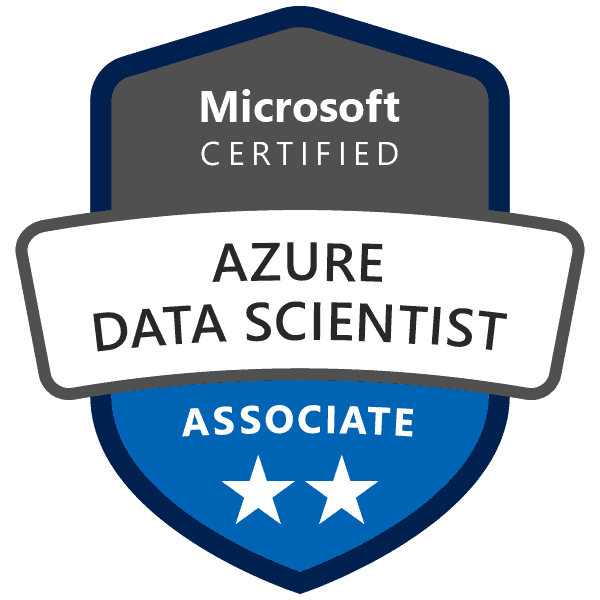
The DP 100 Microsoft Azure Data Scientist Certification is aimed towards those who apply their knowledge of data science and machine learning to implement and run machine learning workloads on Azure, using Azure Machine Learning Service. This implies planning and creating a suitable working environment for data science workloads on Azure, running data experiments, and training predictive ML models.
How can I earn a career credential through this program?
Earning a career credential through this program involves completing a structured curriculum that includes hands-on projects, practical labs, and assessments. By mastering in-demand skills, such as AI, ML, or cloud computing, participants can gain certifications from leading platforms like Microsoft Azure, AWS, or Google Cloud. These credentials demonstrate your expertise, making you a strong candidate for high-paying roles in technology. Additionally, many programs provide guidance for certification exams and industry-recognized credentials, ensuring you’re equipped with the knowledge and proof of your capabilities to advance your career.
What is the Microsoft Azure Data Scientist Associate (DP-100) Exam Prep Professional Certificate?
The Microsoft Azure Data Scientist Associate (DP-100) Exam Prep Professional Certificate equips learners with the skills to design, implement, and maintain machine learning solutions in Azure. It covers key topics like data preparation, model training, deployment, and monitoring using Azure Machine Learning. This certification is ideal for aspiring data scientists looking to validate their expertise in Azure’s AI and ML tools. By earning this certificate, professionals demonstrate their ability to handle real-world machine learning workflows, making it a valuable credential for advancing their careers in AI and data science.
Exam Renewal Policy FAQs
Question 1: What is the DP100 renewal exam, what usually comes in that exam and what’s the format?
The DP-100 renewal exam is designed to assess your continued proficiency in designing and implementing data science solutions on Azure. While it’s a renewal, it’s crucial to stay updated on the latest Azure Data Science advancements.
Exam Format
- Online assessment: This is a free online assessment, typically consisting of multiple-choice questions.
- Time duration: The exact time allotted might vary, but it’s usually shorter than the full DP-100 exam.
- Passing score: Requires a certain percentage of correct answers to renew your certification.
Exam Content The renewal exam focuses on validating your knowledge of:
- Core data science concepts: This includes data exploration, preparation, modeling, and evaluation.
- Azure Machine Learning service: Understanding its features, functionalities, and how to leverage it for data science tasks.
- Data pipelines and automation: Knowledge of Azure Data Factory, Azure Data Bricks, and other relevant tools for data ingestion and processing.
- Model deployment and management: Understanding how to deploy models to production, monitor their performance, and retrain them as needed.
- Ethical considerations: Awareness of data privacy, security, and bias in data science.
Remember: While the renewal exam is generally easier than the initial certification, staying updated is key to passing it successfully.
Question 2: Is the DP-100 Renewal Exam Proctored or Open Book?
The DP-100 renewal exam is proctored and not an open book. This means you cannot access any external resources during the exam.
Question 3: How many times one can take a renewal exam?
You Can Retake the DP-100 Renewal Exam as Many Times as Needed However, it’s important to note that:
- You must pass the exam before your certification expires.
- After your second attempt, you’ll need to wait at least 24 hours before taking it again.
This gives you ample opportunity to prepare and pass the exam, ensuring your certification remains valid.
Why You Should Learn Data Science? ^
There is a lot of raw data generated per day in most IT Industries, so they need a dedicated team that can evaluate this data, plot this data to make inferences and apply the Machine Learning algorithm to make predictions. Hence there is a huge gap in the demand and supply of Data Scientists.
Note: Do Read Our Blog on Automated Machine Learning.
The average salary for a Data Scientist is $117,345/yr as of some resources. This is above the national average of $44,564. Hence, a Data Scientist makes 163% more than the national average salary!
Read more: MLOps is based on DevOps principles and practices that increase the efficiency of workflows and improve the quality and consistency of machine learning solutions.
DP 100 | Certification Benefits ^
- Increase in demand for Data Scientists. The CV with this gleaming certification will have an enormous advantage.
- In terms of job prospects and earnings, a certification leads to a rampant gain in both.
- Most people agree that certification has improved their earnings and 84% of people have seen better job prospects after getting certified.
- Updating your profile with this certificate will boost your job profile and boost your chances of getting chosen.
Also read: To understand Azure Cloud Management Tools in a better way
What skills will I gain from the Microsoft Azure Data Scientist Associate Professional Certificate program?
The Microsoft Azure Data Scientist Associate Professional Certificate equips you with skills to design and implement machine learning solutions using Azure Machine Learning. You’ll learn data preparation, feature engineering, model training, and deployment. The program covers advanced techniques like hyperparameter tuning, automated ML, and model evaluation. Additionally, you’ll gain expertise in integrating Azure services for end-to-end data science workflows, making you proficient in solving real-world business problems with cloud-based AI solutions. This certification prepares you for roles as an Azure Data Scientist or AI specialist.
What will I be able to do upon completing the Professional Certificate?
Upon completing the Professional Certificate, you will gain practical skills to build, train, and deploy machine learning models using Azure. You’ll understand key concepts like data preprocessing, model evaluation, and MLOps for automating workflows. The program equips you to work with Azure ML Studio, Databricks, and advanced AI tools, enabling you to create scalable, cloud-based AI solutions. With hands-on experience, you’ll be prepared for roles such as Data Scientist or AI Engineer and ready to take certification exams like Microsoft Azure Data Scientist Associate (DP-100).
Pre-requisites For DP 100 Exam ^
- Fundamental knowledge of Microsoft Azure
- Experience in writing Python code to work with data, using libraries such as Numpy, Pandas, and Matplotlib.
- Understanding of data science; including how to prepare data, and train machine learning models using common machine learning libraries such as Scikit-Learn, PyTorch, or TensorFlow.
DP-100 | Exam Details ^
- Certification Name: [DP-100] Microsoft Certified: Azure Data Scientist Associate.
- Prerequisites: There are no prerequisites for taking this certification.
- Exam Duration: 100 minutes
- Number of Questions: 40 – 60
- Passing Score: 700
- Exam Cost: USD 165.00
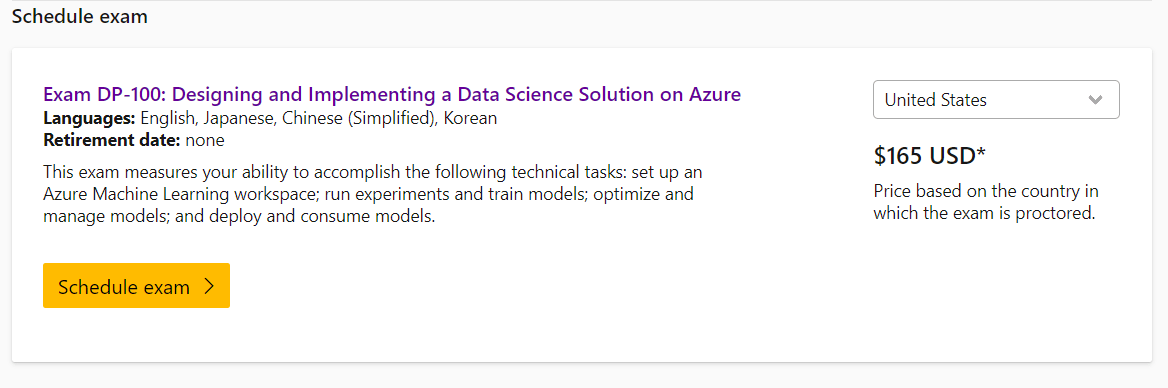
You can apply for Microsoft Certified Azure Data Science Associate [DP-100] by going to the official page.
Learning Path For DP-100

Check out: Overview of Azure Machine Learning Service
What is covered in the Prepare for DP-100 Azure Data Scientist Exam course?
The Prepare for DP-100: Data Science on Microsoft Azure Exam course covers essential topics like designing and implementing machine learning solutions on Azure. It includes data preparation, feature engineering, model training, deployment, and monitoring. Participants learn how to use Azure Machine Learning, apply automation, optimize hyperparameters, and evaluate model performance. The course also emphasizes best practices for managing and operationalizing machine learning workflows in Azure. It equips learners with the knowledge required to pass the DP-100 certification exam and excel as Azure Data Scientists.
What skills will I gain from the Microsoft Azure Machine Learning for Data Scientists course?
The Microsoft Azure Machine Learning for Data Scientists course equips learners with skills in building, training, and deploying machine learning models using Azure ML. Participants will gain expertise in managing data pipelines, applying AutoML, and leveraging advanced features like hyperparameter tuning and model interpretability. The course also covers deploying models in production environments, integrating with other Azure services, and monitoring model performance. By completing the course, learners can effectively implement end-to-end machine learning workflows and prepare for roles in data science and AI engineering.
What is the structure and content of the Create Machine Learning Models in Microsoft Azure course?
The Create Machine Learning Models in Microsoft Azure course covers building, training, and deploying machine learning models using Azure Machine Learning Studio. It includes key topics such as data preparation, automated machine learning (AutoML), hyperparameter tuning, and model evaluation. Participants learn hands-on through practical labs and projects, exploring tools like Azure ML Designer and Python SDKs. The course also delves into deploying models as endpoints for real-world applications. It’s ideal for beginners and professionals aiming to enhance their skills in Azure-based AI and machine learning workflows.
Do I need to take the courses in a specific order?
Courses don’t always need to be taken in a specific order, but it’s recommended to start with foundational courses before progressing to advanced topics. Sequential learning ensures you build a solid understanding of basic concepts, which are crucial for grasping more complex material. Check the course curriculum or prerequisites to identify dependencies between topics. For certifications or structured programs, following the suggested order often aligns with the learning path, making it easier to achieve your goals. Always prioritize understanding over completion speed.
How does the Professional Certificate program support exam preparation for the DP-100?
Courses don’t always need to be taken in a specific order, but it’s recommended to start with foundational courses before progressing to advanced topics. Sequential learning ensures you build a solid understanding of basic concepts, which are crucial for grasping more complex material. Check the course curriculum or prerequisites to identify dependencies between topics. For certifications or structured programs, following the suggested order often aligns with the learning path, making it easier to achieve your goals. Always prioritize understanding over completion speed.
Exam Topics ^
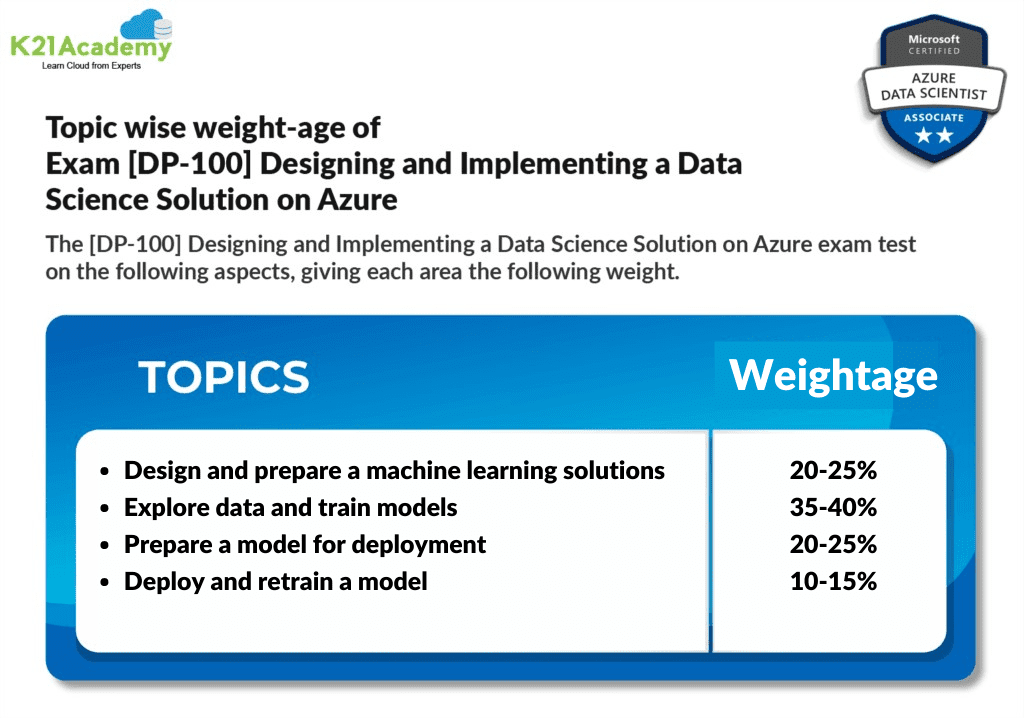
The following domains are the torch-bearers of the DP 100 exam.
1) Design and prepare a machine learning solution (20-25%)
- Design a machine learning solution
- Determine the appropriate computing specifications for a training workload
- Describe model deployment requirements
- Select which development approach to use to build or train a model
- Manage an Azure Machine Learning workspace
- Create an Azure Machine Learning workspace
- Manage a workspace by using developer tools for workspace interaction
- Set up Git integration for source control
- Create and manage registries
- Manage data in an Azure machine-learning workspace
- Select Azure Storage resources
- Register and maintain data stores
- Create and manage data assets
- Manage to compute for experiments in Azure Machine Learning
- Create compute targets for experiments and training
- Select an environment for a machine learning use case
- Configure attached compute resources, including Azure Synapse Spark pools and serverless Spark compute
- Monitor compute utilization
2) Explore data and train models (20-25%)
- Explore data by using data assets and data stores
- Access and wrangle data during interactive development
- Wrangle interactive data with attached Synapse Spark pools and serverless Spark compute
- Create models by using the Azure Machine Learning designer
- Create a training pipeline
- Consume data assets from the designer
- Use custom code components in the designer
- Evaluate the model, including responsible AI guidelines
- Use automated machine learning to explore optimal models
- Use automated machine learning for tabular data
- Use automated machine learning for computer vision
- Use automated machine learning for natural language processing
- Select and understand training options, including preprocessing and algorithms
- Evaluate an automated machine learning run, including responsible AI guidelines
- Use notebooks for custom model training
- Develop code by using a compute instance
- Track model training by using MLflow
- Evaluate a model
- Train a model by using Python SDK v2
- Use the terminal to configure a compute instance
- Tune hyperparameters with Azure Machine Learning
- Select a sampling method
- Define the search space
- Define the primary metric
- Define early termination options
3) Train and deploy models (25-30%)
- Run model training scripts
- Configure job run settings for a script
- Configure compute for a job run
- Consume data from a data asset in a job
- Run a script as a job by using Azure Machine Learning
- Use MLflow to log metrics from a job run
- Use logs to troubleshoot job run errors
- Configure an environment for a job run
- Define parameters for a job
- Implement training pipelines
- Create a pipeline
- Pass data between steps in a pipeline
- Run and schedule a pipeline
- Monitor pipeline runs
- Create custom components
- Use component-based pipelines
- Manage models in Azure Machine Learning
- Describe the MLflow model output
- Identify an appropriate framework to package a model
- Assess a model by using responsible AI principles
4) Optimize language models for AI applications (25-30%)
- Deploy a model
- Configure settings for online deployment
- Configure compute for a batch deployment
- Deploy a model to an online endpoint
- Deploy a model to a batch endpoint
- Test an online deployed service
- Invoke the batch endpoint to start a batch scoring job
- Apply machine learning operations (MLOps) practices
- Trigger an Azure Machine Learning job, including from Azure DevOps or GitHub
- Automate model retraining based on new data additions or data changes
- Define event-based retraining triggers
DP-100 Hands-On Guides ^
For DP-100 we have a list of 16 Step-by-Step Activity Guides (Hands-On Labs) for you to practice and have a clear understanding of the concepts both theoretically and practically. The list of activity guides is as follows:
- Explore the Azure Machine Learning workspace
- Explore developer tools for workspace interaction
- Make data available in Azure Machine Learning
- Work with computing resources in Azure Machine Learning
- Work with environments in Azure Machine Learning
- Train a model with the Azure Machine Learning Designer
- Find the best classification model with Automated Machine Learning
- Track model training in notebooks with MLflow
- Run a training script as a command job in Azure Machine Learning
- Use MLflow to track training jobs
- Perform hyperparameter tuning with a sweep job
- Run pipelines in Azure Machine Learning
- Create and explore the Responsible AI dashboard
- Log and register models with MLflow
- Deploy a model to a batch endpoint
- Deploy a model to a managed online endpoint
How does the Perform data science with Azure Databricks course work?
The Perform Data Science with Azure Databricks course teaches data scientists how to use Azure Databricks for scalable data processing, analysis, and machine learning. It covers topics like setting up Databricks workspaces, exploring data with notebooks, and building machine-learning models. Participants learn to collaborate on data pipelines, optimize workflows, and integrate with Azure Machine Learning for deployment. With hands-on labs and practical examples, the course ensures learners gain real-world experience in leveraging Databricks for efficient and advanced data science tasks.
Who This Certification Is For? ^
After all this, you will be waiting to know that are you the one for this certification right? Well, here is your answer to that,
- Candidates who are interested in Machine Learning and AI.
- IT professionals who have a thorough knowledge of Microsoft Azure and some knowledge of data handling.
- People who are good at statistics.
- Data Scientists who prepare data, train models, and evaluate competing models but have never done this on Azure.
Exam Retake Policy ^
- If a candidate does not clear the certification on the first attempt, then they will have to wait for 24 hours before they try again.
- If the candidate is not clear on the second attempt also, he/she should re-access their training and retake the exam after a period of 14 days.
- At last, a candidate has a maximum of 5 retakes allowed in a year.
FAQs ^
Question 1: How to prepare for the DP-100 certification exam?
Answers: You should follow the right preparation path to pass the DP 100 examination on the primary attempt: • Conduct an associate in-depth assessment of all exam objectives and note the vital topics • Register for the DP-100 coaching course • Utilize DP-100 follow tests to check your skills • Work on your weak areas and clear your doubts
Question 2: What are the important domains covered in the DP-100 certification exam?
Answer: The DP-100 coaching course and follow tests give comprehensive coverage of all the examination domains within the certification : 1. Setting up associate Azure Machine Learning space 2. Execution of experiments & ml model training 3. Optimisation & management of models 4. Preparation & consumption of models
Question 3: What are the important topics for the DP-100 certification exam?
Answer: The notable topics that candidates ought to harden the DP-100 certification examination embody the subsequent, • Creation of Azure Machine Learning space and management of data objects • Execution of training scripts in Azure Machine Learning space • Automation of model training method • Utilization of Auto ml for the creation of best models • Preparation of the model as a service
Question 4: Is there any recommended prerequisite for the DP-100: Designing and Implementing a Data Science Solution on Azure certification exam?
Answer: Any individual meaning to follow a career in knowledge science may pursue the DP-100: Planning and Implementing a Data Science solution on Azure certification examination. However, candidates area unit counseled to possess a basic background in arithmetic, technology, IT, or connected fields. In addition, candidates ought to have fundamental-level data relating to the Azure cloud platform aboard machine learning. Microsoft Azure additionally recommends that candidates ought to have promising learning acumen in conjunction with skilled work expertise within the IT industry
Question 5: What is the validity of the DP-100 certification?
Answer: The Microsoft Certified Azure Data Scientist Associate certification DP 100 exam has a validity of one year. The qualified candidates will have to again appear for the exam after one year to renew their certification recommended by Microsoft Azure for updating their skills according to new services and technologies about the DP-100 certification.
Question 6: How much time will I get to complete the DP-100 certification exam?
Answer: The total length of the DP-100 certification examination is 180 minutes. However, candidates got to use half-hour just for reading the examination directions and signing the non-disclosure agreement. Candidates can get to use the remaining 180 minutes for responding to the queries within the examination.
Question 7: What are the roles and responsibilities of a DP-100 certified professional?
Answer: The DP-100 certified skilled takes over the roles and responsibilities of a Microsoft Certified Azure data scientist Associate. The Azure data scientist Associate should utilize machine learning techniques for training, analysis, and preparation of models for the development of AI solutions to deal with business objectives. In addition, DP-100-certified professionals will utilize applications involving computer vision, language process, predictive analytics, and speech capabilities.
Question 8: What are the benefits of DP-100 certification for my career?
Answers: DP-100 certification allows qualified candidates to showcase their experience and information regarding machine learning and data science to existing and future employers. The certification additionally showcases the talents of execs in operating with a multidisciplinary team for training, analysis, and readying of AI models that will resolve business issues. Most important of all, the DP-100 certification delivers credible edges for career development by rising skills in numerous ways and best practices associated with Azure knowledge science and machine learning services
Related/References
- Join Our Generative AI Whatsapp Community
- Azure AI/ML Certifications: Everything You Need to Know
- Azure GenAI/ML: Step-by-Step Activity Guide (Hands-on Lab) & Project Work
- Step By Step Activity Guides (Hands-On Labs) for DP-100 certification
- Automated Machine Learning | Azure | Pros & Cons
- Object Detection and Tracking in Azure Machine Learning
- Azure Machine Learning Studio
- Azure Cognitive Services (Overview & Types)
- Object Detection And Tracking In Azure Machine Learning
Next Task: Enhance Your Azure AI/ML Skills


![Microsoft Agentic AI Business Solutions Architect [AB-100] | K21 Academy](https://test.k21academy.com/wp-content/uploads/2025/11/Microsoft-Agentic-AI-Business-Solutions-Architect-AB-100-Exam-Overview1.png)