



Our Oracle Applications R12.2 Apps DBA training by Oracle ACE & Author, Atul Kumar with Oracle EBS R12.2 expert, Amit saw an amazing response from Trainees.
We decided to share Day wise review of Training including some of the Questions & Answers discussed in training related to Apps DBAs.
Here is the analysis of what happened on Day 1 including Q/A
Note: Some of these questions are asked repetitively in previous batches as well as in Interviews, so make sure you understand them and if something is not clear then ask by posting in comments
Atul & Amit will be glad to answer any questions received in comments
A diversified batch this time, We had Freshers, Core DBA with 18-20 years of experience, Apps DBA who was familiar with 11iR12.1 but wanted to learn R12.2 version of EBS
On the First Day, we had intended to cover both Modules I & II but due to a lot of questions (We always encourage trainees to ask a lot of questions), we managed to cover only Module I, Architecture & Changes in Oracle E-business R12.2 and decided to cover Module II R12.2 Staging & Installation next week.
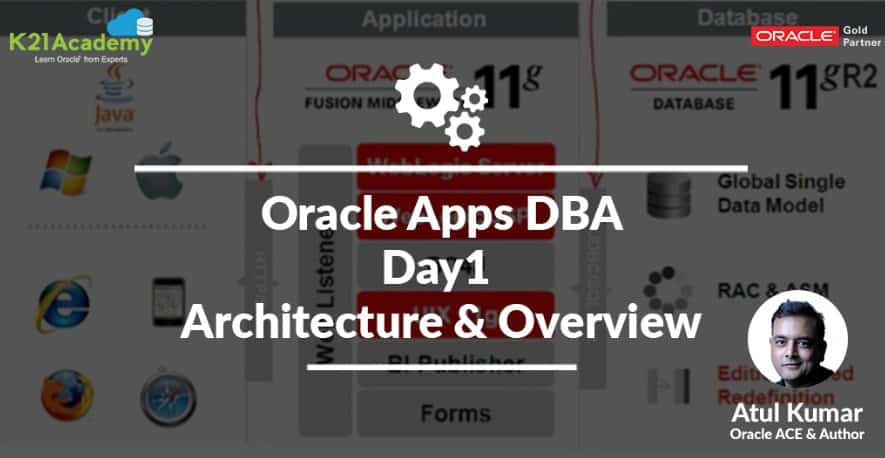
Here is one of the slide from the session

In the session, we gave an in-depth understanding of the new R12.2 Architecture and the underlying components about which we will be dwelling deeper in the coming weeks and also the architecture wise Differences between R12.2 and the previous versions.
The session was very interactive and lots of concept, doubts, and queries were asked, this helps others too who may not even think about these questions.
Also check: Steps to download R12 software from Edelivery Oracle Site
Here are just some of the questions along with the answers that we discussed and worth sharing :
Que 1. What are the minimum service components required to be functional for (Canned, Custom, Customized) SQL/Oracle Reports?
Ans. It will depend on what services are required for Business but bottom line you will need Apache or OHS/OACORE/Forms/Concurrent Manager & Database Services to service end users.
Que 2. While changing apps schema password, do we need to shut down services?
Ans. Yes, it is mandatory to shutdown Application Tier Services before APPS password change. Database Tier Services must be up and running.
Note: We have dedicated module with Lab Exercises for changing Passwords in Apps including SYSADMIN password change.
Que 3. Application not coming up after IP change, Why?
Ans. The IP of the application server is stored in the internal FND table, so we will need to remove the node from the backend tables using scripts provided by Oracle and run auto-config again to fix it.
Que 4. Does Socket Mode require Network port opening between end users and servers?
Ans. Yes for forms in Socket Mode, Form Server port must be open between User and Server.
Tip: Forms Run in 2 Modes, Socket & Servlet. Default in R12.2 is Servlet.
Que 5. Can Forms be launched independently?
Ans. No, in R12 and above, you cannot launch forms independently. You must run with Managed Server and appropriate JVM Container or run adstrtall.sh (Dedicated Module 4 for Services & Start/Stop)
Que 6. How does Forms Connect, JDBC or SQLNET?
Ans. Forms use SQLNet for database connection whereas connection from FMW/WebLogic/Managed Servers (in R12.2) uses JDBC
Que 7. If Apache/OHS crashes, will it crash forms as well?
Ans. yes, forms will not be available if Apache goes down.
Que 8. What are the two Application Servers or Oracle Homes in R12.2?
Ans. FMW 11.1.1.9 (Includes Web tier 11.1.1.9 & WebLogic 10.3.6) and Oracle Application Server 10.1.2.
Que 9. If 10.1.2 is handling forms what does Fusion Middleware handle?
Ans. FMW handles the web pages and forms in servlet mode actually piggybacks on top of FMW WebTier.
Que 10. What does Application Top (APPL_TOP) contain and what does Common Top (COMMON_TOP) contain?
Ans. Application Top contains all the files required for all the modules implemented in ERP whilst Common Top contains JSP files / Java Classes and all other.
Also check: Overview of ADOP
Note: We have dedicated Module III for File System where we cover both APPL_TOP , COMMON_TOP and various other TOPs and Homes in R12.2
Que 11. Which Database User is connected first while authenticating?
Ans. APPLSYSPUB/PUB is the user for forms & GUEST/ORACLE is for JDBC connectivity
Que 12. If a product is marked as installed, can we revert it?
Ans. No, this cannot be removed, we have to be careful while enabling products using license manager
Que 13. Can HTTPS be enabled by default during install time?
Ans. No, enabling SSL is always a post-install step.
Que 14. Usually, who will be scheduling Concurrent requests?
Ans. More than 80% is usually scheduled by business users the rest by DBAs and technical/functional consultants.
Que 15. What is the flow of Concurrent Request?
Ans. The request goes to fnd_concurrent_requests, concurrent managers designated to run this request will pick it up, processes it and updates fnd_concurrent_requests based on completion status.
Note: We have dedicated Module XI for Concurrent Managers (CM) where We’ll go into detail about CM.
Que 16. During Upgrade, can we upgrade application first then upgrade the database from 11.2.0.4?
Ans. No database should be upgraded first to a version that is supported to R12.2 prior to upgrading applications. If your EBS Database is already supported by EBS 12.2 version then you apply just inter-operable patch for R12.2 Database.
Que 17. If we lose the Run Filesystem by accidental deletion, can we start services from the patch filesystem?
Ans. No, it is not possible. You must restore from backup.
Que 18. Weblogic EBS Datasource password for EBS Schema will be updated by autoconfig?
Ans. No, as of Feb 2017, AutoConfig doesn’t change Passwords in WebLogic JDBC for R12.2. We should manually change the password before starting services.
These are only a handful of questions from Day1, We usually have very interactive Session and Videos for Modules are always available on Portal so you learn at your own pace and at your own time with Unlimited Retakes and Lifetime Access.
This is one of the most comprehensive with Hands-On & Best Online Training for Apps DBAs as rated by our 130+ Students in course in 2016 alone). Here are just one of the 100s of testimonials/feedbacks we receive in our WhatsApp Group

This is all for today, Stay Tuned for my next post for the Day 2 of Oracle Apps DBA Training Workshop and if you want all of the updates right in your inbox, then don’t forget to Subscribe to our Blog (Fill up the form on the top right side for Subscribing).
If you want to learn Oracle Apps DBA workshop at more faster pace, then check out our workshop at Oracle Apps DBA Training.
The Oracle Apps DBA Training consists of 13 Modules
Module I: Architecture & Changes in Oracle E-Business Suite R12.2: Get FREE Video Lesson here
Module II: R12.2 Staging & Installation
Module III: File System & Important Files in R12.2
Module IV: Start/Stop in R12.2
Module V: FMW Concepts in Apps DBA – WebLogic & OHS (bonus*)
Module VI: Patching in Apps DBA – ADOP, ADPATCH, OPATCH
Module VII: AD Utilities – ADADMIN, ADSPLICE, ADCONFIG etc
Module VIII: AutoConfig – Apps & DB Tier
Module IX: Cloning in EBS R12.2 (DB & Apps Tier)
Module X: Password Management (Schema, End User)
Module XI: Concurrent Managers
Module XII: Troubleshooting
Module XIII: Advanced Topics (DMZ, Multiple Middle Tier for HA)
Next Task For You
We cover Oracle E-Business R12.2 Architecture & concepts in our Oracle Apps DBA For Beginners Training along with the Installation, Patching, Cloning, and Troubleshooting and also, Database upgrade to 19c and much more including the hands-on labs you must perform to upgrade your skills and get a good job with a high package.
Begin your journey towards becoming an Apps DBA by joining our FREE Masterclass on How To Learn Oracle Apps DBA (R12) & It’s New Features.


![Microsoft Agentic AI Business Solutions Architect [AB-100] | K21 Academy](https://test.k21academy.com/wp-content/uploads/2025/11/Microsoft-Agentic-AI-Business-Solutions-Architect-AB-100-Exam-Overview1.png)