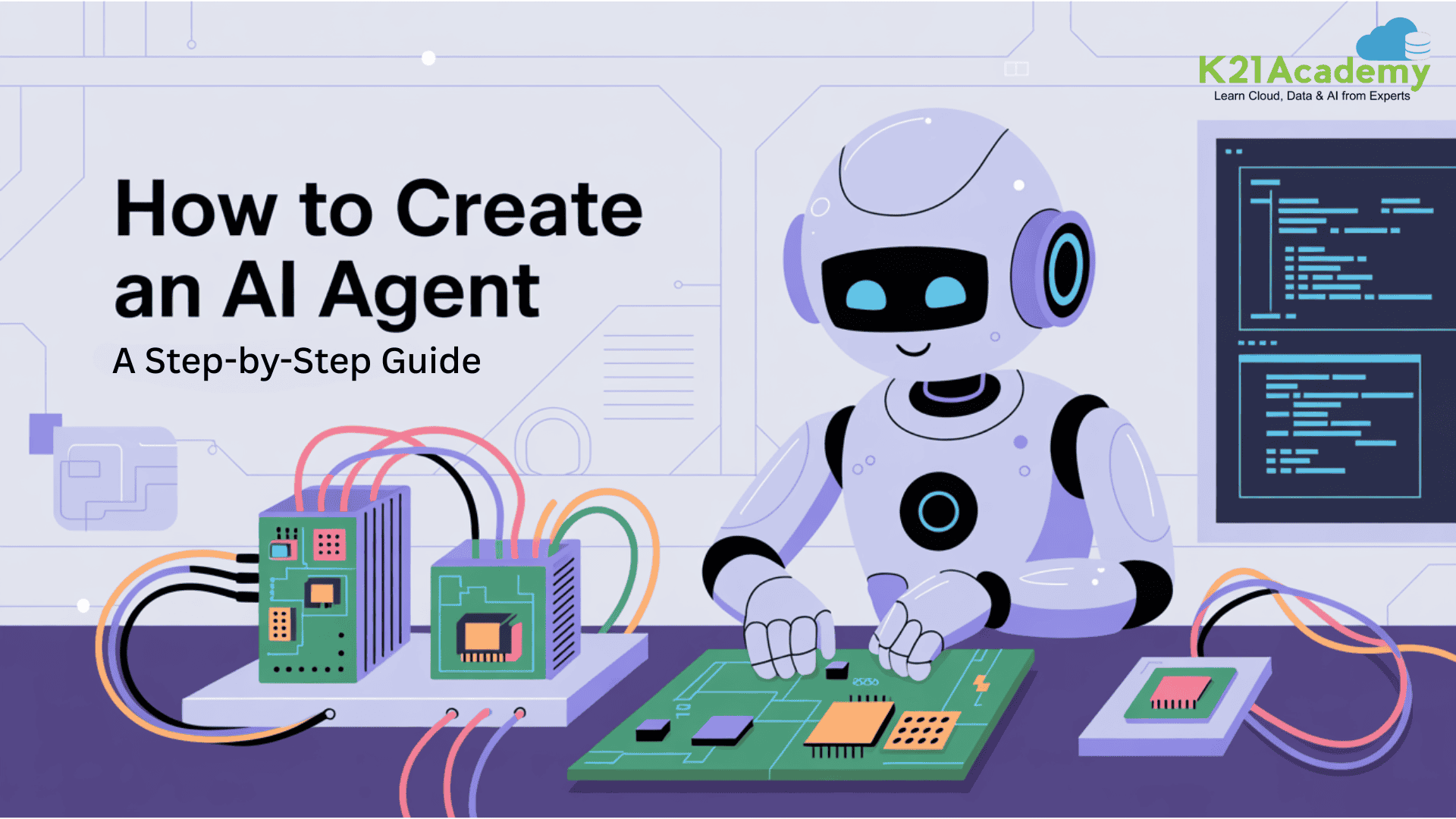





In today’s fast-paced digital landscape, AI agents are becoming an essential tool across industries, revolutionizing everything from customer service to data analysis. But ever wondered how to create an AI agent? Creating an AI agent may sound like a complex task, but with the right guidance, anyone can build one. In this guide, we’ll take you through the basics of AI agent creation, step-by-step, and provide you with the tools, technologies, and strategies you need to get started in 2025. Let’s explore how you can bring your AI agent idea to life!
Table of Contents:
- What is an AI Agent?
- Why are AI Agents useful for businesses?
- How to create an AI Agent: 6 steps to follow
- Approaches to building an AI agent
- Challenges in building AI agents
- Conclusion
What is an AI Agent?

Before we get into the technical details, let’s clear up what an AI agent actually is. Simply put, an AI agent is a system that autonomously perceives its environment, processes information, makes decisions, and takes actions to achieve specific goals. Consider it a digital entity that is capable of
- Examine information or inputs from its surroundings.
- Make choices based on rules, logic, or machine learning.
- Complete things on your own (and occasionally in cooperation with other tools or agents).
- Take note of its previous behavior or comments.
Consider it similar to an autonomous vehicle. It collects information from sensors (such as radars and cameras), evaluates the state of the road, anticipates impediments, and makes judgements instantly. Similar to this, AI agents in software programs gather data, look for trends, and act to finish tasks.

Why Are AI Agents Useful for Businesses?
How to create an AI agent: 6 Steps to follow
Building an AI agent requires planning, selecting the right tools, and careful implementation. Now let’s get practical. Here’s a step-by-step guide to how to create an AI agent that delivers real value:

Stage 1: Ideation & Planning
This is the starting point of the AI agent development lifecycle, where ideas take shape and planning begins. It lays the foundation for building a useful and realistic custom AI agent.
- Identifying needs and use cases: Start by figuring out what issues the AI agent needs to resolve. Concentrate on particular tasks where intelligence or automation might truly be useful, such as answering routine questions, making suggestions, or seeing trends.
- Defining goals and success metrics: Clearly state the goals you have for the AI agent. Establish quantifiable objectives like speeding up response times, boosting accuracy, or lowering manual labour. These objectives will direct the process and aid in performance monitoring in the future.
- Planning resources and timelines: Calculate how many people, resources, time, and equipment will be required to transform the concept into a functional AI agent. From the start, a realistic plan keeps the project on course.
Stage 2: Data Collection & Preparation
Data is the heart of any successful AI agent. In this stage of the AI agent development process, we gather and prepare the information the agent will learn from. The quality and relevance of data play a huge role in how well the AI performs.
- Understanding the types of data needed: The AI agent may require real-time data (such as real-time user interactions), unstructured data (such as emails or chat logs), or structured data (such as databases or spreadsheets), depending on the use case.
- Choosing the right sources: Internal databases, third-party APIs, surveys, user interactions inside your app or website, and customer feedback are just a few of the sources of data. Selecting the appropriate sources guarantees that the agent gains knowledge from accurate and pertinent data.
- Prepare data for training: Cleaning and formatting are frequently required for raw data. This includes cleaning up mistakes, adding missing numbers, and structuring the data in a way that the AI can comprehend. Labeling the data is frequently also crucial, particularly if the AI is being trained to identify patterns or groups.
Related Readings: Structured, Semi Structured and Unstructured Data
Stage 3: Model Design & Development
This stage is where the AI agent starts to take shape. After planning and collecting data, we move into the technical core of custom AI agent development—building the model that powers the agent’s intelligence. It’s a key step in the overall AI agent development process.
- Selecting the right AI approach: Various methods can be applied, such as reinforcement learning for decision-making or Natural Language Processing (NLP) for text comprehension, depending on the task. Building a competent AI agent requires selecting the appropriate framework and algorithm.
- Building & training the model: We train the AI model to identify patterns and make intelligent decisions using the prepared data. In this step, a large number of samples are run through the model until it learns how to respond correctly.
- Testing & Improving: We evaluate the model to determine its performance following the initial training. We adjust and retrain it in cycles to increase its accuracy and dependability based on the outcomes.
How do agents cooperate and coordinate in real-world systems after they are deployed? Everything is explained by our in-depth analysis of MCP and A2A.
Related Readings: Agentic AI Protocols: MCP vs A2A vs ACP vs ANP
Stage 4: Integration & Testing
Once the AI agent is built and trained, the next step in the AI agent development lifecycle is to bring it into the real world. This stage focuses on connecting the agent to the systems it will work with and making sure it runs smoothly and reliably.
- Connect with existing systems: APIs or user interfaces are used to incorporate the AI agent into platforms, applications, or tools. The objective is smooth communication between the agent and its surroundings, whether it is a backend analytics tool or a chatbot on a website.
- Run tests: The agent undergoes a variety of tests before to being online, including user acceptability testing (ensuring it satisfies actual user demands), integration testing (examining how it integrates with other systems), and unit testing (examining individual functionalities).
Stage 5: Deployment & Monitoring
After development and testing, the final stage in the AI agent development lifecycle is deploying the agent and ensuring it continues to perform well over time. This stage is crucial for making the agent available to users and maintaining its effectiveness.
- Deploying to production environments: Whether the end environment is on-premises, in the cloud, or in a hybrid configuration, the AI agent is deployed there. This stage guarantees that the agent is reachable and prepared for practical application.
- Setting up monitoring systems: We set up tools to monitor the AI agent’s performance to make sure everything functions properly. In order to promptly handle problems, these tools keep an eye out for any faults, slowdowns, or strange activities.
Stage 6: Optimization & Scaling
After deploying the AI agent, the next step is to enhance its performance and scale it to meet growing demands. This stage is about fine-tuning the agent to ensure it keeps up with changing needs and performs at its best.
- Analyzing performance data: Examine the AI agent’s performance on a regular basis to find any areas where it is sluggish or experiencing bottlenecks. This makes it easier to identify what has to be changed to maintain efficiency.
- Scaling infrastructure: The underlying infrastructure must expand to meet the growing demand for the AI agent. To make sure the agent can manage higher utilisation without experiencing performance problems, this entails utilising more potent cloud resources, upgrading servers, or enhancing storage.
Approaches to building an AI agent: Build from scratch or use frameworks?
One of the first strategic choices you’ll have to make while creating AI agents is whether to use an existing framework to speed up development or start from scratch.
There isn’t a single, universal solution. The objectives, schedule, skills, and need for control of your organisation should all influence your decision. When deciding how to create an AI agent, you can take two main paths:
Option 1: Build from Scratch
Ideal for teams needing full control or highly custom logic. This requires deep knowledge of:
- Natural Language Processing (NLP)
- Machine Learning
- Software Architecture
- API integrations
Best for enterprise-grade or security-sensitive applications.
Option 2: Use Agent Frameworks
Popular frameworks like LangChain, AutoGen, CrewAI, or OpenAgents offer built-in components for memory, planning, LLM integration, and tool orchestration.
- Memory modules
- Planning and execution engines
- Tool integration templates
- Multi-agent orchestration
Best for startups, rapid prototyping, or building LLM-based copilots.
Related Readings: What is a large language model (LLM)?
Challenges in Building AI Agents
Even when you know how to create an AI agent, expect some hurdles:
- Context limitations: LLMs may forget important info or exceed token limits.
- Prompt engineering: Crafting effective prompts for tasks is part science, part art.
- Tool reliability: Agents calling external APIs must handle errors and latency.
- Evaluation complexity: Debugging an autonomous system is harder than rule-based logic.
- Cost management: LLMs and APIs may incur high operational costs at scale.
Overcoming these challenges is key to building trustworthy, production-ready agents
Related Readings: Top 10 Open-Source AI Agent Tools
Conclusion
As businesses move toward intelligent automation and agentic workflows, knowing how to create an AI agent becomes an essential skill. Whether you’re an AI enthusiast, startup founder, or enterprise developer, the journey from idea to autonomous agent starts with clear goals, the right tools, and an iterative mindset.
You’ve now learned how to create an AI agent in 6 clear steps—from defining objectives and choosing architectures to deploying and improving your agent in the real world.
So go ahead—start simple, test fast, and scale smart. The future is agentic, and now you know how to create an AI agent that can thrive in it.
Related Readings: How to Become an Agentic AI Expert in 2025 – K21Academy?
Frequently Asked Questions
AI agents, as opposed to standard AI solutions, are able to sense their surroundings on their own and communicate with other systems to accomplish their goals. When prompted, regular AI solutions carry out particular tasks. Conversely, AI bots function independently and employ a proactive strategy to complete tasks without continual human involvement.
The creation and application of AI agents in daily company operations, including data entry, customer inquiry resolution, or appointment scheduling, is advantageous for a number of industries, including healthcare, finance, retail, logistics, customer service, education, real estate, and manufacturing.
The first step in creating your own AI agent is to specify its goals and parameters precisely. Next, pick a suitable platform or framework.
Any platform that allows us to construct, deploy, or manage agents without having to start from scratch with hard code is known as a no/low-code AI agent builder.
Building an AI agent can cost anywhere from $0 to over $100,000, depending on complexity, customization, and infrastructure. Simple bots are cheap; advanced multi-agent systems are costly.
There are five main types of AI agents: simple reflex agents, model-based reflex agents, goal-based agents, utility-based agents, and learning agents. What sets AI agents apart from regular AI solutions?
What industries can benefit from AI agent development?
How can I build my own AI agent?
Can I create an AI agent without coding?
How much does it cost to build an AI agent?
What are the 5 types of agents in AI?

![Microsoft Agentic AI Business Solutions Architect [AB-100] | K21 Academy](https://test.k21academy.com/wp-content/uploads/2025/11/Microsoft-Agentic-AI-Business-Solutions-Architect-AB-100-Exam-Overview1.png)