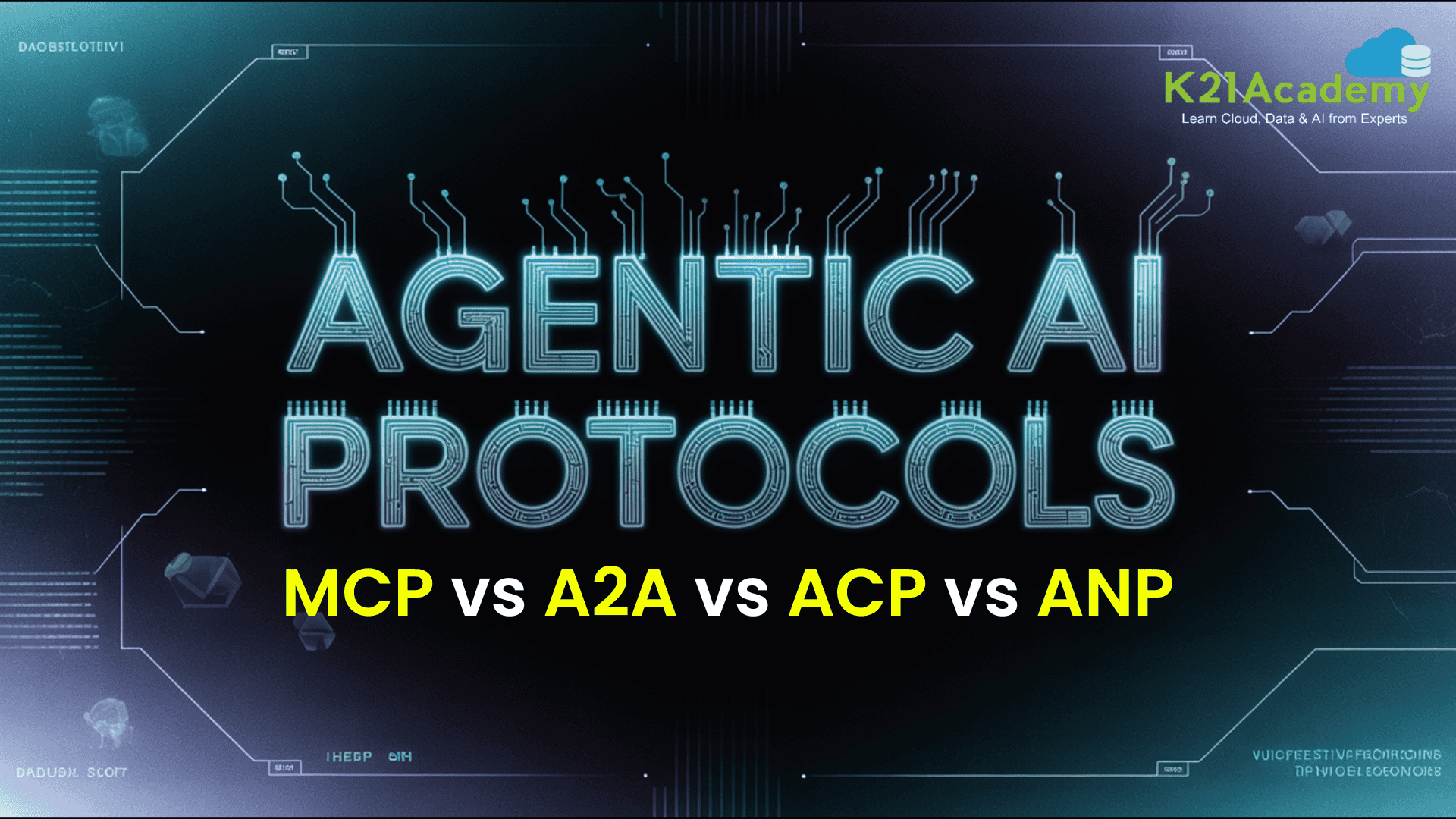




AI is entering its agentic era—a shift from passive, single-response systems to autonomous, goal-driven AI agents that can reason, act, plan, collaborate, and improve over time. As we scale from standalone models to complex systems of interacting agents, the need for structured and scalable communication becomes critical. This is where Agentic AI Protocols come in—they define how intelligent agents talk to each other, share memory, exchange tools, maintain context, and even build trust.
This blog provides an in-depth comparison of four emerging protocols, their key capabilities, and a core comparison of their functionalities.
Table of Contents:
- What are Agentic AI Protocols?
- Model Context Protocol
- Agent-to-Agent Protocol
- Agent Communication Protocol
- Agent Network Protocol
- Comparison of Agentic AI Protocols: MCP vs A2A vs ACP vs ANP
- Conclusion

What are Agentic AI Protocols?
Agentic AI Protocols are formalised systems that define how AI agents interact with their environments, other agents, tools, and users. These protocols govern key elements like
- Context sharing: Persistent memory, intent, and history
- Tool interaction: Invoking APIs, tools, or services
- Multi-agent collaboration: Structured messages, trust, and negotiation
- Autonomy support: Agent discovery, routing, resilience
They serve as the operational and linguistic glue that transforms standalone AI systems into cooperative, intelligent ecosystems. Depending on whether the use case comprises a single agent, a small cooperative group, or a decentralized swarm of autonomous systems, agentic ai protocols vary in terms of their scope, structure, trust models, toolset support, and scalability.
Related Readings: What is Agentic AI?

Now let’s take a closer look at and comparison of MCP, A2A, ACP, and ANP.
MCP (Model Context Protocol)

MCP (Model Context Protocol), introduced by OpenAI, is designed for enabling LLM-based agents to operate in a stateful, tool-using, and memory-aware environment. It outlines the ways in which models engage with context, goals, actions, and tools over time. Unlike stateless prompts, MCP enables stateful, long-running agents that maintain continuity across sessions—ideal for autonomous coding assistants, research agents, or internal copilots.
To put it simply, MCP serves as a link that allows language models to comprehend, preserve, and make use of context throughout time. It specifies how models are able to:
- Use tools or long-term memory
- Keep the persistent state
- Reason between sessions
- Invoke services or functions dynamically
Key Capabilities:
- Tool use interface: Agents can call tools via structured functions.
- Memory management: Contextual memory lets agents remember past actions or facts.
- Goal management: Agents track goals, plans, and the current step.
- Reflection loop: Agents can self-evaluate and revise strategies.
A2A (Agent2Agent Protocol)
 A2A (Agent-to-Agent Protocol) is designed to facilitate structured communication between autonomous agents. It focuses on cooperation, identification, and message standards in multi-agent contexts, going beyond tool invocation. It facilitates safe, decentralised, and trustworthy communication between various agents created by various developers.
Key Capabilities:
- Peer-to-peer message exchange: Secure, signed messages between agents.
- Identity + metadata exchange: Who sent the message, what it’s for, and with what level of trust.
- Interoperability: Enables agents across different ecosystems to interact.
- Open protocol: Flexible for networks of LLMs, bots, or services.
ACP (Agent Communication Protocol)

ACP (Agent Communication Protocol) has its roots in multi-agent system theory. Based on standards like FIPA ACL and KQML, ACP is built for reasoning agents that require structured messaging using “performative” verbs like “inform”, “request”, “propose”, and “accept”.
This protocol allows agents to carry out complex conversations and workflows while maintaining semantic clarity about each message’s intent.
Key Capabilities:
- Performative-based messaging: Every message has a purpose (e.g., “inform”, “reject”, “ask”).
- Formal conversation patterns: Use in workflows like auctions, planning, and contract negotiation.
- Agent roles: Agents can act as buyer, seller, manager, etc.
- Well-suited for logic-based and rule-based agents.
ANP (Agent Network Protocol)

ANP (Autonomous/Agent Network Protocol) powers scalable, decentralised agent ecosystems. It provides mechanisms for agent discovery, routing, health monitoring, and resilience — focusing on network-wide coordination rather than single-agent capabilities.
It is inspired by decentralised technologies (like DHTs, P2P, and Web3) and is ideal for large networks of autonomous agents operating across domains or systems.
Key Capabilities:
- Dynamic agent discovery and routing: New agents can join or leave dynamically.
- Fault tolerance: Handles failures gracefully with redundancy.
- Reputation and trust layers: Helps evaluate trustworthiness in open networks.
- Supports federated or hybrid agent deployments.
Related Readings: AI Agents vs Human Agents: Key Differences & Benefits in Modern Business
Comparison of different Agentic AI Protocols

When to use which protocol?

Related Readings: Top 10 Open-Source AI Agent Tools
Conclusion
The rise of autonomous AI agents calls for new standards of communication that are structured, interoperable, secure, and scalable. Each of the four Agentic AI protocols we’ve explored plays a distinct role in this emerging ecosystem:
- MCP enables powerful individual agents with memory and tool use.
- A2A allows teams of agents to communicate, coordinate, and collaborate.
- ACP brings formal reasoning, negotiations, and behavioural logic into play.
- ANP empowers entire networks of agents to function resiliently and autonomously.
As we move forward into the era of agentic AI platforms, autonomous service networks, and interoperable digital ecosystems, understanding and applying the right agentic AI protocol will be essential to building robust, intelligent systems.
Frequently Asked Questions
While MCP links agents to the information and resources they require to operate in real-world workflows, A2A enables agents to collaborate across ecosystems.
Using capability-based Agent Cards, A2A facilitates peer-to-peer task delegation, facilitating safe and expandable cooperation across enterprise agent workflows. ANP uses JSON-LD graphs and W3C decentralised identifiers (DIDs) to facilitate secure collaboration and open network agent discovery.
Agentic AI is more autonomous, flexible, and capable of solving problems than standard AI systems, which adhere to preset instructions. Important Distinctions: Autonomy: Agent AI functions autonomously, but traditional AI needs human input. What is the difference between A2A and MCP AI protocols?
What is the difference between A2A and ANP?
What is agentic AI vs AI?

![Microsoft Agentic AI Business Solutions Architect [AB-100] | K21 Academy](https://test.k21academy.com/wp-content/uploads/2025/11/Microsoft-Agentic-AI-Business-Solutions-Architect-AB-100-Exam-Overview1.png)