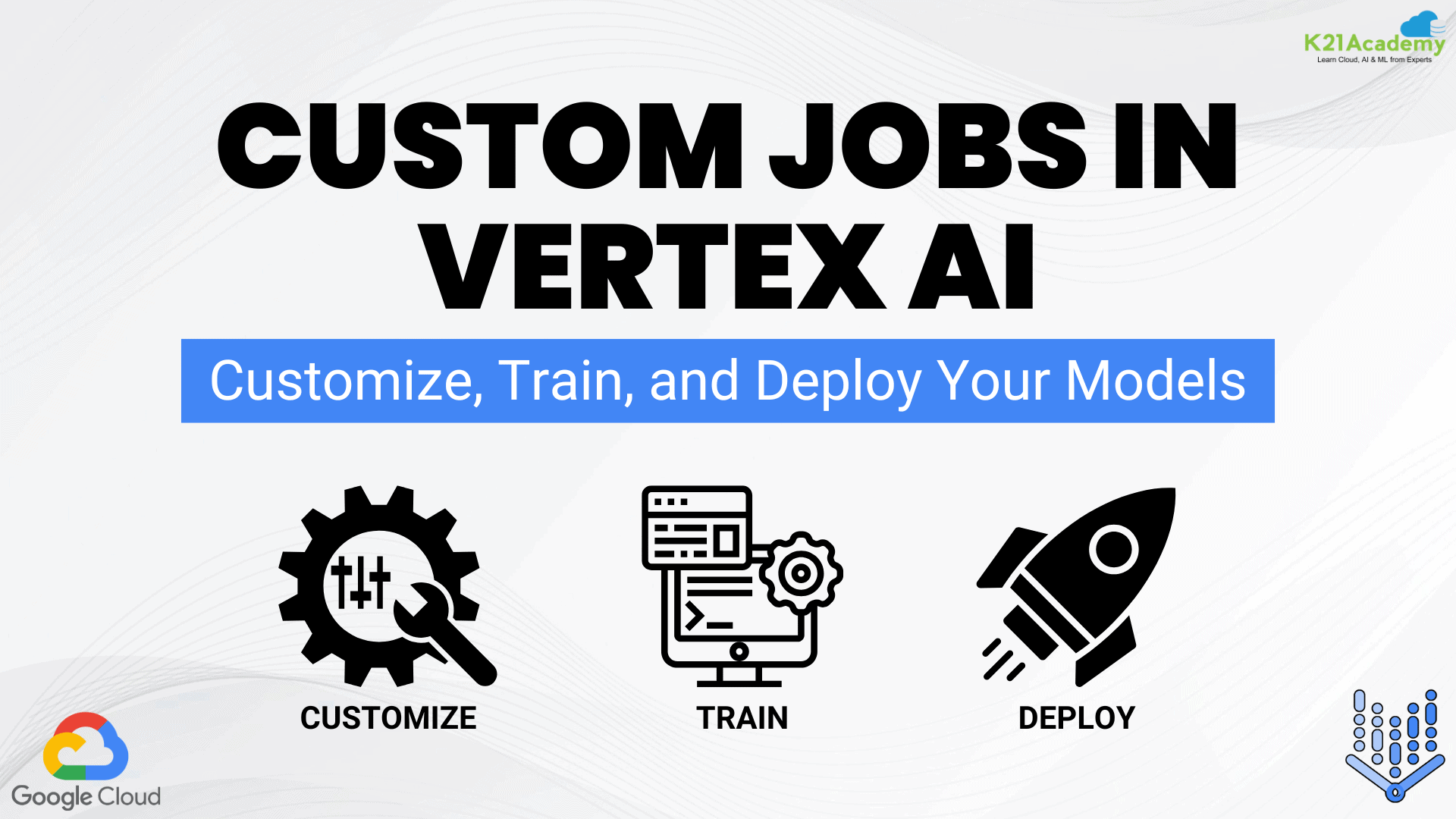




In machine learning, many projects require custom solutions that go beyond standard models and services. Custom Jobs in Vertex AI allow you to have full control over your training and deployment processes. You can use your own code, containers, and resources to tailor the environment to your specific needs.
In this blog, we’ll explore:
What are Custom Jobs in Vertex AI?
Custom jobs in Vertex AI let you run your own machine learning training code or processing tasks on Google Cloud. You can use your own code, choose the computing power you need, and Vertex AI takes care of setting up and running the job for you. It’s helpful when you need more flexibility than what pre-built tools provide.
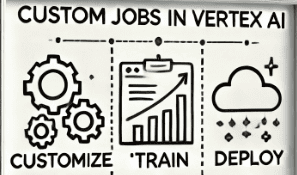
With Custom Jobs, you can define your own containers, runtime environments, and scripts, giving you the flexibility to use any framework or library that suits your needs—whether it’s TensorFlow, PyTorch, XGBoost, or any other popular ML framework.
Key Features of Custom Jobs in Vertex AI
Here are some of the key features that make Custom Jobs in Vertex AI powerful and flexible:
- Custom Containers: You can package your model code, dependencies, and environment in a Docker container, which ensures portability and consistency across different environments. Vertex AI will run your container on Google Cloud infrastructure.
- Resource Management: Vertex AI handles provisioning, scaling, and managing the infrastructure for the job, so you don’t have to manage the underlying hardware or worry about scaling issues.
- Integration with Google Cloud: Custom jobs can be integrated with other Google Cloud services such as Cloud Storage (for data storage), BigQuery (for data processing), and Google Cloud Logging (for monitoring and debugging).
- Support for Specialized Hardware: You can run your custom job on different machine types, including GPUs or TPUs, which is helpful for training large models or performing inference on complex data.
To know more about Vertex AI, Click Here.
Steps to Run a Custom Job in Vertex AI
Here’s a simplified workflow for running a custom job:
1. Prepare Your Code and Environment
- Write the code you want to execute (e.g., a Python script for training or inference).
- If you have specific dependencies (like TensorFlow, PyTorch, or other libraries), you will need to package them either in a Docker container or a Python environment that Vertex AI can use.
Also Read: Our blog post on How to Create a Jupyter Notebook Instance Using Vertex AI Workbench
2. Build a Custom Container (Optional)
If you need a specialized environment or libraries, you can create a custom Docker container to run your job.
- Create a Dockerfile: This file defines your custom environment, specifying the base image (like Python or TensorFlow) and any extra libraries or dependencies you need.
- Build the Docker Image: You can build the container image locally and push it to Google Container Registry or Artifact Registry.
- Push to Google Cloud: After building the container, push it to a container registry so that Vertex AI can use it for your custom job.
3. Create a Custom Job in Vertex AI
You define a custom job using the Vertex AI SDK, the Google Cloud Console, or REST API. You specify:
- The Docker container image (if you’re using a custom container).
- Compute resources (e.g., number of CPUs, GPUs, memory).
- The command or script to execute inside the container (e.g., running a Python script).
Example of creating a custom job using the Python SDK:
from google.cloud import aiplatform

# Initialize Vertex AI with your project and region
aiplatform.init(project='your-project-id', location='us-central1')

# Define the custom job
custom_job = aiplatform.CustomJob(
    display_name="my-custom-job",  # Name for the job
    worker_pool_specs=[
        {
            "machine_spec": {
                "machine_type": "n1-standard-4",  # CPU specs
                "accelerator_type": "NVIDIA_TESLA_K80",  # GPU specs
                "accelerator_count": 1
            },
            "replica_count": 1,
            "container_spec": {
                "image_uri": "gcr.io/YOUR_PROJECT_ID/your-container-image",  # Docker image URI
                "command": ["python", "train.py"],  # Command to run inside the container
                "args": ["--epochs", "10"]  # Arguments passed to the script
            }
        }
    ]
)

# Run the custom job
custom_job.run(sync=True)
4. Monitor the Custom Job
Once the custom job is running, you can monitor it:
- Google Cloud Console: Track job status, view logs, and check resource usage.
- Logging and Metrics: Vertex AI integrates with Google Cloud Logging and Monitoring, so you can see detailed logs and monitor the health of your job.
- Error Handling: If the job fails, you can review the logs for debugging.
5. Access Job Outputs
After the job completes, you can retrieve the outputs:
- Model Artifacts: For training jobs, this might include model weights, metrics, or checkpoints.
- Logs: These might include training logs, debug logs, or error reports.
- Data Outputs: Any files or results generated by your job, which can be stored in Google Cloud Storage.
When to Use Custom Jobs
Custom jobs are useful in the following scenarios:
- Custom ML frameworks: If you’re using a custom ML framework or version of a library not available in Vertex AI’s pre-built containers.
- Specific dependencies: When your job requires specific versions of libraries or software that aren’t available in the standard Vertex AI environments.
- Complex workflows: When your ML pipeline involves multiple stages, data processing, or custom scripts that need to run in a specific order or environment.
- Specialized hardware: If you need to use GPUs or TPUs to train deep learning models and want to configure the environment precisely for that purpose.
Best Practices for Custom Jobs
- Optimize Docker Containers: Keep your containers as small and efficient as possible to speed up job start times and reduce costs.
- Use Version Control: Version your custom containers and code, so you can track changes and reproduce results consistently.
- Monitor and Log Everything: Implement detailed logging inside your custom job to help with debugging and understanding performance bottlenecks.
- Choose Resources Wisely: Allocate the right amount of CPU, memory, and GPU resources based on the size of your job. Over-provisioning can increase costs unnecessarily, while under-provisioning can lead to slower performance.
Sample Exam Q&A on Custom Jobs for ML Engineer Certification
Custom jobs in Vertex AI are part of the Google Cloud Professional ML Engineer Certification syllabus. These questions test your skills in creating and training models, managing resources, and troubleshooting, which are key for working with Google Cloud.
1. What is the main advantage of using custom jobs in Vertex AI over pre-built models?
A) Custom jobs are faster to deploy
B) Custom jobs provide flexibility to define your own model and training process
C) Pre-built models offer more control over the model’s performance
D) Custom jobs do not require any coding
Answer: B) Custom jobs provide flexibility to define your own model and training process
2. When creating a custom job in Vertex AI, which of the following is NOT required?
A) Selecting the machine type and resources
B) Uploading training code and data
C) Defining the deployment endpoint
D) Configuring job metadata
Answer: C) Defining the deployment endpoint
3. In Vertex AI, which service would you use to monitor logs and metrics during a custom job execution?
A) Google Cloud Functions
B) Google Cloud Logging
C) Vertex AI Workbench
D) Google Cloud Pub/Sub
Answer: B) Google Cloud Logging
4. What can you do if a custom job is taking longer than expected in Vertex AI?
A) Decrease the machine’s CPU resources
B) Check and adjust the dataset size or batch size
C) Remove the validation step from the training pipeline
D) Set the training job timeout to zero
Answer: B) Check and adjust the dataset size or batch size
5. How does Vertex AI handle distributed training for custom jobs?
A) It uses data parallelism to distribute training across multiple machines
B) It automatically splits the model across multiple GPUs without user configuration
C) It automatically selects the best model based on accuracy
D) It runs the job on a single machine regardless of the dataset size
Answer: A) It uses data parallelism to distribute training across multiple machines
Want more exam questions? Download our free exam guide.
Sample Interview Questions on Custom Jobs
In interviews, you’ll need to explain how to create, manage, and fix issues with custom jobs in Vertex AI. These questions assess your ability to work with machine learning models and solve problems, which are important skills for an ML Engineer role.
1. What are custom jobs in Vertex AI, and how do they differ from pre-built models?
Answer:
Custom jobs in Vertex AI let you train your own machine learning models using your data and code. Unlike pre-built models, which are ready-made for common tasks (like image recognition), custom jobs offer flexibility for unique use cases and customizations.
2. How do you create and deploy a custom job in Vertex AI?
Answer:
- Prepare your code: Write your machine learning model code.
- Upload: Upload the code and training data to Vertex AI.
- Configure the job: Choose resources (e.g., GPUs) and set job parameters.
- Submit: Start the job and monitor progress.
- Deploy the model: Once training is complete, deploy the model for predictions.
3. How do you manage and monitor custom models in Vertex AI?
Answer:
You can monitor jobs through the Vertex AI Dashboard, view logs and metrics in Google Cloud Logging, and track model versions with the model registry. For deployed models, use data drift detection and alerts to monitor performance over time.
4. What are the advantages of using Vertex AI for custom jobs?
Answer:
- Scalability: Automatically scales training using GPUs or TPUs.
- Managed infrastructure: No need to manage servers or hardware.
- Integration: Easily connects with other Google Cloud services.
- Simplified Deployment: Quickly deploy trained models to production.
5. How do you troubleshoot issues during custom jobs in Vertex AI?
Answer:
- Check logs: Review logs for errors in the Google Cloud Console.
- Monitor resources: Ensure the job has enough resources (e.g., GPUs).
- Verify data: Check data formatting and permissions.
- Review code: Look for issues in your code or model setup.
Want to ace your interview? Grab our free interview Q & A guide.
Conclusion
Custom jobs in Vertex AI offer the flexibility and control needed for advanced machine learning tasks that require specific dependencies or environments. By creating your own Docker containers, managing compute resources, and leveraging Google Cloud’s infrastructure, you can efficiently run training, inference, and other machine learning jobs at scale.
This capability is especially useful when working with custom models, specific libraries, or hardware acceleration like GPUs/TPUs, allowing you to integrate Vertex AI seamlessly into your custom ML workflows.
Frequently Asked Questions (FAQ’s)
What are custom jobs in Vertex AI?
Custom jobs in Vertex AI are jobs where you can run custom machine learning (ML) code on Google Cloud. These jobs can be used for training models, running inference, or performing batch predictions. Custom jobs allow you to bring your own code and container, giving you full control over the environment and execution.
How do I create a custom job in Vertex AI?
To create a custom job in Vertex AI, you need to define the training script or model, select the required machine type, and specify the Docker container or Python environment that will run the job. You can submit a custom job through the Google Cloud Console, CLI, or SDK, providing details such as input data, output locations, and resource requirements.
What is the difference between custom jobs and pre-built models in Vertex AI?
The key difference is flexibility. Custom jobs are ideal for users who need full control over the training process, such as choosing specific algorithms or optimizing hyperparameters. In contrast, pre-built models are ready-to-use solutions that require minimal customization and are great for common tasks like image classification or natural language processing.
What are the costs associated with custom jobs in Vertex AI?
The cost of custom jobs depends on factors such as the compute resources used (e.g., the machine type and GPUs), the duration of the job, and storage costs for storing training data and model artifacts. You are charged for the resources allocated during job execution, and additional costs may apply if you use specific services like AI Platform Pipelines or batch predictions.
How can I monitor and manage custom jobs?
Vertex AI provides a detailed monitoring dashboard where you can track the progress and status of your custom jobs. It includes metrics such as job logs, system metrics, and error tracking. You can also set up notifications and alerts to monitor job completion, failures, or resource usage.
Related References
- Join Our Generative AI Whatsapp Community
- Generative AI (GenAI) vs Traditional AI vs Machine Learning (ML) vs Deep Learning (DL)
- Introduction to Generative AI and Its Mechanisms
- Introduction to AI/ML Services in Google Cloud Platform (GCP)
- Google AI/ML: Step-by-Step Activity Guide (Hands-on Lab) & Project Work for getting a higher paying Job & Certifications
Next Task For You
Don’t miss our EXCLUSIVE Free Training on Mastering GooGle AI/ML & GenAI. Master cutting-edge AI and Machine Learning technologies with Google tools. Join a growing community of learners ready to elevate their careers.
Click the image below to secure your spot!


![Microsoft Agentic AI Business Solutions Architect [AB-100] | K21 Academy](https://test.k21academy.com/wp-content/uploads/2025/11/Microsoft-Agentic-AI-Business-Solutions-Architect-AB-100-Exam-Overview1.png)