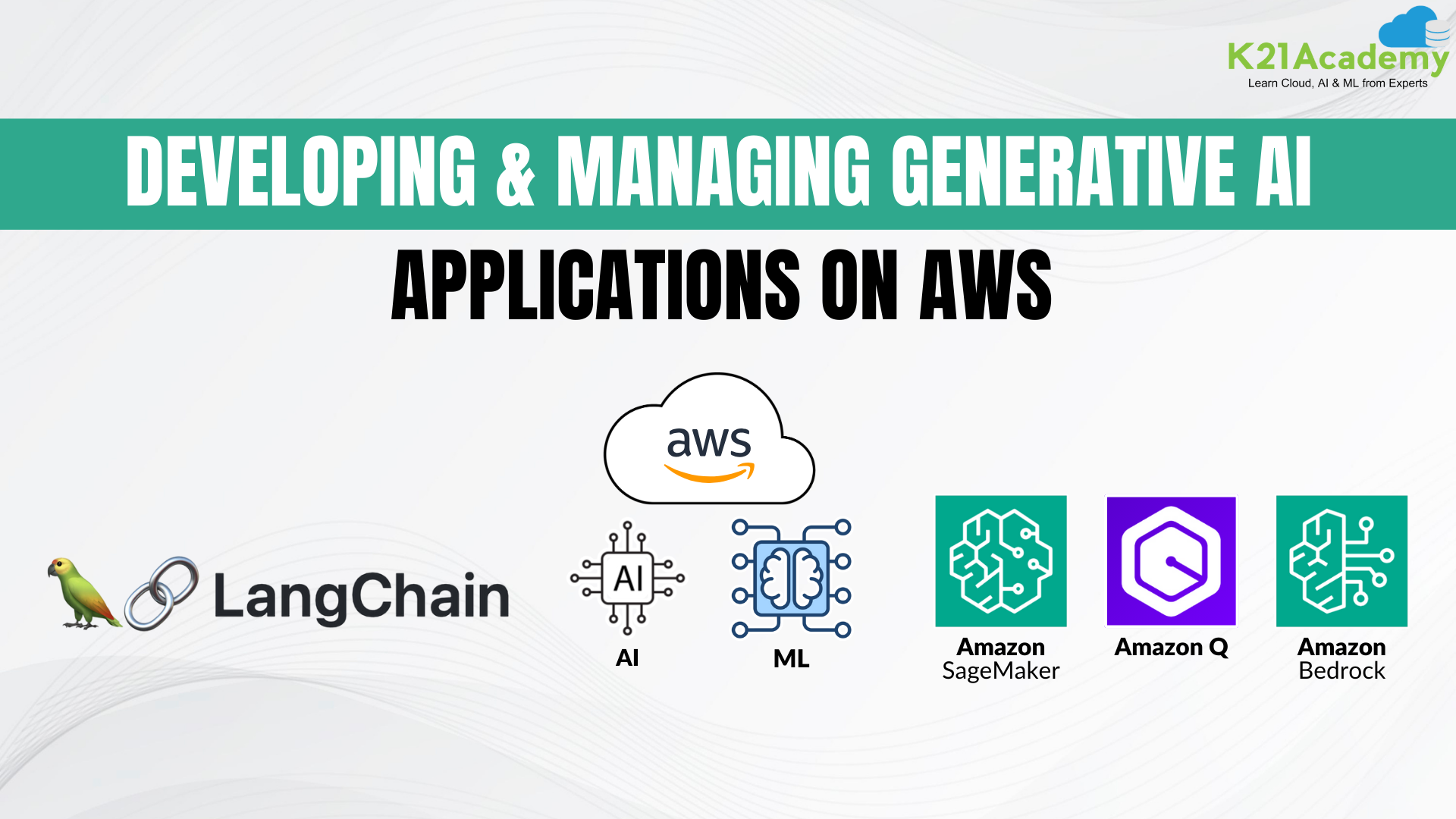





Generative AI is revolutionizing how developers create solutions. It enables the generation of text, images, and even code using machine learning models.
With AWS, building and managing generative AI applications becomes accessible through services like Amazon Bedrock and frameworks such as LangChain. These tools offer seamless integration with Large Language Models (LLMs), making it easier to develop scalable AI solutions.
Whether you’re automating tasks or enhancing customer interactions, AWS empowers developers to harness the full potential of generative AI. This blog will guide you through the key aspects of developing AI applications on AWS.
For a clearer understanding of the differences between AI, ML, DL, and Generative AI, check out this informative video:
Table of Contents
- Overview and Objectives
- Introduction to Generative AI – Art of the Possible
- Planning a Generative AI Project
- Foundations of Prompt Engineering
- Components of a Generative AI Application
- Amazon Bedrock Foundation Models
- Integrating LangChain with AWS
- Architecture Patterns for Generative AI
- Real-World Applications and Use Cases
- Conclusion
- Frequently Asked Questions
Overview and Objectives ^
Building generative AI applications on AWS starts with understanding how large language models (LLMs) and AI services like Amazon Bedrock work together. The objective is to enable developers to create AI-driven applications without the need for fine-tuning models.
AWS offers tools to streamline the development process, making it easier to manage AI applications at scale. The focus is on key components like prompt engineering, model architecture, and integrating generative AI into real-world use cases.
By the end of the process, developers will be equipped to implement generative AI solutions for various tasks, including text generation, chatbots, and content automation. AWS ensures these solutions are scalable, secure, and cost-effective, helping developers maximize the business value of AI applications.
Introduction to Generative AI – Art of the Possible ^
Generative AI opens up new possibilities for creating AI-driven solutions. Unlike traditional machine learning models, generative AI focuses on creating content such as text, images, and even code, which can significantly enhance automation and personalization.
 With AWS, developers can leverage Amazon Bedrock to build generative AI applications without needing to fine-tune models. These applications can be used in areas like chatbots, automated content creation, and data summarization, offering tangible benefits for businesses.
However, it’s important to understand the risks and challenges, such as managing AI bias and ensuring security. By following best practices and leveraging the tools AWS provides, developers can mitigate these risks while harnessing the full potential of generative AI.
To explore this concept further, click here for more insights on Generative AI.
Planning a Generative AI Project ^
To successfully build a generative AI application on AWS, careful planning is essential. It begins with identifying the specific use case—whether it’s content generation, chatbots, or automated data analysis—and determining the business value that AI will bring.
 Next, developers need to consider the technical requirements, such as which foundation models to use and how to structure prompt engineering effectively. AWS tools like Amazon Bedrock simplify this by offering scalable, pre-built models.
Risk mitigation is another crucial factor. Issues such as AI bias and security vulnerabilities should be anticipated, and strategies should be put in place to address them. Planning thoroughly helps ensure that your AI project is not only innovative but also secure and efficient.
Getting Started with Amazon Bedrock ^
Amazon Bedrock provides an easy entry point for developers looking to create generative AI applications without the complexity of fine-tuning models. It offers access to powerful foundation models that are pre-built and ready for use, streamlining the development process.
 To start, developers can quickly set up Amazon Bedrock via the AWS Management Console, making it easy to experiment with AI models for tasks like text generation or image creation. Bedrock’s architecture allows seamless integration with other AWS services, enabling scalability and security for your AI projects.
By leveraging Bedrock’s foundation models, developers can focus on building the application logic and delivering AI-driven solutions faster. This makes it ideal for anyone looking to deploy generative AI in real-world scenarios efficiently.
For practical examples and detailed information, click here to access our blog on Amazon Bedrock.
Foundations of Prompt Engineering ^
At the heart of every generative AI application is prompt engineering, the process of crafting instructions that guide AI models in producing desired outputs. Whether you’re working with zero-shot learning, where no prior examples are given, or few-shot learning, which uses minimal examples, designing effective prompts is crucial for achieving reliable results.
 The key to successful prompt engineering is clarity. Clear and structured prompts lead to more accurate and context-relevant outputs. AWS offers tools that help refine these prompts, ensuring they align with the task at hand, whether it’s text generation, summarization, or code creation.
Additionally, it’s important to account for potential biases in the model’s responses. By iterating and refining prompts, developers can mitigate these risks and improve the quality of their generative AI applications. AWS provides the flexibility needed to experiment with and optimize these prompts for different use cases.
To explore this concept further, click here for more insights on Prompt Engineering.
Components of a Generative AI Application ^
A complete generative AI application relies on various components to function seamlessly. Beyond the foundation models, developers need to integrate key elements such as datasets, embeddings, and the Retrieval Augmented Generation (RAG) technique. RAG enables AI to retrieve and generate information based on external sources, ensuring your application stays relevant and updated.
 Word embeddings play a critical role in helping AI models understand the context of words by converting them into numerical representations. This enables more nuanced and context-aware outputs.
AWS offers powerful tools to manage these components, such as Amazon Bedrock and LangChain, which handle data retrieval and memory management. Additionally, security is paramount when deploying generative AI applications. AWS provides robust security features, including data encryption, monitoring, and governance tools, ensuring your AI solutions are not only effective but also secure.
Amazon Bedrock Foundation Models ^
The foundation models available through Amazon Bedrock are the backbone of many generative AI applications on AWS. These models are designed to handle complex tasks like text generation, image creation, and more, without requiring developers to fine-tune them manually. This allows developers to focus on integrating these models into their workflows and delivering real-world AI solutions quickly.

Amazon Bedrock supports a range of inference tasks, enabling users to experiment with models using techniques like zero-shot and few-shot learning. This flexibility makes it easy to adapt the models for a variety of use cases, from content creation to automated customer support.
With the AWS Management Console, developers can easily deploy and manage these models, scaling them as needed. This provides a streamlined process for implementing generative AI in applications, ensuring both efficiency and scalability.
For a deeper dive into this topic, click here to read our detailed blog on Foundation Models
Integrating LangChain with AWS ^
LangChain is a powerful framework that integrates seamlessly with AWS to enhance the performance of large language models (LLMs). By using LangChain, developers can streamline tasks such as prompt engineering, data retrieval, and memory management. This allows for more efficient AI workflows, especially when working with complex applications that require multiple steps or interactions.
 LangChain simplifies the process of constructing LLM-based applications by offering tools like prompt templates, document loaders, and agents to manage external resources. These components work together to optimize how AI interacts with data and processes information.
When combined with Amazon Bedrock, LangChain allows for the development of robust AI solutions, including chatbots, content generators, and automated customer support systems. This integration ensures that your generative AI applications are scalable, efficient, and able to handle real-world tasks with ease.
To gain a better understanding, click here for an in-depth explanation of LangChain
Architecture Patterns for Generative AI ^
When developing generative AI applications on AWS, selecting the right architecture pattern is crucial for ensuring efficiency and scalability. Some of the common patterns include text summarization, question answering, and chatbots. For instance, you can use models like Amazon Titan for summarizing long texts or answering complex queries by retrieving relevant information.
 Another pattern is code generation, where generative AI models can automatically generate code based on specific prompts. AWS’s architecture supports the integration of these models into real-world applications, making it easier to build scalable AI-driven solutions.
By combining architecture patterns with services like Amazon Bedrock and frameworks like LangChain, developers can create dynamic and interactive AI solutions tailored to various business needs. These patterns enable the development of applications that are both adaptable and robust, capable of handling diverse use cases from content creation to customer support.
Real-World Applications and Use Cases ^
Generative AI applications built on AWS can be applied to a wide range of real-world scenarios. Businesses can leverage AI models for content creation, automating the generation of blog posts, social media content, or even marketing copy. Additionally, chatbots powered by Amazon Bedrock can enhance customer service by providing human-like interactions and quick responses to inquiries.
 Another key use case is code generation, where developers can automate the creation of code snippets or scripts based on specific prompts. This helps streamline the development process and reduces manual coding efforts.
With the scalability and security provided by AWS, developers can confidently deploy AI-driven applications that offer both immediate business value and long-term efficiency. By using the tools and frameworks available on AWS, the possibilities for generative AI are endless, offering solutions across industries.
Conclusion ^
Building and managing generative AI applications on AWS is now more accessible than ever with services like Amazon Bedrock and frameworks like LangChain. These tools enable developers to quickly implement AI-driven solutions, whether for text generation, chatbots, or automated customer interactions.
By leveraging prompt engineering, foundation models, and scalable architecture patterns, developers can deploy powerful AI applications that are both efficient and secure. AWS makes it easy to tap into the full potential of generative AI, empowering developers to stay ahead in an ever-evolving technological landscape.
Frequently Asked Questions
Q1) What makes Amazon Bedrock a better option for developing generative AI applications compared to other AI platforms?
Ans: Amazon Bedrock stands out due to its simplicity and scalability. Unlike some AI platforms that require extensive fine-tuning, Bedrock provides pre-built foundation models that are ready for use, meaning you can get started faster. Additionally, it integrates seamlessly with other AWS services, so if you're already using AWS for cloud infrastructure, it’s easier to manage and scale your AI applications. The security and governance features AWS offers also ensure that you can deploy generative AI solutions without worrying about data breaches or model bias.
Q2) How does prompt engineering impact the performance of a generative AI application on AWS?
Ans: Prompt engineering is critical because it directly influences the quality and accuracy of the AI model’s output. Well-structured and clear prompts lead to more reliable and context-relevant responses from the model. For instance, when using zero-shot or few-shot learning on Amazon Bedrock, the effectiveness of the model heavily depends on how well you’ve crafted the prompts. AWS offers flexibility in refining prompts, allowing you to iterate and experiment to achieve the desired outcome. Poorly designed prompts, on the other hand, can introduce bias or cause the model to misunderstand the task at hand, leading to ineffective outputs.
Q3) What kind of real-world applications can I develop with generative AI on AWS?
Ans: The possibilities are vast. With Amazon Bedrock and frameworks like LangChain, you can develop a range of applications, including chatbots that provide real-time customer support, content generators for automating marketing materials, and code generation tools that assist developers by creating scripts or snippets based on prompts. You can also create text summarization tools that distill long documents into concise summaries or build question-answering systems that retrieve relevant information based on a query. The scalability of AWS ensures that these applications can handle large volumes of data and interactions without compromising performance.
Q4) I’ve heard generative AI can be risky. What steps can I take to minimize those risks on AWS?
Ans: You’re right—there are risks, such as bias in AI outputs, data privacy concerns, and potential misuse of AI-generated content. AWS helps mitigate these risks through built-in security features, including data encryption and access control. When it comes to bias, one of the best practices is to carefully design your prompts and refine them based on the output you’re receiving. Additionally, AWS offers tools for monitoring and governing AI models, allowing you to regularly audit and adjust the model’s behavior to ensure it aligns with ethical and business guidelines. Taking these steps will ensure that your generative AI applications remain both effective and secure.
Q5) Do I need to have advanced AI knowledge to start using generative AI on AWS?
Ans: Not at all! One of the key benefits of AWS services like Amazon Bedrock is that they are designed to be accessible even for developers who don’t have deep AI expertise. The foundation models provided by Bedrock are pre-trained, so you don’t need to spend time fine-tuning them. With basic knowledge of cloud services and programming, especially in Python, you can start building generative AI applications quickly. However, the more you understand about prompt engineering and how AI models work, the better your results will be. AWS offers plenty of documentation and tutorials to help you ramp up quickly.
Related References
- Join Our Generative AI Whatsapp Community
- Introduction To Amazon SageMaker Built-in Algorithms
- Introduction to Generative AI and Its Mechanisms
- Mastering Generative Adversarial Networks (GANs)
- Exploring Large Language Models (LLMs)
- The Essentials of Prompt Engineering
- Demystifying Natural Language Processing (NLP)
- Generative AI for Kubernetes: K8sGPT Insights
Next Task For You
Join our EXCLUSIVE Free Session and start your journey toward earning the AWS Certified AI Practitioner certification.
In this interactive session, you’ll gain insights into AI, ML, DL, and Generative AI, all guided by experienced professionals. Whether you’re new to the field or enhancing your skills, this session offers valuable knowledge on the latest AWS AI technologies.
Click the image below to secure your spot today!


![Microsoft Agentic AI Business Solutions Architect [AB-100] | K21 Academy](https://test.k21academy.com/wp-content/uploads/2025/11/Microsoft-Agentic-AI-Business-Solutions-Architect-AB-100-Exam-Overview1.png)