



In this post, we will look at the Architecture of Google Cloud Platform (GCP). Here, a variety of resource categories, including those specific to zones, regions, several regions, and the entire world, are combined to create a flexible, scalable, and efficient system.
Topics Covered in this blog:
- Google Cloud Platform: Overview
- Google Cloud Architecture
- Google Cloud resources
- Zonal
- Regional
- Multi-Regional
- Global
- Making Architectural Decisions
- Conclusion
Google Cloud Platform: Overview
Google Cloud Platform (GCP) offers a robust framework for deploying applications globally, ensuring optimal performance, availability, and scalability. One of the fundamental aspects of designing cloud architecture is understanding the different types of resources available: zonal, regional, multi-regional, and global. Each type serves specific purposes and offers unique benefits. In this blog post, we’ll explore these resources in-depth to help you make informed decisions about your cloud infrastructure.

Now that we’ve looked at the different resource types GCP offers, let’s examine how these resources are organized and managed using the Google Cloud Architecture Framework, which serves as a roadmap for developing extremely efficient cloud systems.
Google Cloud Architecture
The Google Cloud Architecture Framework serves as a comprehensive guide for architects and developers in building and managing cloud systems. It ensures setups are safe, efficient, resilient, fast, and cost-effective. Updated regularly by Google experts, it aligns with industry standards and Google Cloud features.
The framework is divided into six categories or “pillars,” providing valuable advice for various cloud scenarios, whether migrating existing systems, using hybrid setups or developing cloud-native applications.

- System Design Architecture: This forms the core of the Google Cloud Architecture Framework. Define the architecture, components, modules, interfaces, and data necessary to meet cloud system needs. Discover Google Cloud products and features that facilitate system design.
- Operational Excellence: Streamline the deployment, operation, monitoring, and management of your cloud workloads for maximum efficiency.
- Security, Privacy, and Compliance: Enhance data and workload security in the cloud, prioritize privacy in design, and adhere to regulatory requirements and standards.
- Reliability: Build and maintain resilient and highly available cloud workloads.
- Cost Optimization: Extract maximum business value from your Google Cloud investment by optimizing costs.
- Performance Optimization: Fine-tune your cloud resources to achieve optimal performance.
After looking at the six pillars of the Google Cloud Architecture Framework, let’s look at the global distribution of Google Cloud’s resources across different data centers and how their placement affects dependability and performance.
Google Cloud resources
Google Cloud is made up of a collection of virtual and physical resources housed in data centers all over the world, including virtual machines (VMs) and computers and hard drives. Every data center is situated within an area. There are options for North America, South America, Europe, Asia, Australia, and the Middle East. Every region is made up of separate zones that are kept apart from one another. Every zone has a name that combines the name of the region with a letter identification. For instance, the region of East Asia’s zone is called asia-east1-a.
Placing resources closer to customers helps reduce delays, and if something goes wrong, having resources spread out offers backup. The guidelines also show how to mix resources together effectively.
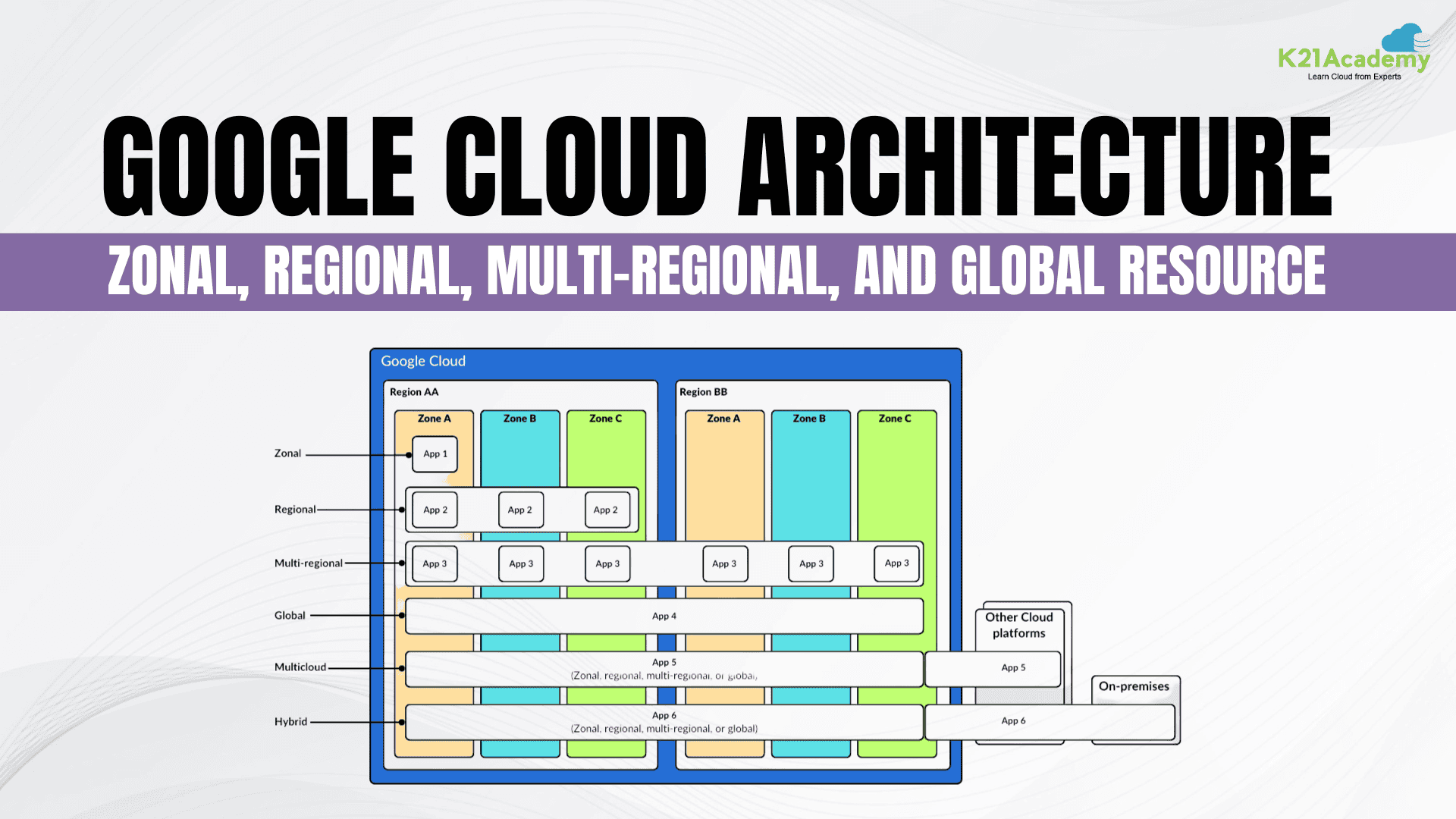
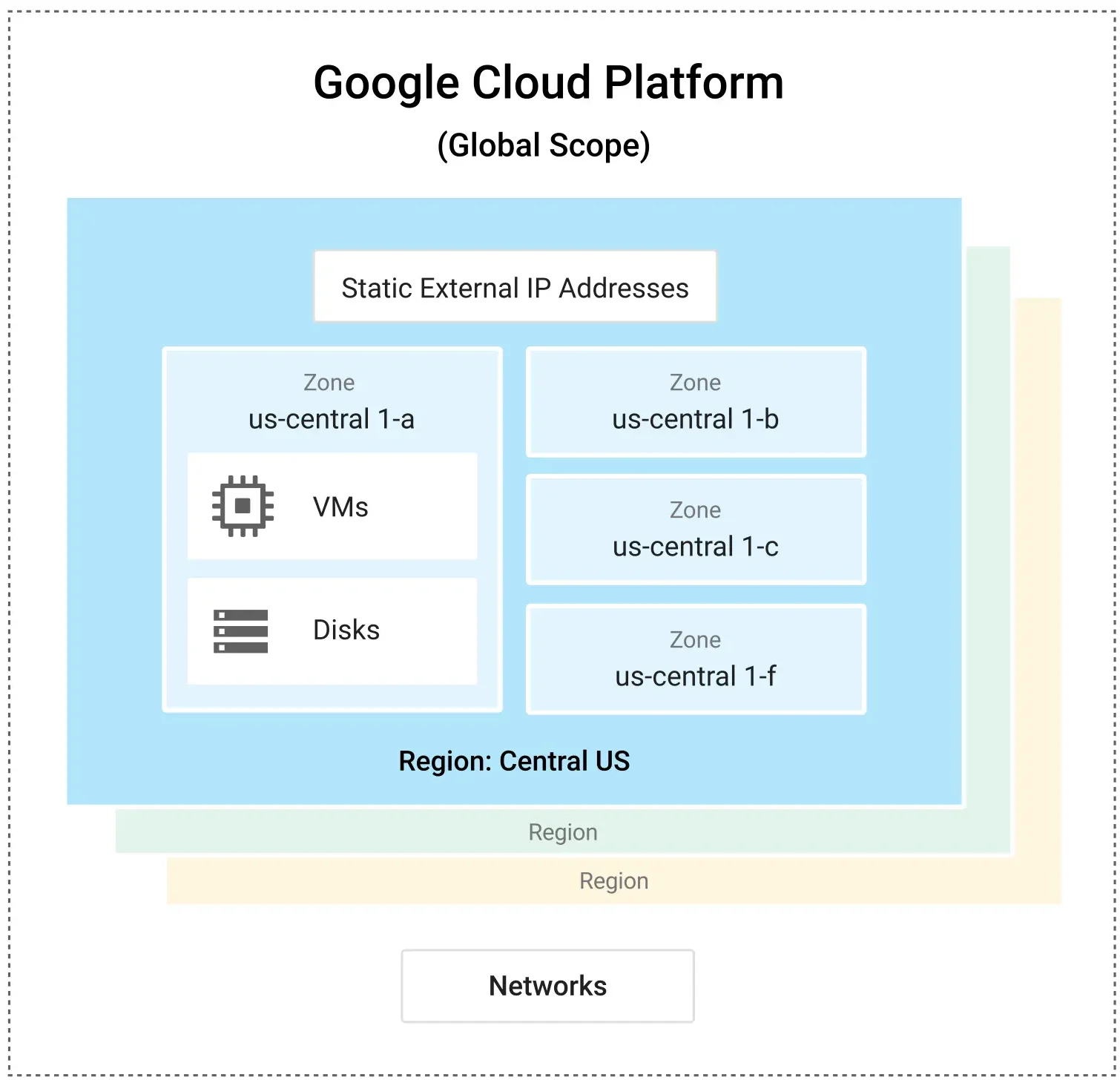
The relationship between the global scope, regions, zones, and some of their resources is depicted in the following diagram:
 Google Cloud
The scope of an operation in Google Cloud depends on the type of resources involved. For instance, creating a network is considered a global operation because networks are global resources. However, reserving an IP address is a regional operation because IP addresses are specific to regions.
Understanding the interaction between regions and zones is crucial for optimizing Google Cloud applications. For example, it’s not advisable to attach a disk from one region to a computer in another region due to the latency it would introduce, resulting in poor performance. Fortunately, Google Cloud restricts such actions; disks can only be attached to computers within the same zone.
Now that we’ve seen the framework for Google Cloud’s resources, let’s explore each specific resource within the GCP architecture.
Zonal
What are Zonal Resources?
Zonal resources are tied to a specific zone, which is a deployment area within a region. Zones are isolated locations within a region to provide redundancy and reduce latency.
Examples: Compute Engine virtual machines, Zonal persistent disks
Purpose: Zonal resources are ideal for applications requiring low latency for users within a specific geographic area. They also allow for fine-grained control over where your services are deployed, which can be critical for regulatory and compliance reasons.

Benefits and Limitations:
The main benefit of zonal resources is their ability to minimize latency by being physically closer to the user. However, their limitation lies in their susceptibility to zone-specific failures, which could impact availability if not properly managed with redundant configurations.
Regional
What are Regional Resources?
Regional resources are available across multiple zones within a single region, offering higher availability and fault tolerance than zonal resources.
Examples: Regional persistent disks, Regional IP addresses
Purpose: These resources are used when you need more availability and resilience than zonal resources can provide but don’t require distribution across multiple regions.

Benefits and Limitations:
Regional resources provide better fault tolerance by spreading data across multiple zones, protecting against zone failures. However, they can incur higher costs and slightly increased latencies compared to zonal resources.
Multi-Regional
What are Multi-Regional Resources?
Multi-regional resources are distributed across at least two regions, enhancing global reach and availability.
Examples: Multi-regional storage in Google Cloud Storage
Purpose: They are crucial for businesses serving a global customer base, requiring high availability and quick data access across continents.

Benefits and Limitations:
These resources ensure better performance for global applications and improve user experience by reducing latency on a global scale. The downside is the higher cost and potential regulatory challenges in data sovereignty.
Global
What are Global Resources?
Global resources are accessible globally, regardless of regions or zones, and are managed centrally.
Examples: Google App Engine applications, Google Cloud CDN, BigQuery
Purpose: Global resources simplify the management of applications that need to operate on a worldwide scale, without the need to manage resources in specific regions or zones.


Benefits and Limitations:
The main advantage is centralized management and seamless global operation. However, these resources may face inconsistent performance and latency issues depending on the user’s location relative to the data centers.
Making Architectural Decisions
When choosing between these resource types, consider factors such as application requirements, user locations, cost implications, and compliance needs. It’s also important to apply best practices such as deploying redundant resources across zones and regions to ensure high availability and fault tolerance.

Conclusion
Choosing the right type of resource in Google Cloud can significantly impact the efficiency and reliability of your applications. Careers in cloud computing require an understanding of the resources and architecture of Google Cloud Platform (GCP).
GCP provides an extensive architecture to accommodate various deployment requirements, spanning from local to global scales. Global, multi-regional, zonal, and regional resources are some of the concepts that help people understand GCP’s infrastructure. Modern businesses can easily create scalable, reliable, and effective cloud solutions using GCP’s design. Furthermore, for individuals advancing their cloud skills or making the move from traditional IT employment, GCP offers a wealth of learning and development options.
Frequently Asked Questions
How does understanding Google Cloud Architecture contribute to a successful career transition into GCP?
Employers value abilities such as creating scalable solutions, diagnosing issues, and efficiently using GCP services—all of which require a thorough understanding of Google Cloud Architecture.
Can you explain how multi-regional deployment supports global applications with low latency and high availability?
By distributing resources over several regions, multi-regional deployment enables fault tolerance and redundancy. Global load balancers reduce latency and guarantee continuous service for users everywhere by directing traffic to the closest accessible location.
What factors should be considered when deciding between a multi-regional and global deployment for a global-scale application?
The geographical distribution of users of the programme, latency requirements, economic considerations, and the demand for data replication and synchronisation across regions are all taken into account.
What are some hybrid and multi-cloud strategies that can be employed alongside Google Cloud Architecture?
Multi-cloud uses several cloud providers, whereas hybrid cloud combines on-premises infrastructure with GCP services. These tactics provide flexibility, vendor diversity, and redundancy.
Related/Reference Links
- Google Cloud Services & Tools for Beginners
- Regions & Zones In Google Cloud Platform
- Introduction to Google Cloud Platform
- Google Cloud Architecture Framework
Next Task For You
If you are also interested and want to know more about the Google Professional Cloud Architect certification then register for our Free Cass.


![Microsoft Agentic AI Business Solutions Architect [AB-100] | K21 Academy](https://test.k21academy.com/wp-content/uploads/2025/11/Microsoft-Agentic-AI-Business-Solutions-Architect-AB-100-Exam-Overview1.png)