


DevOps is a set of cultural philosophies, practices, and tools that improve an organization’s ability to deliver applications and services at high velocity: evolving and improving products at a faster rate than traditional software development and infrastructure management processes. This speed allows organizations to better serve their customers and compete in the market.
This blog will cover everything you need to know about the AWS DOP-C02.
- What is the AWS DOP-C02 Exam?
- Exam Overview
- AWS DOP-C02 Exam Domains Overview
- AWS DOP-C02 Exam Domains in Detail
- Exam results
- Frequently Asked Questions
What is the AWS DOP-C02 Exam?
The AWS Certified DevOps Engineer-Professional content outline is being updated. Crack the AWS Certified DevOps Engineer Professional DOP-C02 exam with expert-led training & practice tests at K21 Academy. Start learning today!
This update is the result of a Job Task Analysis (JTA), and it reflects changes in trends, the industry landscape, and cloud professionals’ work practices. This AWS Certified DevOps Engineer certification validates your technical ability to provision, operate, and manage distributed application systems on the AWS platform.
 Exam Overview
| Format | Multiple-choice and multiple-response questions only |
| Type | Professional |
| Delivery method | Pearson VUE testing center or online proctored exam |
| Number of questions | 75 |
| Time | 180 minutes |
| Cost | 300 USD |
| Language | English, Japanese, Korean, and Simplified Chinese. |
| Passing Marks | 750 & above |
AWS DOP-C02 Exam Domains Overview
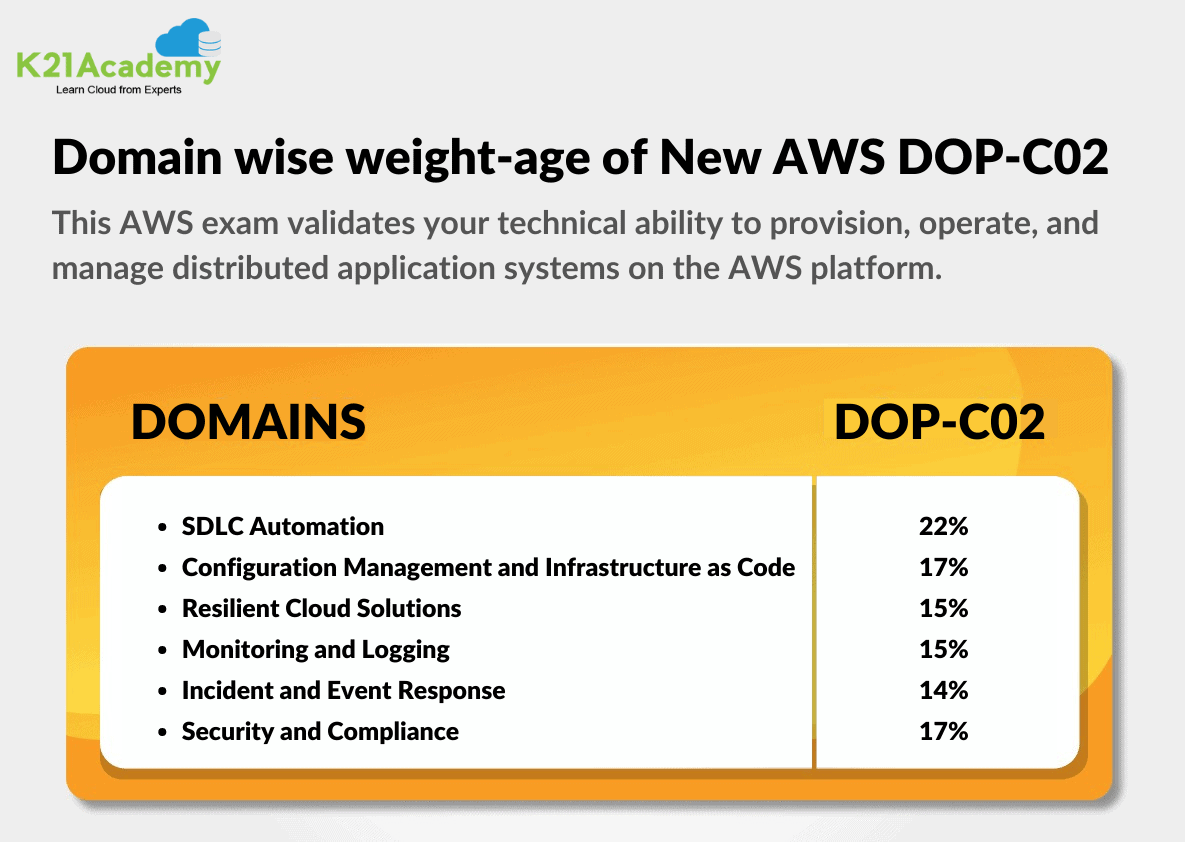
The six primary domains of the AWS Certified DevOps Engineer: Professional (DOP-C02) exam each represent the changing duties of contemporary DevOps practitioners.
With 22% of the exam, SDLC (Software Development Lifecycle) Automation is the major exam domain. This emphasizes how crucial it is to automate CI/CD pipelines, effectively manage code repositories, and deliver apps.
With 15% coverage, the Monitoring and Logging domain places a strong emphasis on the ability to set up monitoring systems, configure log aggregation, and create event-driven architectures.
The next domain, which makes up 17% of the test, is Configuration Management and Infrastructure as Code (IaC). It focuses on automating infrastructure provisioning and management through the use of tools such as AWS CloudFormation, CDK, and Systems Manager.
At 14%, the Incident and Event Response domain evaluates your capacity to manage failures, carry out root cause analysis, and successfully fix system problems.
Resilient Cloud Solutions (15%) is a major exam domain that focuses on creating systems that are highly available, scalable, and fault-tolerant. This covers backup plans, automated failovers, and multi-AZ and multi-region installations.
Security and Compliance is another important area, accounting for 17% of the test. It verifies that you understand SCPs, encryption, auditing, IAM policies, and services like Macie, GuardDuty, Inspector, and Config.
Based on its new exam domain content distribution, the AWS Certified DevOps Engineer exam has significantly included many security-related topics. This means you must concentrate on various security topics and AWS security services.
Start Your Free AWS DevOps Class with K21 Academy
AWS DOP-C02 Exam Domains in Detail
The AWS DevOps exam guide also includes a comprehensive list of exam domains, task statements, and knowledge areas; see the exam domains and task statements listed below for more information.
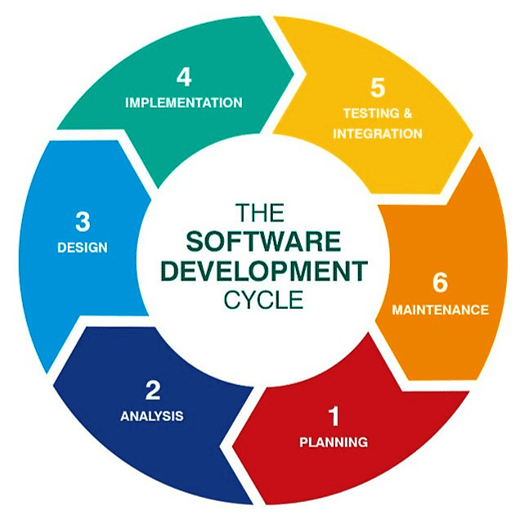
Domain 1: SDLC Automation (22%)
You will be required to automate the software development lifecycle by configuring code repositories and CI/CD pipelines in this domain. You should understand how to integrate these pipelines with various application environments and how to use automated testing to ensure that applications are ready for deployment. You should be able to create and configure various artifact repositories, as well as understand the various deployment strategies involved in the container or serverless architectures. Additionally, you’ll need to use tools like AWS Secrets Manager or Parameter Store to securely manage secrets while the pipeline is running. Furthermore, knowledge of deployment techniques like rolling, canary, and blue/green deployments is crucial for practical DevOps situations.
Domain 2: Configuration Management and Infrastructure as Code (17%)
In this domain, you’ll need to use AWS CloudFormation, AWS CDK, and AWS SAM to configure and deploy infrastructure as code, or IaC templates. You should understand how to use CloudFormation StackSets across multiple AWS regions and accounts. To that end, you should also be familiar with best practices for multi-region and multi-account environments, such as how to use AWS Organizations and Control Tower to manage accounts centrally.
You’ll also need to use services like Systems Manager, Step Functions, and OpsWorks to design, build, and configure automated solutions that can perform tasks across large-scale environments. It’s critical to use technologies like AWS Service Catalog to directly include security best practices and governance controls into reusable IaC templates. In order to grow effectively throughout the company, you should also understand how to automate the processes of account creation, onboarding, and resource provisioning.
Domain 3: Resilient Cloud Solutions (15%)
This domain is all about implementing robust, scalable, and highly available solutions. Configuring multi-AZ and multi-region deployments, as well as leveraging auto-scaling, load balancing, and caching to help meet performance and availability requirements, is required. You should also be able to implement, test, and configure automated backup, restore, and failover processes, as well as understand the concepts of recovery time objective and recovery point objective (RTO/RPO).
Using services like Amazon Route 53, S3, and DynamoDB, you must be able to locate and remove single points of failure and plan for cross-region redundancy. It’s also crucial to be familiar with disaster recovery techniques, including multi-site active-active, pilot light, and warm standby.
Domain 4: Monitoring and Logging (15%)
This domain will put your knowledge of configuring the collection, aggregation, and storage of application logs and metrics to the test. You should be able to design event-driven architectures that use SNS, EventBridge events, or Lambda for alerting and automating various actions in various environments using AWS Config, CloudWatch, and CloudTrail.
In addition to configuring metric filters, dashboards, and alerts for real-time visibility, you’ll need to securely handle log data utilizing encryption and retention regulations. It’s also anticipated that you know how to use tools like Amazon Athena and CloudWatch Logs Insights for log analysis.
Domain 5: Incident and Event Response (14%)
This domain is concerned with how to handle application events as well as incidents such as system and application-level failures. You should understand how to set up notification and alerting processes in response to various events, including various types of failures. When analyzing failed deployments or processes, you’ll also need to know how to perform root cause analysis and make the necessary configuration changes and remediations to return things to a desired state.
You should know how to use Lambda or Step Functions to integrate event sources such as AWS Health, CloudTrail, and EventBridge with automation workflows. System stability and compliance can also be preserved by putting automated remediation into place using AWS Config rules and Systems Manager.
Domain 6: Security and Compliance (17%)
This final domain necessitates the implementation of large-scale security solutions, such as identity and access management, security and access controls, and security monitoring and auditing solutions. You should be able to identify security vulnerabilities and protect against common security threats using AWS services such as GuardDuty, Inspector, and Config.
 Related Readings: AWS Certified DevOps Professional DOP-C02 Step-By-Step Activity Guides
AWS DOP-C02 Exam Results
The AWS Certified DevOps Engineer – Professional (DOP-C02) exam is graded on a pass/fail basis. The exam is graded against a minimum standard established by AWS professionals who adhere to best practices and guidelines in the certification industry.
The exam results are reported as a scaled score of 100-1,000. A passing score of 750 is required. Your score indicates how well you did on the exam as a whole and whether or not you passed. Scaled scoring models aid in equating scores across multiple exam forms with varying degrees of difficulty.
A table of classifications of your performance at each section level could be included in your score report. This data is designed to provide general feedback on your exam performance. Because the exam employs a compensatory scoring model, you do not need to achieve a passing score in each section. You only need to pass the overall exam.
Because each section of the exam has a different weighting, some sections have more questions than others. The table includes general information about your strengths and weaknesses. When interpreting section-level feedback, proceed with caution.

Frequently Asked Questions
The most recent AWS Certified DevOps Engineer - Professional exam does not include any Exam-Labs. The official exam guide for the DOP-C02 test confirms this. However, it is crucial to be well-prepared for practical scenarios through the course material and hands-on labs to understand the concepts in depth.
The exam results are reported as a scaled score of 100-1,000. A passing score of 750 is required. Your score indicates how well you did on the exam as a whole and whether or not you passed. It’s important to focus on mastering both theoretical concepts and practical application to meet the passing criteria.
Certifications from AWS are valid for three years. To keep your AWS Certified status, you must periodically demonstrate your continued expertise through a process known as recertification. Recertification increases the overall value of your AWS Certification by demonstrating to individuals and employers that your credential covers the most up-to-date AWS knowledge, skills, and best practices. Keep in mind that AWS periodically updates its certifications to reflect new features and services.
Yes, we have updated the course along with hands-on, and now we are using the revised content for live sessions covering AWS DOP-C02 topics/services. The updated content ensures you're learning the latest best practices, tools, and techniques relevant to the exam.
Exam attempts are not limited. However, for each exam attempt, you must pay the full registration fee. It’s essential to analyze your performance, review the areas where you struggled, and utilize additional study materials before retaking the exam.
The exam consists of multiple-choice questions (single or multiple choice), and there is no negative marking. The questions are designed to test your understanding and practical experience with AWS DevOps tools and services.
Examinees have 180 minutes (3 hours) to finish the test. While the time is sufficient, it’s essential to pace yourself and not get stuck on difficult questions to ensure you complete the exam on time.
The test is closed-book, no. During the test, you are unable to access any notes, online resources, or AWS documentation. It’s important to thoroughly prepare and memorize key concepts and services so you can confidently answer all questions.
Preparation should include studying the official exam guide, using updated course materials (such as those from K21Academy), and practicing sample questions. Additionally, hands-on experience with AWS tools and services will help reinforce your understanding of the concepts covered in the exam. Will the DOP-C02 exam include an Exam Lab section?
What is the passing score for the AWS DevOps Professional exam?
Do AWS exams expire?
Have the courses on K21Academy been updated?
What if I fail an AWS exam?
AWS DOP-C02 exam format?
How long does it take to finish the DOP-C02 exam?
Can I use AWS documentation or any resources during the exam?
How should I prepare for the DOP-C02 exam?
Next Task For You
Begin your journey towards becoming an AWS Certified DevOps Engineer Professional by checking our FREE CLASS. Click on the image below to register for our FREE CLASS.


![Microsoft Agentic AI Business Solutions Architect [AB-100] | K21 Academy](https://test.k21academy.com/wp-content/uploads/2025/11/Microsoft-Agentic-AI-Business-Solutions-Architect-AB-100-Exam-Overview1.png)