



Amazon Forecast, AWS’s fully managed machine learning solution, is designed to help users generate extremely precise forecasts from time-series data. Forecast forecasts future time-series data based on existing data using cutting-edge algorithms and does not require any prior machine learning knowledge. It is based on the same technology that Amazon.com uses for time-series forecasting.
In this blog, we will discuss:
- Introduction of Amazon Forecast
- How is Forecasting Accomplished?
- What does Amazon Forecast bring to the table?
- Workflow
- Benefits of Amazon Forecast
- Use cases
- Forecast Pricing
- Frequently Asked Questions
Introduction of Amazon Forecast
Amazon has been using machine learning to solve hard forecasting problems since 2000, increasing accuracy 15X in the last two decades. It is based on the same technology as Amazon.com and can be used for a wide range of business use cases, from financial and resource planning to forecasting future performance and product demand in a variety of industries ranging from retail to healthcare.
Forecasting results can be improved, predictions can be made with greater accuracy, and business insights can be gained by automatically identifying the correlations between time-series data that change over time and independent variables such as product attributes, store locations, and so on.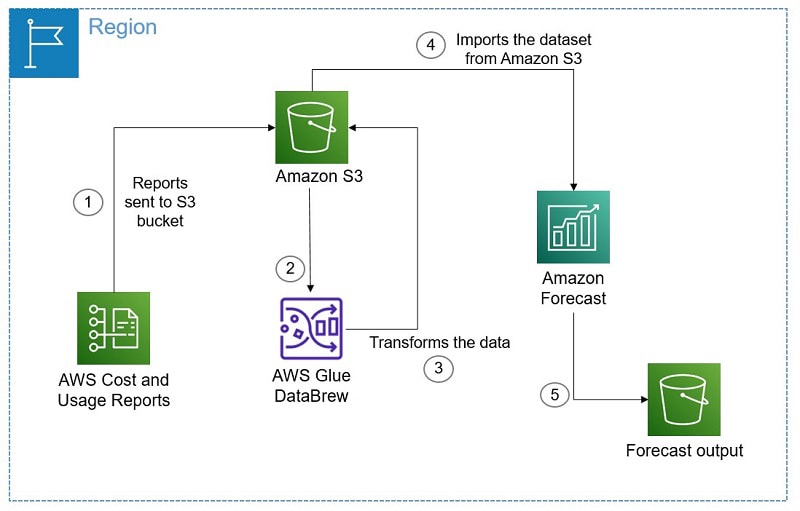
How is Amazon Forecasting Accomplished?
Looking Backward
The first step is to start with historical data that has identification in the form of timestamps, items, and values. These provide baseline data.
Trends Identification
Statistical deep-learning techniques can be used to examine historical data for trends.
Making Predictions
Patterns that have been identified allowing for projected values.
What does Amazon Forecast brings to the table?
It is a completely automated and managed machine learning service that provides extremely accurate forecasting, with an improvement of up to 50% over conventional techniques. The service is simple to use and does not necessitate extensive training.
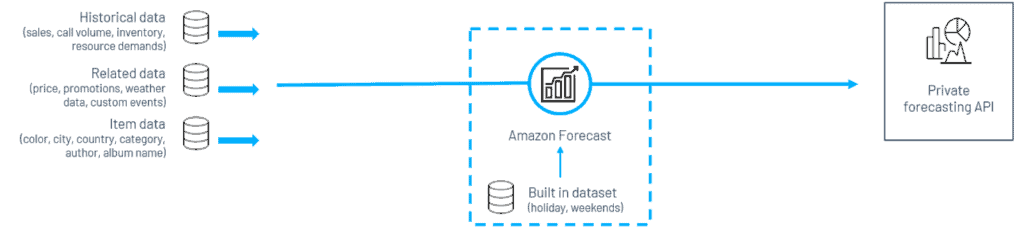
The mechanism underlying Amazon Forecast begins with three types of data supplied into the service from your Amazon S3 repositories: historical data, related data, and item data.
 Behind the scenes
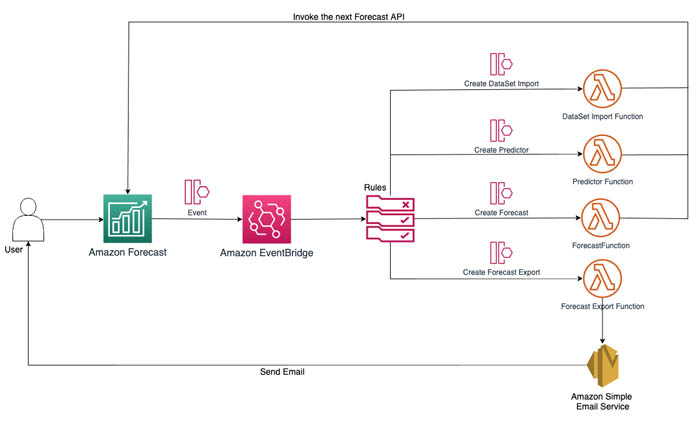
The user is not required to manage the various background processes that Amazon Forecast employs. Examples include data loading and inspection, training models with numerous diagrams, selecting hyperparameters for optimization, selecting the most correct model, and hosting it.
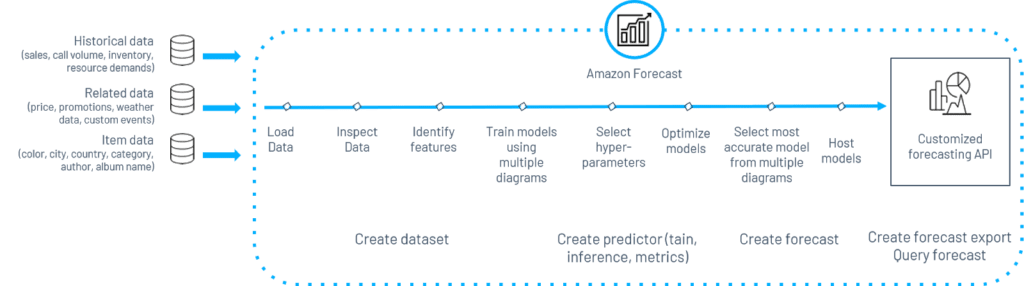
How does Amazon Forecast work?
Starting with Amazon Forecast
When you create an AWS account, you go through three steps:
- Making and Bringing in Datasets
- Choosing Predictors and algorithm
- Generating Forecasts
Making and Bringing in Datasets
CreateDataset and DescribeDataset are the two operations available in the Amazon Forecast tool. When creating your datasets, you specify the type of data you want to forecast as well as any other variables you want to include.
The target time-series dataset, which is required to perform time-series forecasting, includes the time series and target field for which you want to produce a forecast.
Choosing Predictors and Algorithms
Following the creation of your datasets, the Create Predictor procedure is guided by machine learning. Making a prediction requires the following:
- Database group. The imported data were chosen for use in the prediction training in the first step.
- A setup for featurization. This information is used to convert the data so that it is compatible with the training algorithm and to set the forecast frequency.
- A prediction length or forecast horizon. This parameter determines the range of future projections.
- Evaluation standards. Creating training and testing datasets from a single dataset.
- AutoML or an algorithm. The algorithm is used to create default values and train a model.
Generating Forecasts
The machine learning algorithm that generates forecasts considers every item in the datasets (created in the first step). The forecast frequency is set to the frequency of data collection you selected when you first created your datasets.
After you’ve generated the forecast, you can request a specific date range within it. If necessary, you can download the data as a CSV file to further filter it.
It charges $0.6 per 1000 forecasts generated, $0.088 per GB of data storage, and $0.24 per training hour under a pay-as-you-go pricing model.
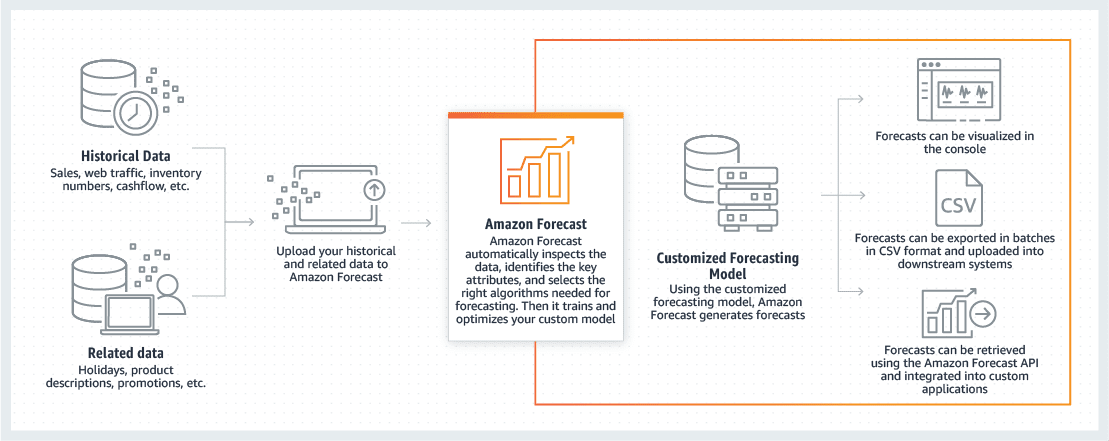
Benefits of Amazon Forecast
- It employs machine learning to generate more accurate demand forecasts.
- Amazon Forecast uses machine learning to learn not only the best algorithm for each item, but also the best ensemble of algorithms for each item, to automatically build the optimal model for the user’s data. This technology enables advanced industrial robot learning.
- The forecast includes an Explainability report in the form of affect ratings for all of the user’s forecasts, specific time periods of interest, or selected time periods.
- It offers developers the same technology as a fully managed service, based on Amazon.com’s twenty years of forecasting expertise.
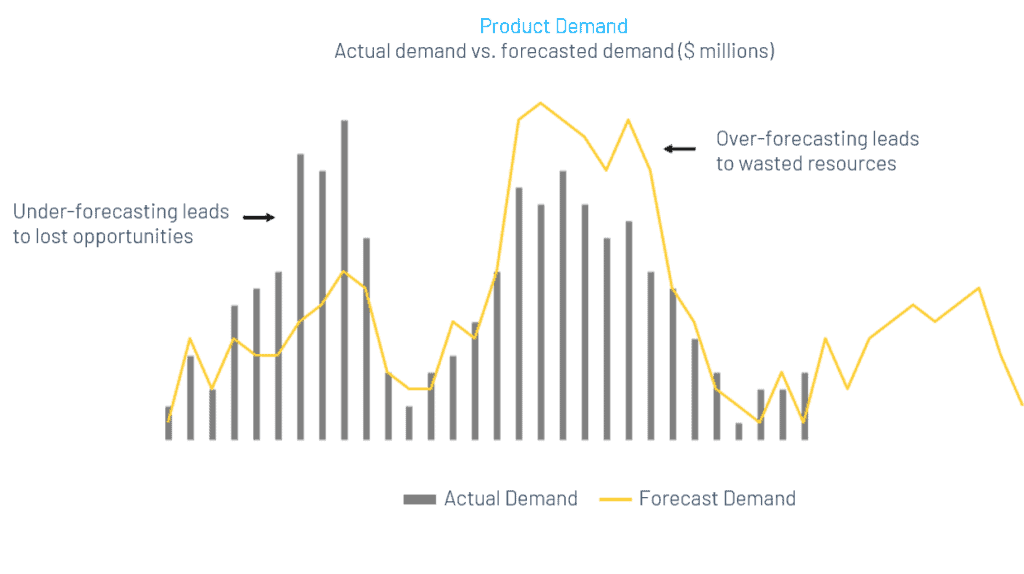
Use cases of Amazon Forecast
-
One application is the addition of ML predictions to users’ SaaS products.
The Amazon Forecast expands the capabilities of SaaS products by incorporating machine learning-based predictions to identify intricate demand correlations.
-
It has a use case for better product demand forecasting.
It combines sales and demand data from the past with information about online traffic, prices, product categories, weather, and holidays.
-
Effective resource management is one of its application cases.
Using the Amazon Forecast, which provides precise resource need predictions in near real-time, you can increase usage and customer satisfaction.
 Pricing of Amazon Forecast
There are no minimum costs or upfront commitments with Amazon Forecast; you simply pay for what you use. When using Amazon Forecast, there are four different types of charges to consider:
- Cost per GB of data imported for training and forecasting purposes into Amazon Forecast.
- Cost per hour of infrastructure is used for developing a unique predictor based on your input data. Keep in mind that prices are determined by the number of instance hours consumed, not by the time required to train a predictor.
- Cost for several distinct forecast values that were generated over all-time series (items and dimensions) combinations.
- The price is determined by the number of forecast data points and the number of qualities (such as price, holidays, or weather index) that are justified.
Frequently Asked Questions:
Q1: What data does Amazon Forecast require to start forecasting?
Ans: Amazon Forecast can create a forecast from any historical set of time series data. However, clients can also provide related time series data as well as meta-data for each time series (for example, the location of a house when estimating energy usage) (e.g., historical pricing data along with sales data for products).
Q2: What is time series data?
Ans: A time series is a collection of data points that are ordered by some unit of time. Time series examples include weekly product sales, daily inventory levels, and hourly website visits.
Q3: What is time series forecasting?
Ans: Time series forecasting is a method that forecasts future time series data using historical data.
Q4: How do I get started with Amazon Forecast?
Ans: Amazon Forecast can be used via an API or the AWS Console. The first step is to load your data into Amazon Forecast. After you’ve uploaded the data, you can have Amazon Forecast try out various algorithms to train multiple models and then provide the model with the highest forecasting accuracy. You can also manually train a model by choosing one of the forecasting algorithms. Amazon Forecast provides detailed accuracy metrics to help you evaluate the model’s performance after you’ve created it. If you’re satisfied, you can deploy the model and generate forecasts with a single click or API call using Amazon Forecast. Amazon Forecasts can be accessed via API, exported to CSV, or viewed in the console.
Q5: Who has access to my content that Amazon Forecast processes and stores?
Ans: Only authorized employees will have access to your Amazon Forecast-processed content. Our top priorities are your trust, privacy, and the security of your content, and we use sophisticated technical and physical controls, including encryption at rest and in transit, to prevent unauthorized access to or disclosure of your content and to ensure that our use is consistent with our commitments to you.
Related Links/References
- AWS Certified Solutions Architect Associate SAA-C03 Exam details
- AWS Free Tier: Create an Account
- AWS Free Tier Limits
- AWS Free Tier Account Details
- AWS Shield | DDoS Attacks | AWS Shield Pricing: Overview
- AWS Virtual Private Network (AWS VPN): Everything You need to Know
- AWS Free Tier Account Services
- AWS Data Pipeline
- AWS Data Exchange
- AWS Timestream
- Amazon EMR
- Amazon Detective
Next Task For You
Begin your journey towards an AWS Cloud by joining our FREE Informative Class on Amazon Cloud Free Class by clicking on the below image.


![Microsoft Agentic AI Business Solutions Architect [AB-100] | K21 Academy](https://test.k21academy.com/wp-content/uploads/2025/11/Microsoft-Agentic-AI-Business-Solutions-Architect-AB-100-Exam-Overview1.png)