


In this blog, we are going to cover Continuous Delivery and Continuous Deployment, the needs and benefits of Continuous Delivery, and Continuous Deployment & Continuous Delivery vs Continuous Deployment.
Topics we’ll cover:
- Continuous Delivery
- Continuous Deployment
- The needs and benefits of Continuous Delivery
- The needs and benefits of Continuous Deployment
- Continuous Delivery vs Continuous Deployment
Continuous Delivery and Continuous Deployment are practices that automate phases of software delivery. These practices enable development teams to release new features, enhancements, and fixes to their customers with greater speed, accuracy, and productivity.
With continuous delivery, every code change is built, tested, and then pushed to a non-production testing or staging environment. With continuous deployment, production happens automatically without explicit approval.
Continuous Delivery
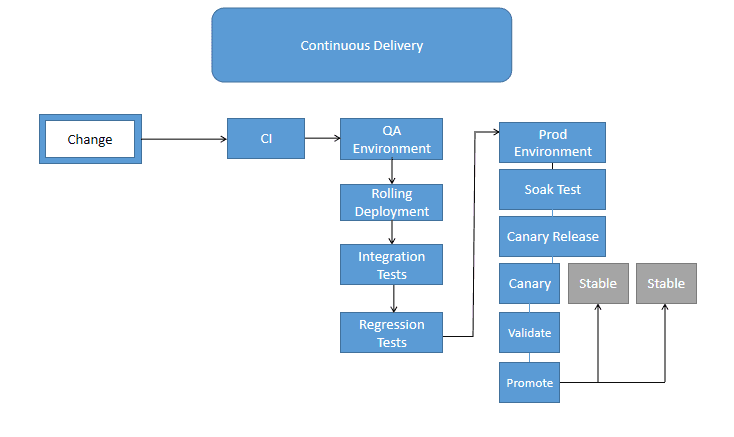
Continuous Delivery is the robotization of steps to securely get changes into creation. Where Continuous Deployment centers around the real organization, Continuous Delivery centers around the delivery and delivery technique. A slippery objective would be a “press of a button” to get changes into creation.
That “press of a button” is Continuous Delivery. Continuous delivery automates the next phase: deliver. Under continuous delivery, anytime a new build artifact is available, the artifact is automatically placed in the desired environment and deployed.
Continuous Deployment
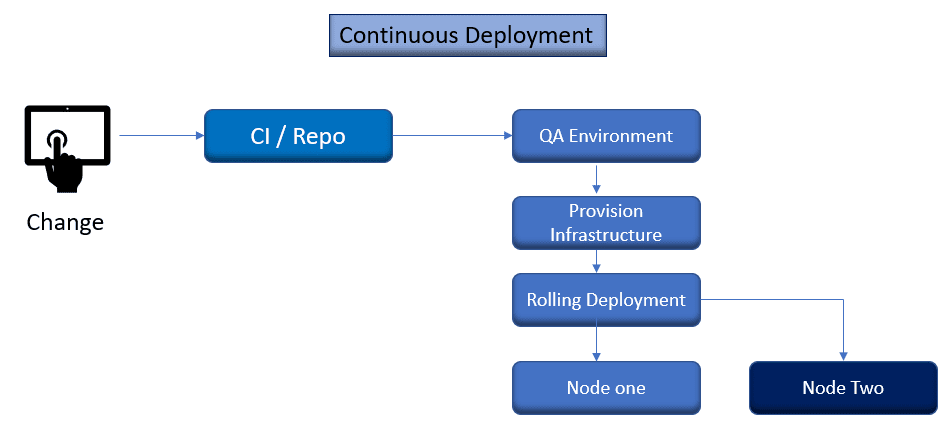
Continuous Deployment centers – very much like the name infers – on the deployment; the real establishment and appropriation of the pieces. During a deployment, the application double/bundling can cross over the geography of where the application or application framework needs to serve traffic.
With current stages, for example, Kubernetes, the partition of conditions probably won’t be actual when contrasted with inheritance or conventional machine-based stages. A namespace (programming partition) may be all that is isolating improvement from creation, however, great circulated frameworks standards actually apply to pay little mind to what stage you picked. With dispersed frameworks, the geographies that changes need to spread to can be enormous, even in pre-creation conditions.
Continuous Delivery: Needs and Benefits
Continuous delivery cannot occur on the off chance that your group doesn’t as of now have a solid establishment in the continuous integration and an all and a well-developed, automated testing process installed. In this stage, automating your deployments is basic too. In continuous conveyance, the trigger is as yet manual, yet the actual cycle ought to be computerized whenever it is set into motion.
The immediate benefits of implementing continuous deployment are the following:
- The method involved with getting ready for deployment is fundamentally limited.
- You can deliver code into creation all the more frequently.
- The feedback loop between you and your clients shrinks.
Continuous Deployment: Needs and Benefits
In continuous deployment, even the release is completely automated. That means that your testing process needs to be almost perfect. The better your automated tests are, the cleaner your releases will be.
The immediate benefits of implementing continuous deployment are the following:
- Development is an ongoing, continuous, and faster process because you no longer have to stop developing in order to release new code into production.
- You’re less likely to see bugs and the ones you do find will be easier to fix.
- Your customers are able to see steady progress in your product since you are delivering new features, bug fixes, and other improvements on a regular constant basis.
Continuous Delivery vs Continuous Deployment
The way that they share a shortening (CD) positively doesn’t assist individuals with getting what the distinction between ceaseless conveyance and nonstop organization is, yet fortunately, the clarification is genuinely neat and tidy.
Despite the fact that they have comparative obligations in the product improvement process, conveyance generally precedes sending, implying that there is dependably a last, manual endorsement step in constant conveyance before the code is delivered underway.
Once the package arrives you will inspect it. If you’re happy with it, you can start using it. That’s deployment. If you are not happy with the item, you can reject it and send it back. This can be compared to your code failing an automated test, which means that it would be sent back to your developers instead of being deployed to your clients so that they can start taking advantage of the changes right away.
This means that continuous deployment represents the full, complete, end-to-end development pipeline. And the main difference between continuous deployment and delivery is that releases happen automatically in continuous deployment if all criteria for the release are met through testing.
You Should Also Try
- [AZ-400] Azure DevOps For Beginners
- [AZ-400] Azure DevOps Certification Path
- [AZ-400] Microsoft Azure DevOps Certification Exam: Everything You Need To Know
Next Task For You
Begin your journey toward Mastering Azure Cloud and landing high-paying jobs. Just click on the register now button on the below image to register for a Free Class on Mastering Azure Cloud: How to Build In-Demand Skills and Land High-Paying Jobs. This class will help you understand better, so you can choose the right career path and get a higher paying job.


![Microsoft Agentic AI Business Solutions Architect [AB-100] | K21 Academy](https://test.k21academy.com/wp-content/uploads/2025/11/Microsoft-Agentic-AI-Business-Solutions-Architect-AB-100-Exam-Overview1.png)