



In this blog, I will share some quick tips, including Q&A and useful links from Day 4 of AWS Solution Architect Associate covering Module 3: Object Storage Options.
We also covered hands-on Lab 9, Lab 10, and Lab 11 out of our 30+ extensive labs.
The previous week, In Day 3 session, we covered topics Identity & Access Management (IAM), AWS WAF, AWS Shield, and AWS Key Management Service (KMS).
Two weeks before, In Day 2 session, we covered topics Create EC2 Windows Machine, Linux Machine, and Webserver.
Three weeks before, In the Day 1 session, we covered the topics Cloud Service Model, AWS Services, Creating FREE Tier Accounts, and Ways to Access Services.
AWS Storage

Because of its scalability, data availability, security, and performance, Amazon Simple Storage Service (Amazon S3) is the most widely used object storage service and is used by most companies, from startups to enterprise-level. Any data stored over S3 is protected, secure, and always available regardless of the amount of data for a variety of use cases, such as websites, mobile applications that generate lots of data, backups for applications, IoT devices, and big data analytics.
Read More: About Amazon SNS.
Q1. How many storage services are there in AWS?
Ans. Amazon offers three broad categories of storage services: object, block, and file storage.

Q2. What is S3 used for?
Ans. Amazon Simple Storage Service (Amazon S3) is an object storage service that offers industry-leading scalability, data availability, security, and performance. You can use Amazon S3 to store and retrieve any amount of data at any time, from anywhere.
Q3. What is the Difference between EFS, EBS, and S3?
Ans. Here are some of the differences.

Q4. How many storage classes does S3 have?
Ans. Following are the Storage Classes we have in S3.

Read More: About AWS Networking Fundamentals.
CloudFront
Amazon CloudFront is a content delivery network operated by Amazon Web Services. Content delivery networks provide a globally distributed network of proxy servers that cache content, such as web videos or other bulky media, more locally to consumers, thus improving access speed for downloading the content.

Q5. What is the main benefit of CloudFront?
Ans. By using Amazon CloudFront, the volume of application origin requests is automatically reduced. Content is stored in CloudFront’s edge, and regional caches and only fetched from origins when needed. The load on application origins can further reduce by using Origin Shield to enable a centralized caching layer.
Q6. What is CloudFront origin?
Ans. An origin is a location where content is stored and from which CloudFront gets content to serve viewers. To specify an origin: Use S3OriginConfig to specify an Amazon S3 bucket that is not configured with static website hosting. Any other HTTP server running on an Amazon EC2 instance or any other kind of host.

Q7. Is CloudFront region-specific?
Ans. Amazon CloudFront uses a global network of edge locations and regional edge caches for content delivery. You can see a full list of Amazon CloudFront locations here.
Check Out: How to Learn AWS.
AWS Snowball
AWS Snowball is a service that provides secure, rugged devices, so you can bring AWS computing and storage capabilities to your edge environments and transfer data into and out of AWS. These rugged devices are commonly referred to as AWS Snowball or AWS Snowball Edge devices.

Q8. What is the difference between AWS Snowball and Snowmobile?
Ans. AWS Snowball is a suitcase-sized data migration and edge computing device with two device options: Compute Optimized and Storage Optimized. AWS Snowmobile is a shipping container moved with a tractor-trailer.
Q9. How big is an Amazon snowball?
Ans. In the US regions, Snowballs come in two sizes: 50 TB and 80 TB. All other regions have the 80 TB Snowballs only. If you’re using Snowball to import data, and you need to transfer more data than will fit on a single Snowball, create additional jobs.
Check Out: Our blog post on Amazon AWS Auto Scaling.
AWS Storage Gateway
AWS Storage Gateway is a hybrid cloud service set that gives you on-premises access to virtually unlimited cloud storage. Customers use Storage Gateway to integrate AWS Cloud storage with existing on-site workloads to simplify storage management and reduce costs for key hybrid cloud storage use cases.

Q10. What is the main use case of AWS Storage Gateway?
Ans. The gateway connects your applications to AWS storage by providing standard storage interfaces. It provides transparent caching, efficient data transfer, and integration with AWS monitoring and security services.
Q11. What are the different types of storage gateway?
Ans. There are three types of Storage Gateways:
- File Gateway
- Volume Gateway
- Tape Gateway
Q12. What is the distinction between an S3 file gateway and a storage gateway?
Ans. AWS S3 functions as a file system. It serves as a network disc. If you are unfamiliar with the cloud, you can treat it similarly to Dropbox. AWS Storage Gateway is a virtual interface that allows you to read and write data from and to Amazon S3 and other AWS storage services.

Check Out: What Is Amazon Cognito?
Quiz Time (Sample Exam Questions)!
Our AWS Solution Architect Associate training program covers 500+ sample exam questions to help you prepare for the certification SAA-C03.
Check out one of the questions and see if you can crack this…
Ques. Which of the following can be attached to EC2 Instances to store data?
A. Amazon Glacier
B. Amazon EBS Volumes
C. Amazon EBS Snapshots
D. Amazon SQS
Comment down your answer.
The right answer will reveal in next week’s blog.
Here is the answer to the question shared last week (Scroll down at the end of this post for the question).
Ques. Which of the following services can be used as a web application firewall in AWS?
A. AWS EC2
B. AWS WAF
C. AWS Firewall
D. AWS Protection
Correct Answer: B
Explanation:– AWS WAF is a web application firewall that lets you monitor the HTTP and HTTPS requests forwarded to Amazon CloudFront or an Application Load Balancer. AWS WAF also lets you control access to your content.
Read More: About AWS Route 53.
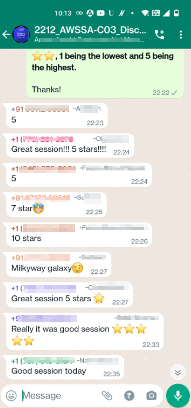
Feedback
We always work on improving and being the best version of ourselves from the previous session hence constantly ask for feedback from our attendees.
Here are the feedbacks that we received from our trainees who attended the session…
Related/References
- Overview of Amazon Web Services & Concept
- AWS Certified DevOps Engineer Professional DOP-C02
- AWS Management Console Walkthrough
- AWS Networking Fundamentals
- Amazon RDS: Introduction and Tutorial
- Top 100 AWS Interview Questions You Must Prepare in 2023
- How to create a free tier account in AWS
- AWS Certified Solutions Architect Associate SAA-C03: Everything You Need To Know
Next Task For You
Begin your journey towards an AWS Cloud by joining our FREE Informative Class on Amazon Cloud Free Class by clicking on the below image.


![Microsoft Agentic AI Business Solutions Architect [AB-100] | K21 Academy](https://test.k21academy.com/wp-content/uploads/2025/11/Microsoft-Agentic-AI-Business-Solutions-Architect-AB-100-Exam-Overview1.png)